Free printable · couples packet
Fight Fair: A Couples Packet
Four habits to drop, four to use instead, and a few simple agreements to keep.
6 pages · US Letter PDF, print and fillable versions · free, no sign-up
Where’s the evidence? Hostile conflict behavior went with lower relationship satisfaction across 64 studies (Woodin 2011).
A direct PDF download. No email or account needed.
Clinician use included. Licensed for personal use, or one clinician using it with their own clients and students (print or share the PDF with people you serve). Please don’t resell, redistribute, or upload to shared drives or marketplaces.
Based on research by John and Julie Gottman and colleagues. Not affiliated with or endorsed by The Gottman Institute.
What’s inside
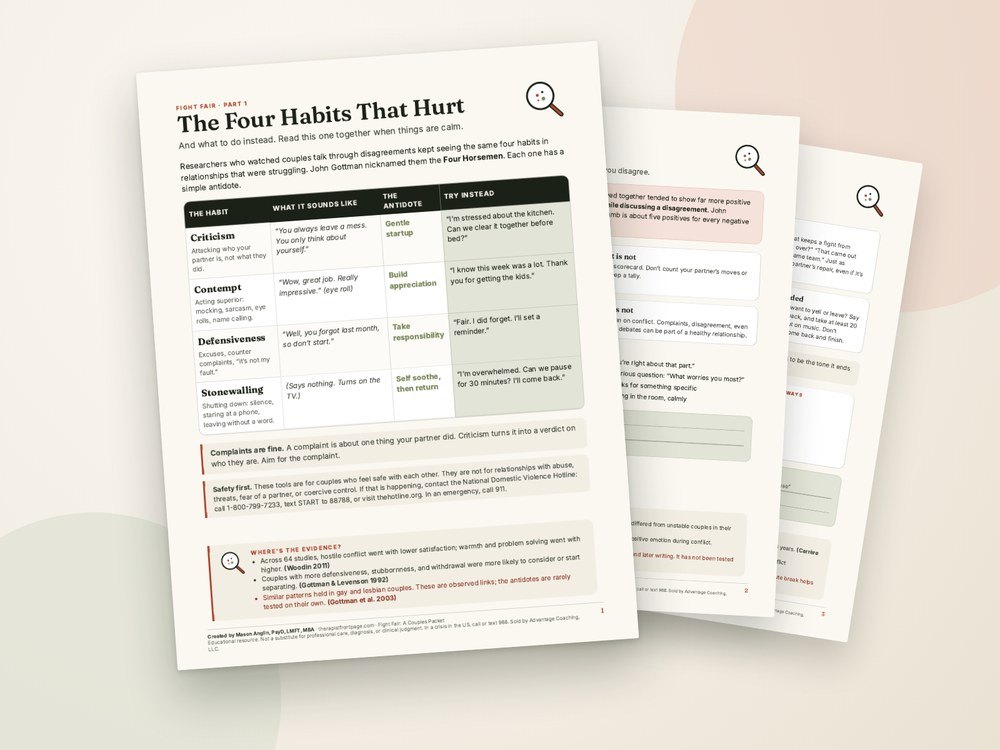
A calm, short packet for couples who want to argue better. It covers the four conflict habits that wear relationships down and what to do instead, what the 5 to 1 idea really means, and four basics to stick to: soft starts, repair, turning toward bids, and taking a real break when flooded. It ends with a one page Our Agreements sheet for the fridge. Based on research by John and Julie Gottman and colleagues, written from scratch, with an honest evidence page.
- The four habits that hurt, with what to say instead
- The 5 to 1 idea, explained plainly
- Four basics to stick to
- Our Agreements: a one page fridge sheet
- Clinician evidence page with honest limits
- References with PMIDs and DOIs
All 6 pages, and who each is for
- The Four Habits That Hurt · Client
- The 5 to 1 Idea · Client
- Four Basics to Stick To · Client
- Our Agreements · Client
- Where's the evidence? · Clinician
- References · Clinician
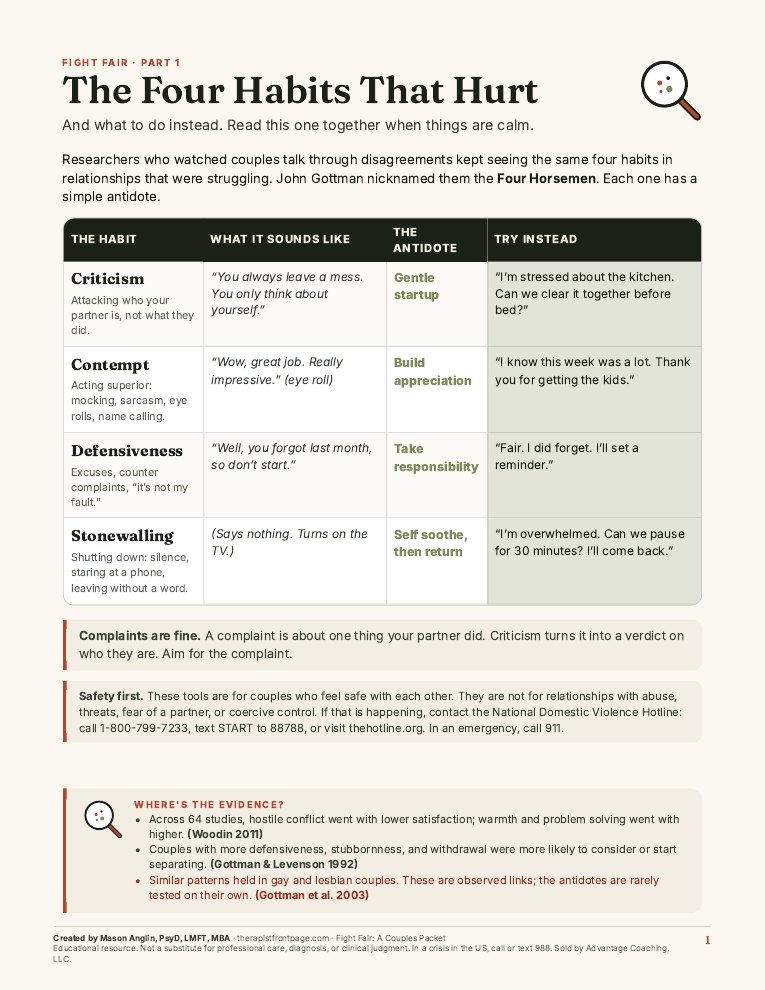
Page 1: The Four Habits That Hurt 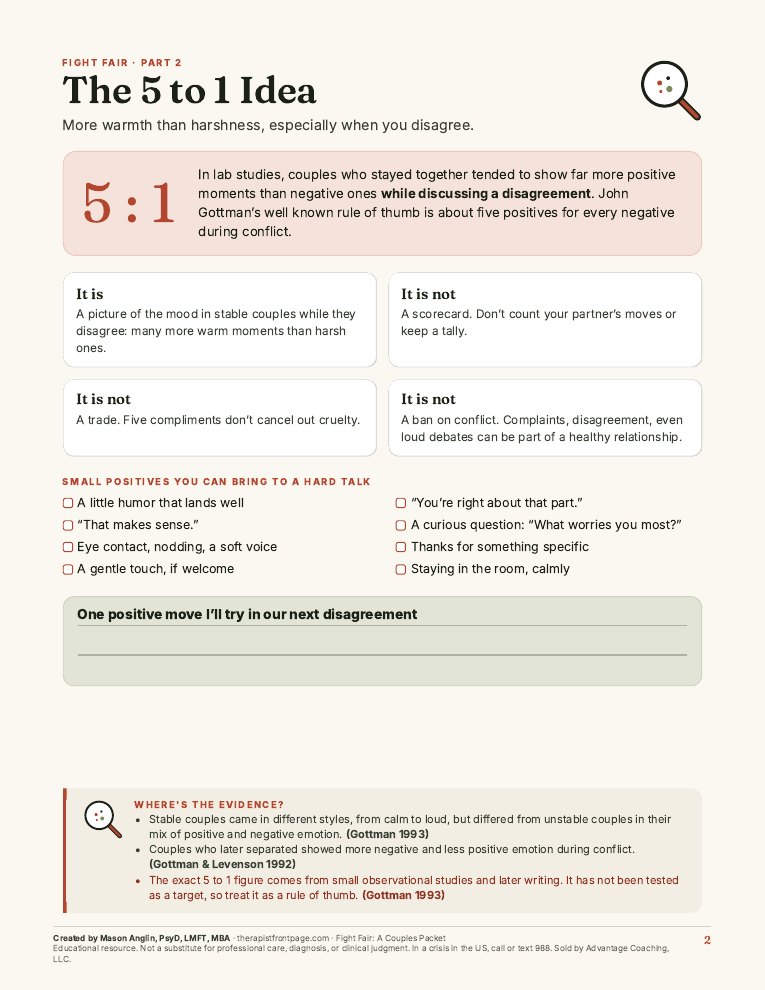
Page 2: The 5 to 1 Idea 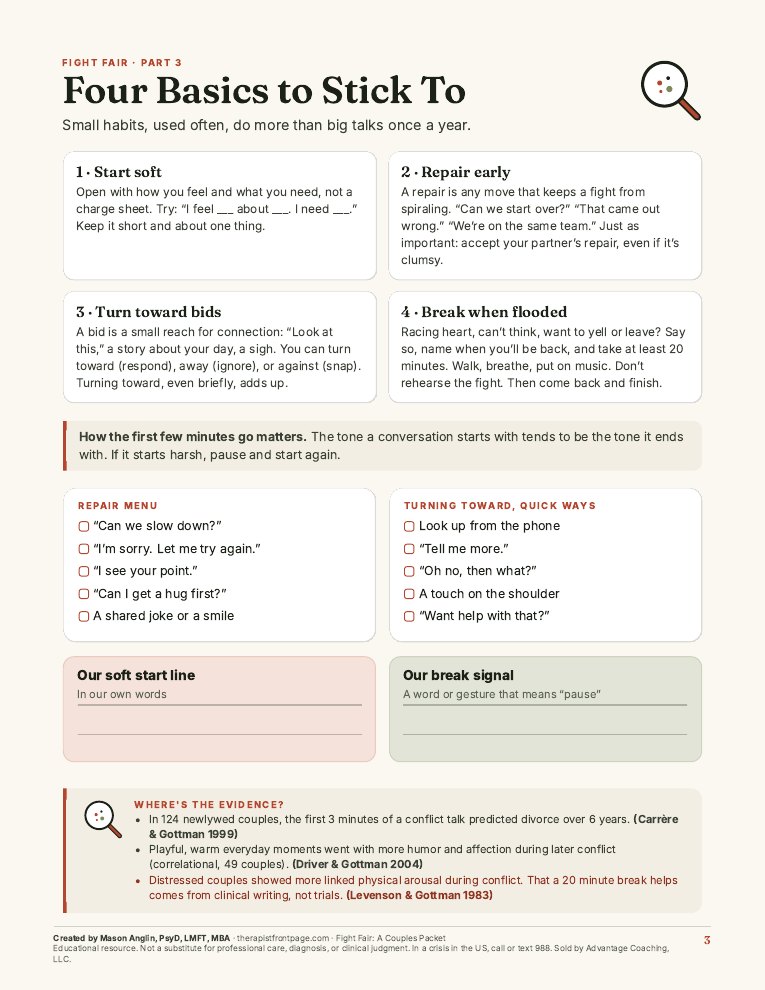
Page 3: Four Basics to Stick To 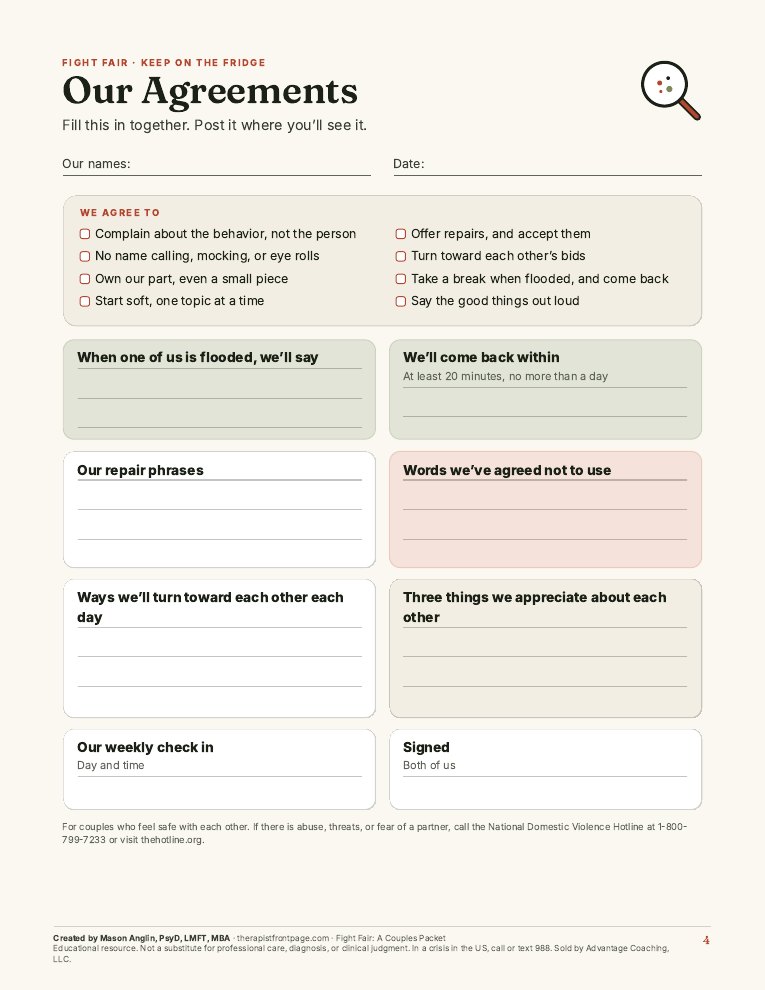
Page 4: Our Agreements 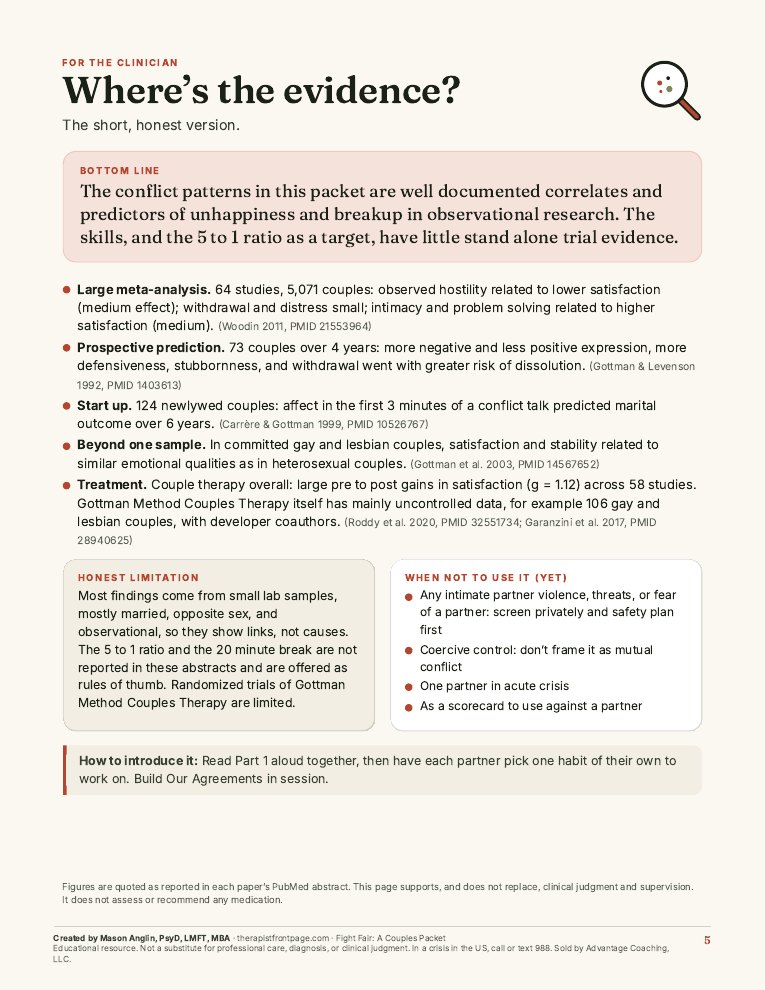
Page 5: Where's the evidence? 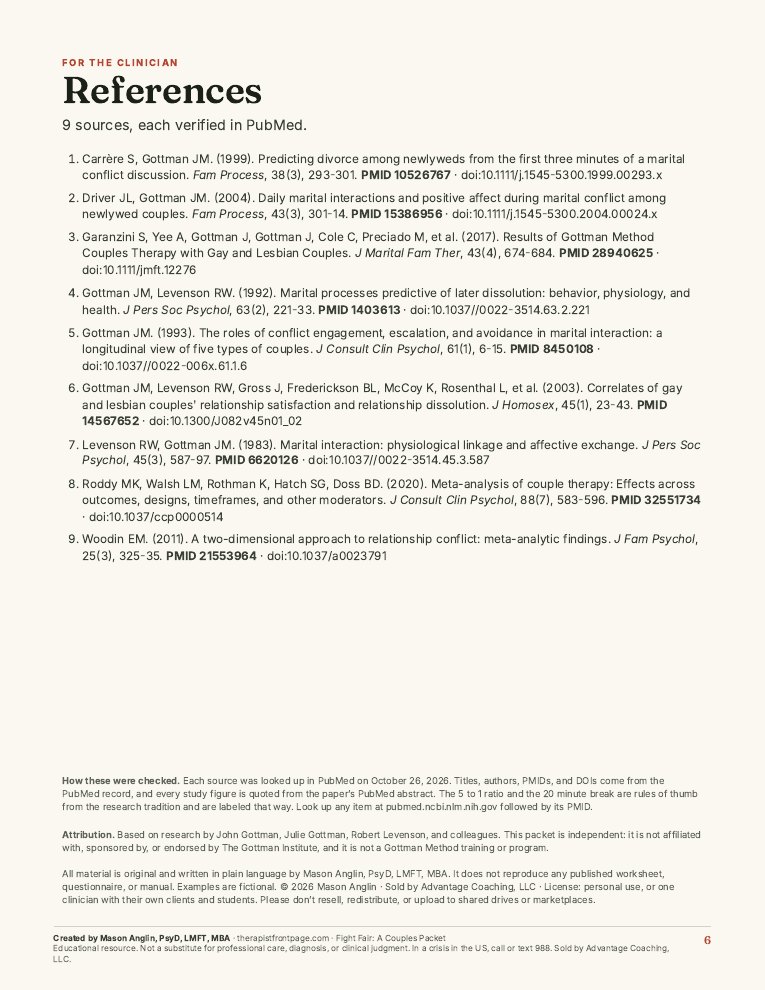
Page 6: References
Where’s the evidence?
The conflict patterns in this packet are well documented correlates and predictors of unhappiness and breakup in observational research. The skills, and the 5 to 1 ratio as a target, have little stand alone trial evidence.
On the packet itself
- Across 64 studies, hostile conflict went with lower satisfaction; warmth and problem solving went with higher. (Woodin 2011)
- Couples with more defensiveness, stubbornness, and withdrawal were more likely to consider or start separating. (Gottman & Levenson 1992)
- Similar patterns held in gay and lesbian couples. These are observed links; the antidotes are rarely tested on their own. (Gottman et al. 2003)
- Stable couples came in different styles, from calm to loud, but differed from unstable couples in their mix of positive and negative emotion. (Gottman 1993)
- Couples who later separated showed more negative and less positive emotion during conflict. (Gottman & Levenson 1992)
- The exact 5 to 1 figure comes from small observational studies and later writing. It has not been tested as a target, so treat it as a rule of thumb. (Gottman 1993)
- In 124 newlywed couples, the first 3 minutes of a conflict talk predicted divorce over 6 years. (Carrère & Gottman 1999)
- Playful, warm everyday moments went with more humor and affection during later conflict (correlational, 49 couples). (Driver & Gottman 2004)
- Distressed couples showed more linked physical arousal during conflict. That a 20 minute break helps comes from clinical writing, not trials. (Levenson & Gottman 1983)
On the clinician page
- Large meta-analysis. 64 studies, 5,071 couples: observed hostility related to lower satisfaction (medium effect); withdrawal and distress small; intimacy and problem solving related to higher satisfaction (medium). (Woodin 2011)
- Prospective prediction. 73 couples over 4 years: more negative and less positive expression, more defensiveness, stubbornness, and withdrawal went with greater risk of dissolution. (Gottman & Levenson 1992)
- Start up. 124 newlywed couples: affect in the first 3 minutes of a conflict talk predicted marital outcome over 6 years. (Carrère & Gottman 1999)
- Beyond one sample. In committed gay and lesbian couples, satisfaction and stability related to similar emotional qualities as in heterosexual couples. (Gottman et al. 2003)
- Treatment. Couple therapy overall: large pre to post gains in satisfaction (g = 1.12) across 58 studies. Gottman Method Couples Therapy itself has mainly uncontrolled data, for example 106 gay and lesbian couples, with developer coauthors. (Roddy et al. 2020; Garanzini et al. 2017)
Honest limitation
Most findings come from small lab samples, mostly married, opposite sex, and observational, so they show links, not causes. The 5 to 1 ratio and the 20 minute break are not reported in these abstracts and are offered as rules of thumb. Randomized trials of Gottman Method Couples Therapy are limited.
When not to use it (yet)
- Any intimate partner violence, threats, or fear of a partner: screen privately and safety plan first
- Coercive control: don’t frame it as mutual conflict
- One partner in acute crisis
- As a scorecard to use against a partner
Safety first. These skills are for couples where both partners feel safe. If you are afraid of your partner, skip the packet and reach the National Domestic Violence Hotline: call 1-800-799-7233, text START to 88788, or visit thehotline.org.
Figures are quoted as reported in each paper’s PubMed abstract. Every source below was checked in PubMed on October 26, 2026.
References (9 sources, with PMIDs)
- Carrère S, Gottman JM (1999). Predicting divorce among newlyweds from the first three minutes of a marital conflict discussion. Fam Process. PMID 10526767
- Driver JL, Gottman JM (2004). Daily marital interactions and positive affect during marital conflict among newlywed couples. Fam Process. PMID 15386956
- Garanzini S, Yee A, Gottman J, et al. (2017). Results of Gottman Method Couples Therapy with Gay and Lesbian Couples. J Marital Fam Ther. PMID 28940625
- Gottman JM, Levenson RW (1992). Marital processes predictive of later dissolution: behavior, physiology, and health. J Pers Soc Psychol. PMID 1403613
- Gottman JM (1993). The roles of conflict engagement, escalation, and avoidance in marital interaction: a longitudinal view of five types of couples. J Consult Clin Psychol. PMID 8450108
- Gottman JM, Levenson RW, Gross J, et al. (2003). Correlates of gay and lesbian couples' relationship satisfaction and relationship dissolution. J Homosex. PMID 14567652
- Levenson RW, Gottman JM (1983). Marital interaction: physiological linkage and affective exchange. J Pers Soc Psychol. PMID 6620126
- Roddy MK, Walsh LM, Rothman K, et al. (2020). Meta-analysis of couple therapy: Effects across outcomes, designs, timeframes, and other moderators. J Consult Clin Psychol. PMID 32551734
- Woodin EM (2011). A two-dimensional approach to relationship conflict: meta-analytic findings. J Fam Psychol. PMID 21553964
The clinician page
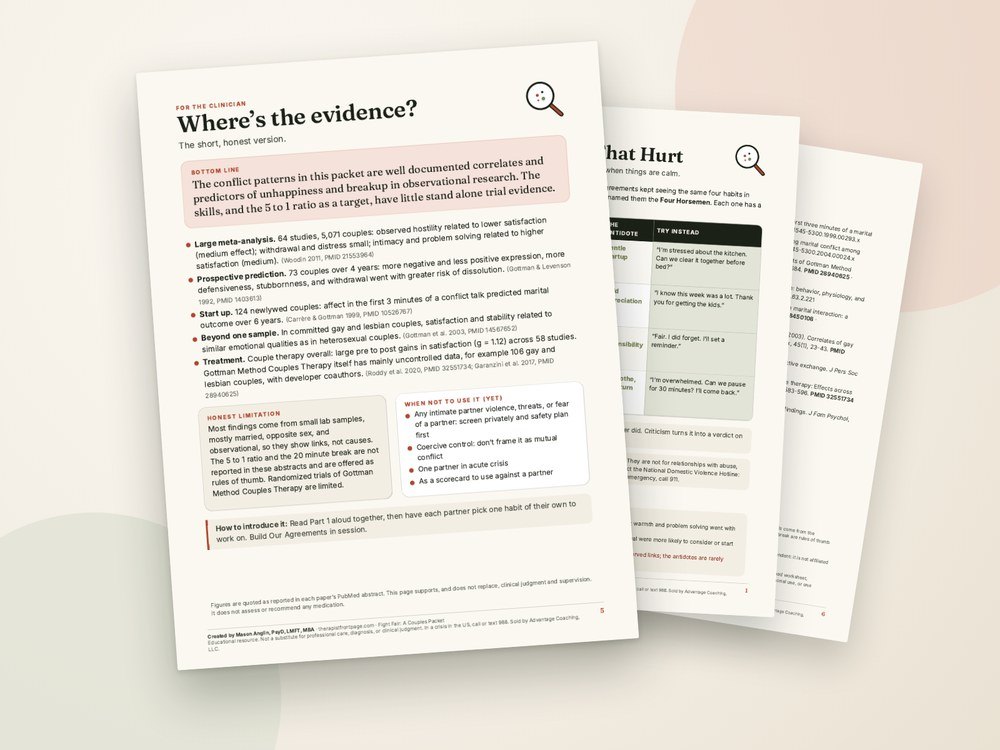
The packet ends with one clinician page and a references page. The numbers come straight from each study’s PubMed abstract, and thin evidence is labeled as thin.
How it’s used
Built for
- Couples who want calmer arguments
- Couples and family therapists
- Premarital and relationship education
- Coaches working with couples
A simple flow
- Read the four habits together
- Talk through the 5 to 1 idea
- Pick the basics you will use
- Fill in Our Agreements and post it
Want to practice one skill at a time?
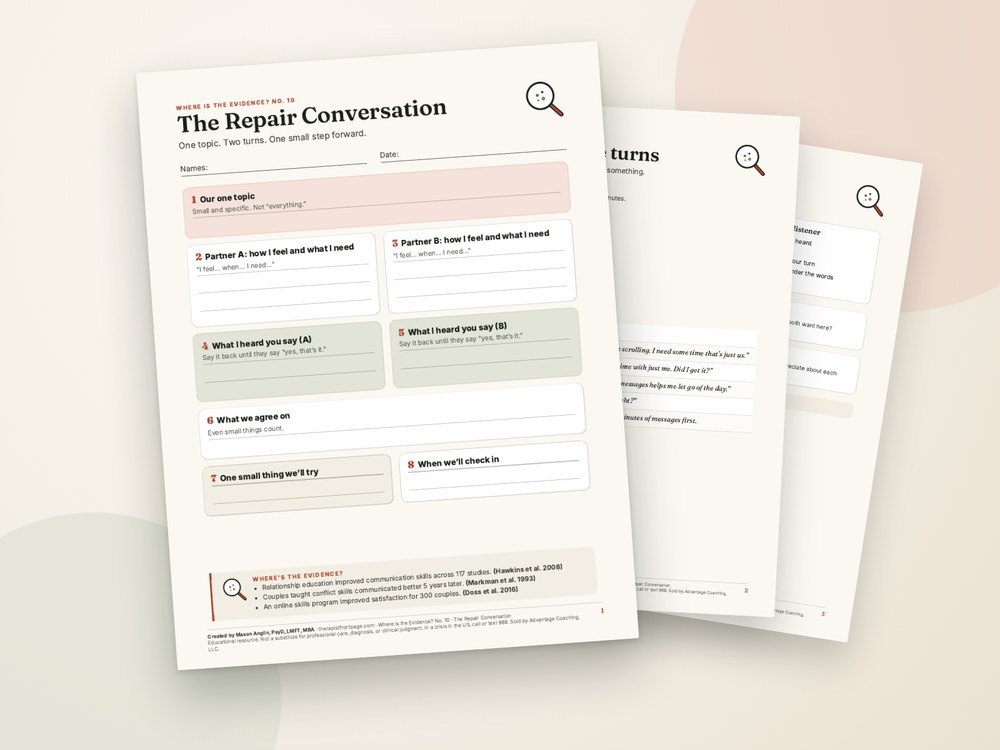
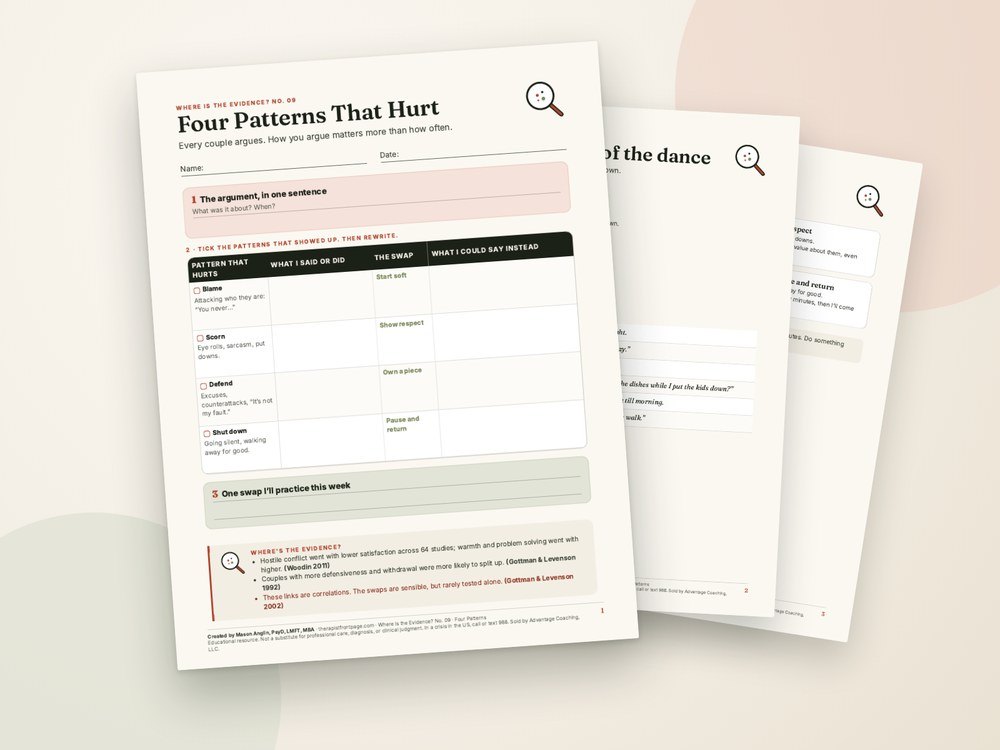
Two $5 worksheets from the Where Is the Evidence? series go deeper on the same ground: one walks a couple through repairing a single argument, the other looks back at which of the four patterns showed up.
Where Is the Evidence? No. 10
The Repair Conversation
A one page guide for couples to talk through one conflict, take turns, and agree on a small next step.
6 pages · print and fillable PDF · PubMed refs
Where Is the Evidence? No. 09
Four Patterns That Hurt, Four That Help
Spot four conflict patterns that wear couples down, and practice the swap that helps.
6 pages · print and fillable PDF · PubMed refs
Price: $5 See the evidence: Four Patterns That Hurt, Four That Help
Mason’s own products; Therapist Front Page earns from these sales.
Get the free PDF
A direct PDF download. No email or account needed.
Created by Mason Anglin, PsyD, LMFT, MBA · LMFT #121211 · Registered Psychological Associate #PSB94029529
Based on research by John and Julie Gottman and colleagues. Not affiliated with or endorsed by The Gottman Institute.
Educational, not a substitute for care. In a crisis in the US, call or text 988.