Where Is the Evidence? No. 10
The Repair Conversation
A one page guide for couples to talk through one conflict, take turns, and agree on a small next step.
6 pages · US Letter PDF, print and fillable versions · references with PMIDs
Where’s the evidence? Relationship education improved communication skills across 117 studies (Hawkins 2008).
Instant PDF download right after purchase (print and fillable versions). Questions or refunds: contact us. Checkout is by Stripe; the seller on your receipt is Advantage Coaching, LLC.
Clinician use included. Licensed for personal use, or for one clinician to use with their own clients and students. Please don’t resell, redistribute, or upload it to shared drives or marketplaces.
Mason’s own product; Therapist Front Page earns from these sales.
What’s inside
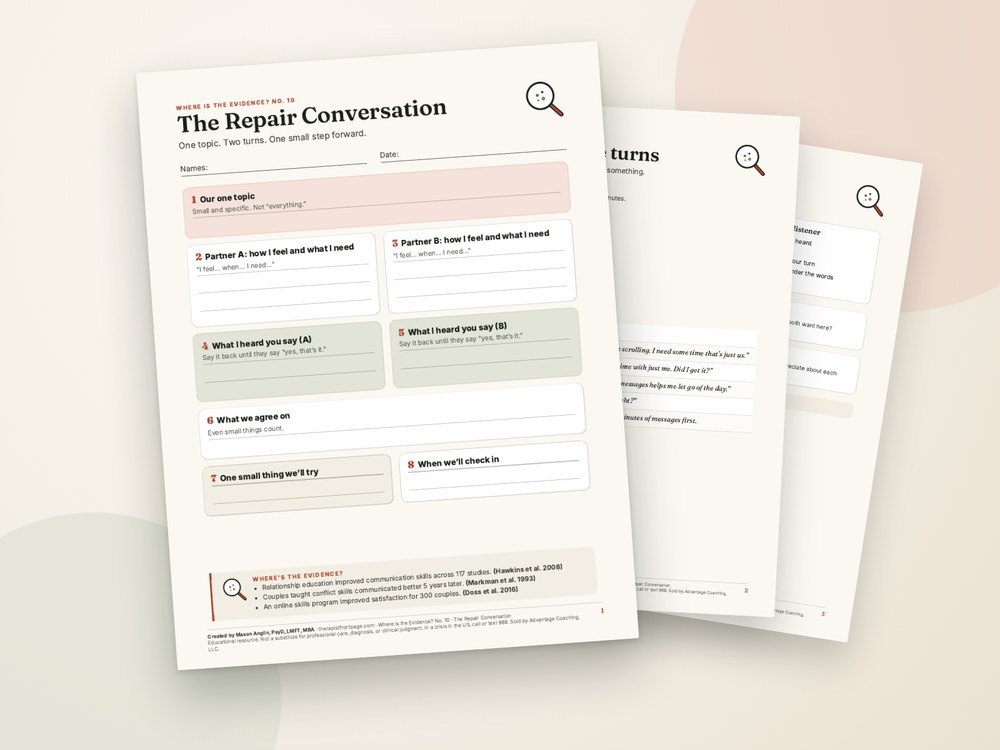
One topic, two turns, one small agreement. This one page guide walks a couple through a calmer conversation: speak for yourself, reflect what you heard, then agree on a small experiment. A short evidence strip on the page shows what communication and conflict skills research supports.
- One page Repair Conversation with the evidence printed on it
- How-to plus a short worked example
- Quick card: speaker and listener tips
- Follow up check-in
- Clinician page: evidence, honest limits, when not to use
- References with PMIDs and DOIs
All 6 pages, and who each is for
- The Repair Conversation · Client
- Slow it down, take turns · Client
- Speaker and listener · Client
- Check-in · Client
- Where's the evidence? · Clinician
- References · Clinician
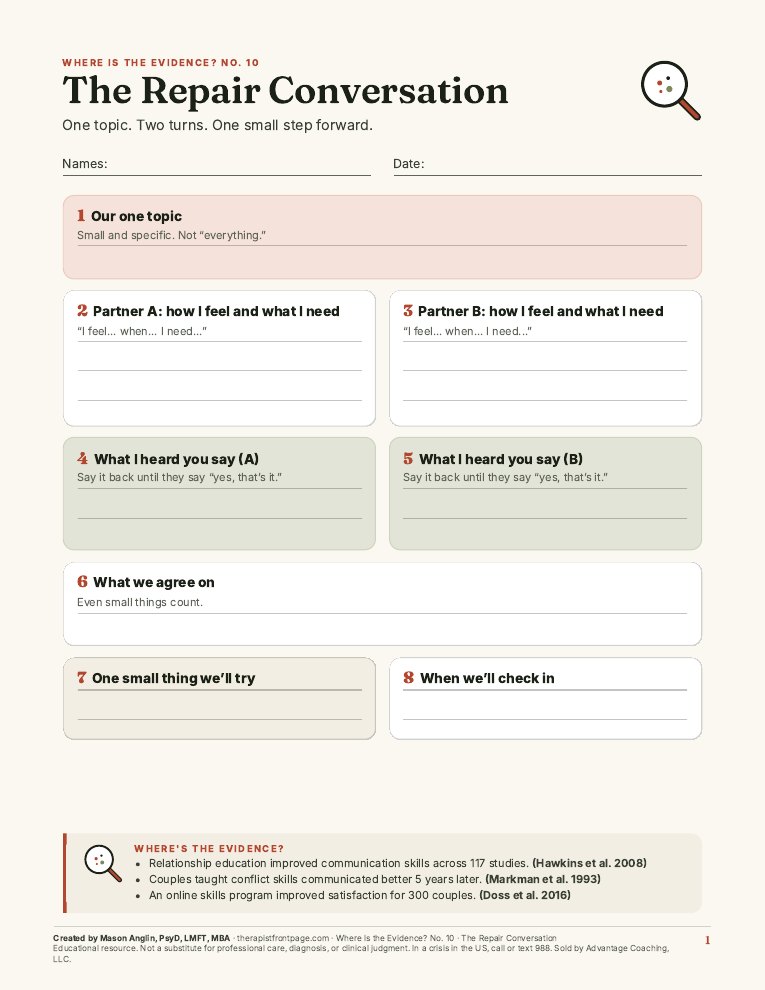
Page 1: The Repair Conversation 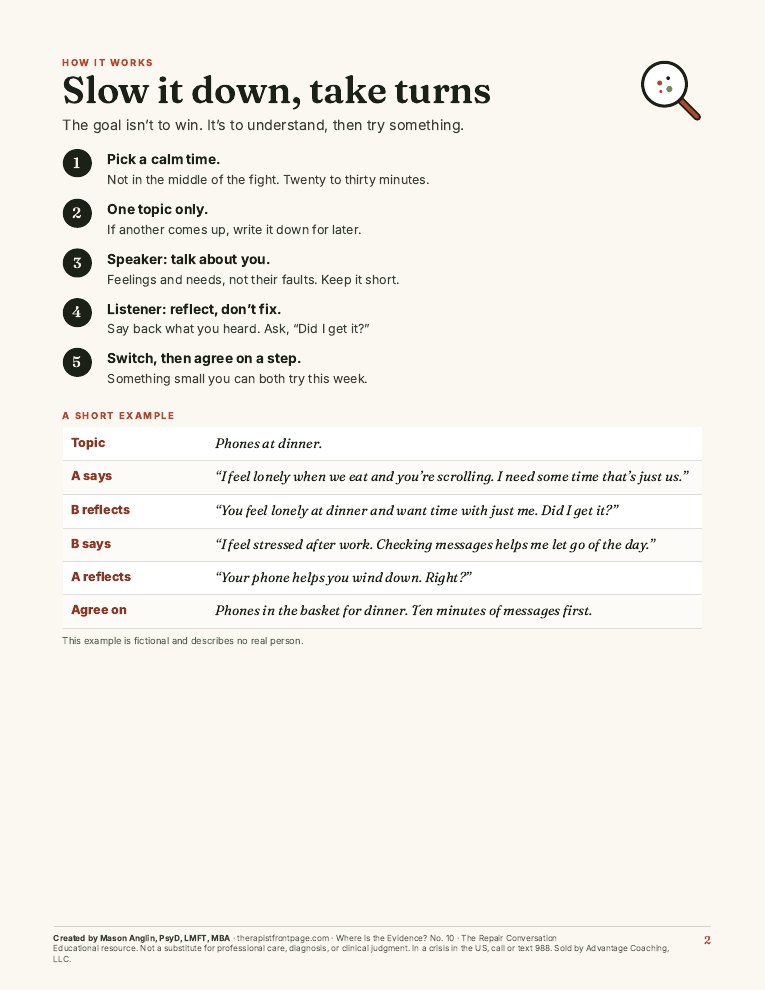
Page 2: Slow it down, take turns 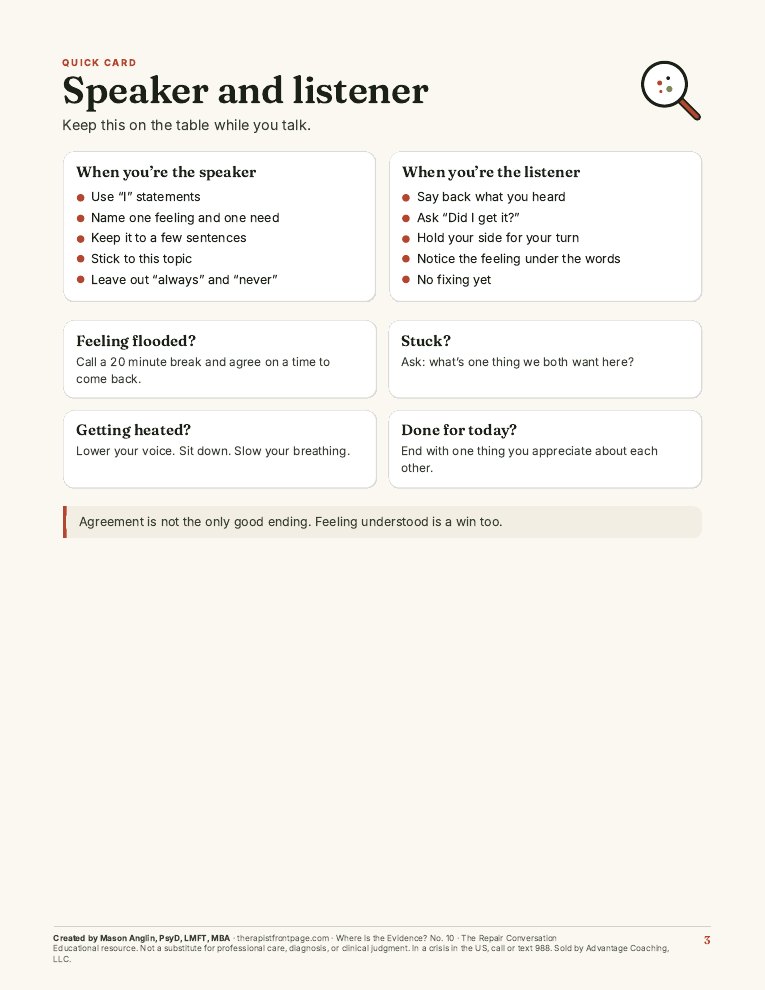
Page 3: Speaker and listener 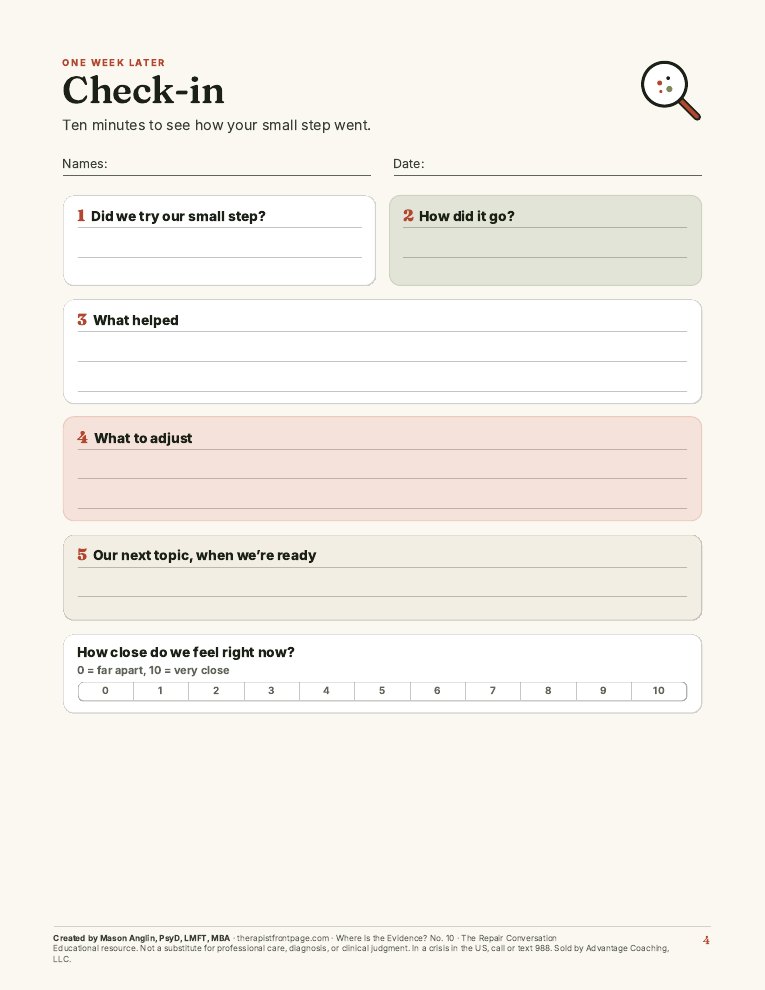
Page 4: Check-in 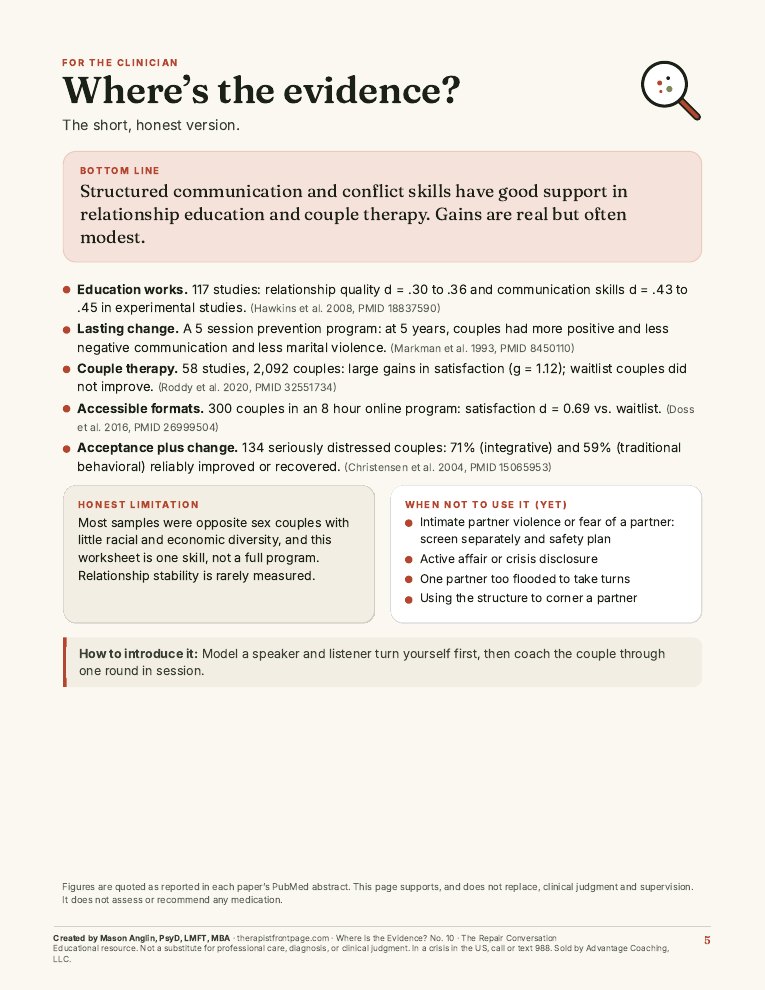
Page 5: Where's the evidence? 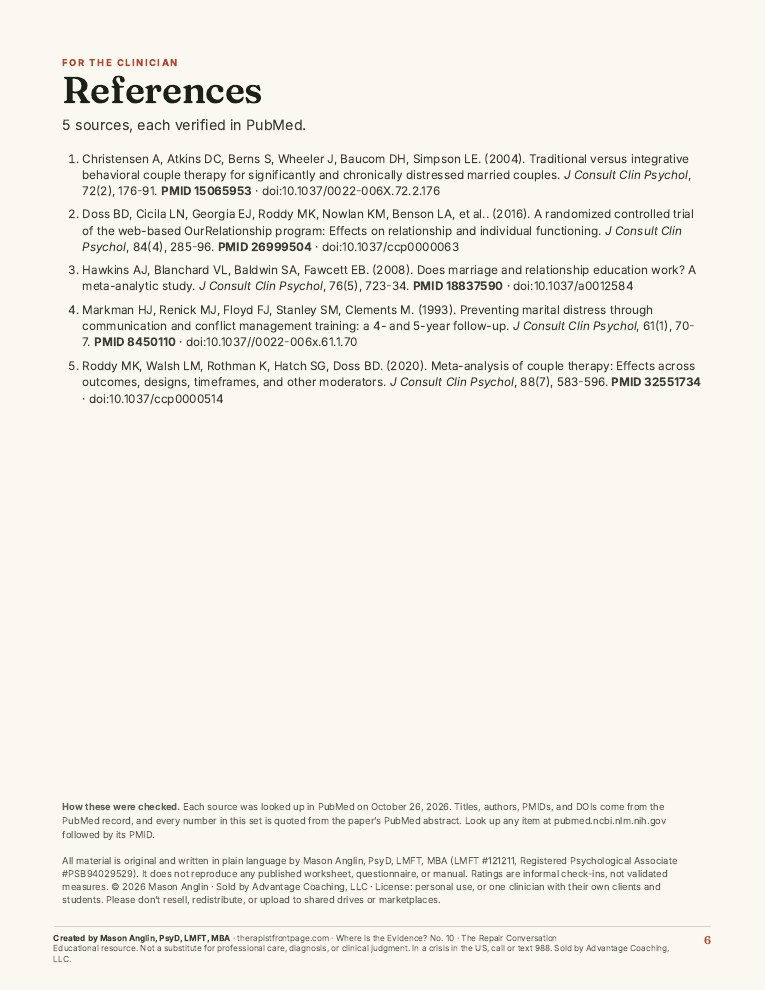
Page 6: References
Where’s the evidence?
Structured communication and conflict skills have good support in relationship education and couple therapy. Gains are real but often modest.
On the worksheet itself
- Relationship education improved communication skills across 117 studies. (Hawkins et al. 2008)
- Couples taught conflict skills communicated better 5 years later. (Markman et al. 1993)
- An online skills program improved satisfaction for 300 couples. (Doss et al. 2016)
On the clinician page
- Education works. 117 studies: relationship quality d = .30 to .36 and communication skills d = .43 to .45 in experimental studies. (Hawkins et al. 2008)
- Lasting change. A 5 session prevention program: at 5 years, couples had more positive and less negative communication and less marital violence. (Markman et al. 1993)
- Couple therapy. 58 studies, 2,092 couples: large gains in satisfaction (g = 1.12); waitlist couples did not improve. (Roddy et al. 2020)
- Accessible formats. 300 couples in an 8 hour online program: satisfaction d = 0.69 vs. waitlist. (Doss et al. 2016)
- Acceptance plus change. 134 seriously distressed couples: 71% (integrative) and 59% (traditional behavioral) reliably improved or recovered. (Christensen et al. 2004)
Honest limitation
Most samples were opposite sex couples with little racial and economic diversity, and this worksheet is one skill, not a full program. Relationship stability is rarely measured.
When not to use it (yet)
- Intimate partner violence or fear of a partner: screen separately and safety plan
- Active affair or crisis disclosure
- One partner too flooded to take turns
- Using the structure to corner a partner
Figures are quoted as reported in each paper’s PubMed abstract. Every source below was checked in PubMed on October 26, 2026.
References (5 sources, with PMIDs)
- Christensen A, Atkins DC, Berns S, et al. (2004). Traditional versus integrative behavioral couple therapy for significantly and chronically distressed married couples. J Consult Clin Psychol. PMID 15065953
- Doss BD, Cicila LN, Georgia EJ, et al. (2016). A randomized controlled trial of the web-based OurRelationship program: Effects on relationship and individual functioning. J Consult Clin Psychol. PMID 26999504
- Hawkins AJ, Blanchard VL, Baldwin SA, et al. (2008). Does marriage and relationship education work? A meta-analytic study. J Consult Clin Psychol. PMID 18837590
- Markman HJ, Renick MJ, Floyd FJ, et al. (1993). Preventing marital distress through communication and conflict management training: a 4- and 5-year follow-up. J Consult Clin Psychol. PMID 8450110
- Roddy MK, Walsh LM, Rothman K, et al. (2020). Meta-analysis of couple therapy: Effects across outcomes, designs, timeframes, and other moderators. J Consult Clin Psychol. PMID 32551734
The clinician page
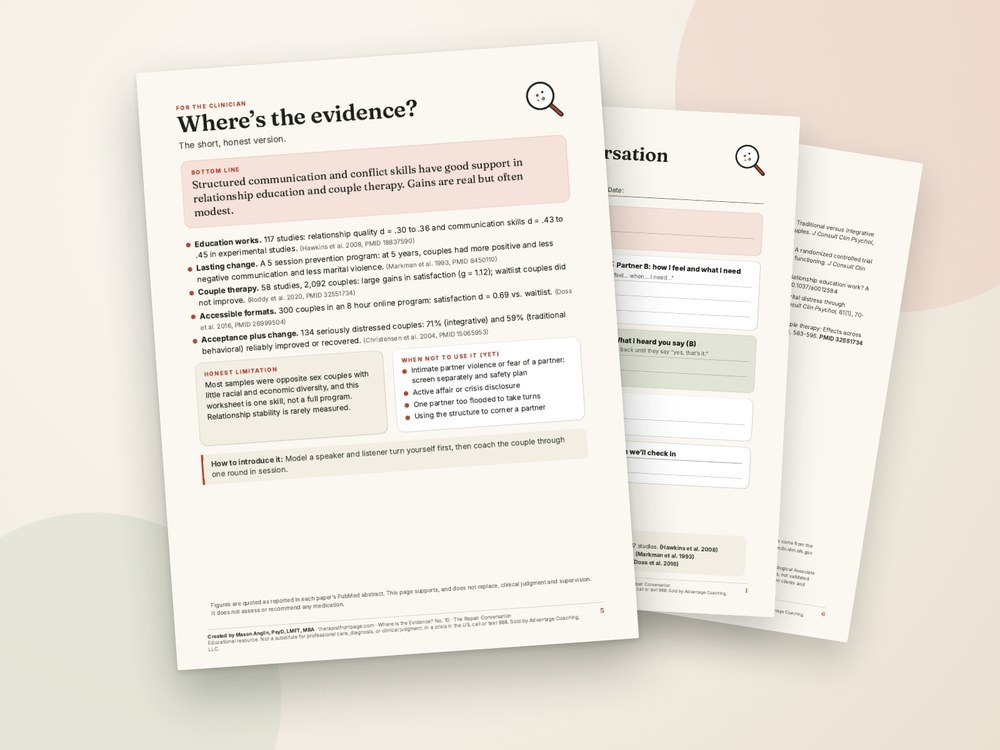
Every worksheet in the series ends with one clinician page and a references page. The numbers come straight from each study’s PubMed abstract, and thin evidence is labeled as thin.
How it’s used
Built for
- Couples in therapy or coaching
- Couples and family therapists
- Premarital and relationship education
- Partners who want calmer talks
A simple flow
- Agree on one topic
- Take turns speaking and reflecting
- Find what you agree on
- Try one small experiment
License: clinician use included
Clinician use included. Licensed for personal use, or for one clinician to use with their own clients and students. Please don’t resell, redistribute, or upload it to shared drives or marketplaces.
Get The Repair Conversation
Instant PDF download right after purchase (print and fillable versions). Questions or refunds: contact us. Checkout is by Stripe; the seller on your receipt is Advantage Coaching, LLC.
Mason’s own product; Therapist Front Page earns from these sales.
Created by Mason Anglin, PsyD, LMFT, MBA · LMFT #121211 · Registered Psychological Associate #PSB94029529
Educational, not a substitute for care. In a crisis in the US, call or text 988.