Client Workbook Series No. 02 · Worry & generalized anxiety
Making Peace with Maybe
A workbook for worry, overthinking, and generalized anxiety (GAD), to use with your therapist.
50 pages · full-color PDF + low-ink print-friendly PDF · 34 sources · edition 1.1 · by Mason Anglin, PsyD, LMFT
Instant PDF download right after purchase (full-color and print-friendly versions). Questions or refunds: contact us. Checkout is by Stripe; the seller on your receipt is Advantage Coaching, LLC.
Mason’s own product; Therapist Front Page earns from these sales.
You don’t have to stop every worry to feel better
If your mind often jumps ahead to what could go wrong, that habit is tiring. The good news: worry is a habit, and habits can change. Many people who worry a lot are caring, careful, and responsible. They want to be ready for anything. But the mind keeps asking “What if…?” and the answers never feel good enough. Sleep, focus, and fun can all suffer.
This workbook will not ask you to “just relax” or “think positive.” Instead, you’ll learn to change your relationship with worry: to step back from it, solve the problems you can, and live well even when you can’t be sure how things will turn out. That is what “making peace with maybe” means.
What’s inside
Part 1, Understanding worry. What worry can look like, a plain-language worry loop, what worry gives you and what it costs, and how worry differs from fear and problem-solving.
Part 2, Ten skill modules. Each has a short reading, one core skill, and worksheets.
Module 1: Getting to know your worry
Worry diary; my worry patterns
Module 2: Why worry sticks around
My beliefs about worry; testing a belief about worry
Module 3: Worry time: postpone, don’t fight
My worry-time plan; worry-time log
Module 4: Letting thoughts pass
“I’m having the thought that…”; letting-go practice log
Module 5: Making peace with uncertainty
My certainty-seeking habits; uncertainty experiment menu and planner
Module 6: Solving the problems you can
Problem-solving worksheet; action plan
Module 7: Facing the “what ifs”
Worry outcome journal; facing a “what if” on purpose
Module 8: Calming your body
Body scan & calm toolbox; two-week body calm tracker
Module 9: Living by values, not worry
What worry has taken, and what matters; valued action plan
Module 10: Keeping your progress
My warning signs & plan; what helped & a letter to future me
Part 3, Tools. A weekly tracker, a weekly reflection, and pages for before and after your therapy sessions.
All 50 pages
- Cover, welcome & how to use, contents · pp. 1–3
- Before you begin: important notes · p. 4
- Part 1 · Understanding worry: what worry can look like, the worry loop, what worry gives me and what it costs, worry vs. problem-solving · pp. 5–8
- What the research says, and why this matters now · pp. 9–10
- Part 2 · Ten skill modules · pp. 11–42
- Part 3 · Tools: weekly tracker, weekly reflection, before and after my session · pp. 43–46
- References (34 sources) · pp. 47–49
- About & license · p. 50
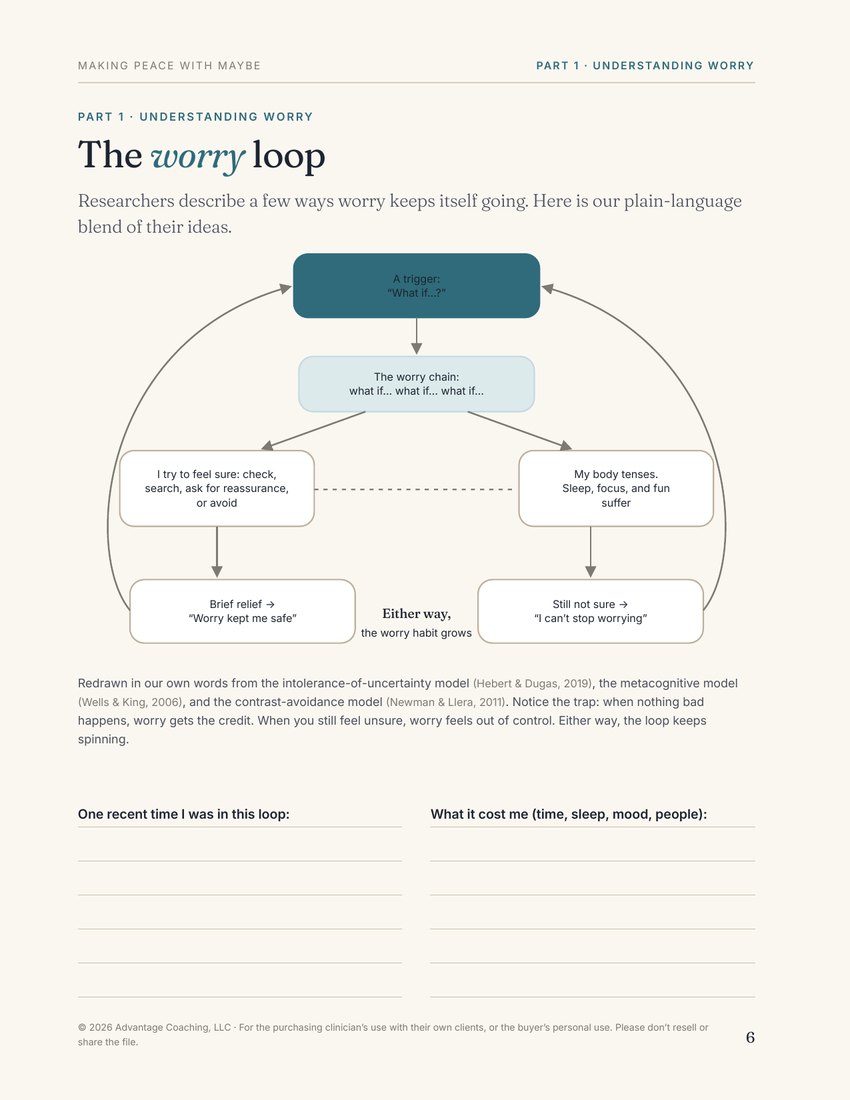
Page 6: The worry loop 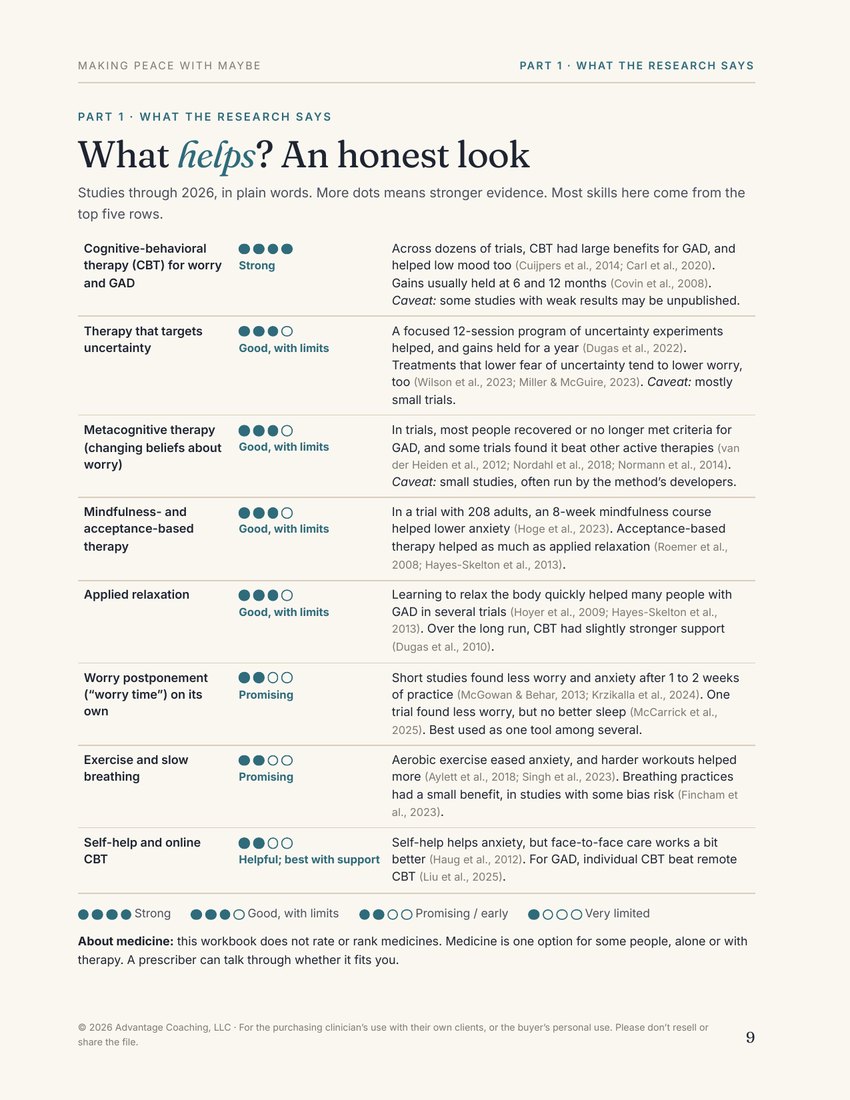
Page 9: What helps? An honest look 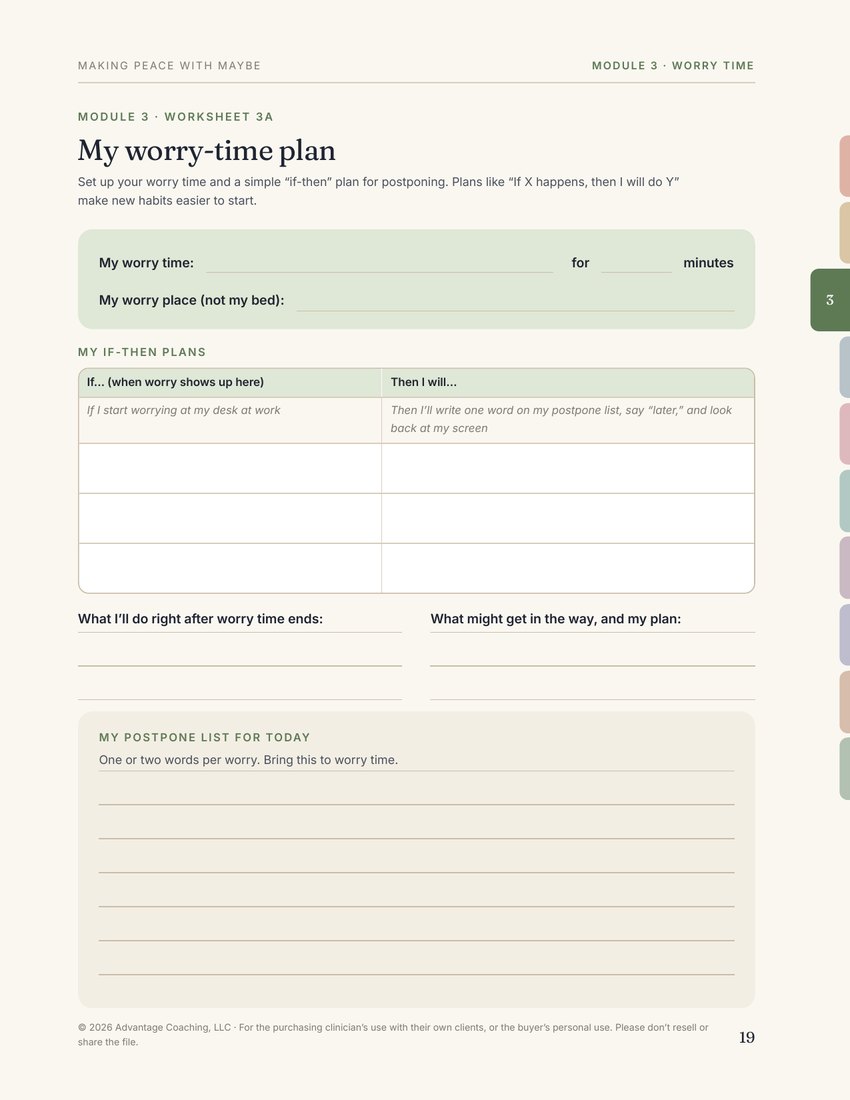
Page 19: Worksheet 3A: my worry-time plan 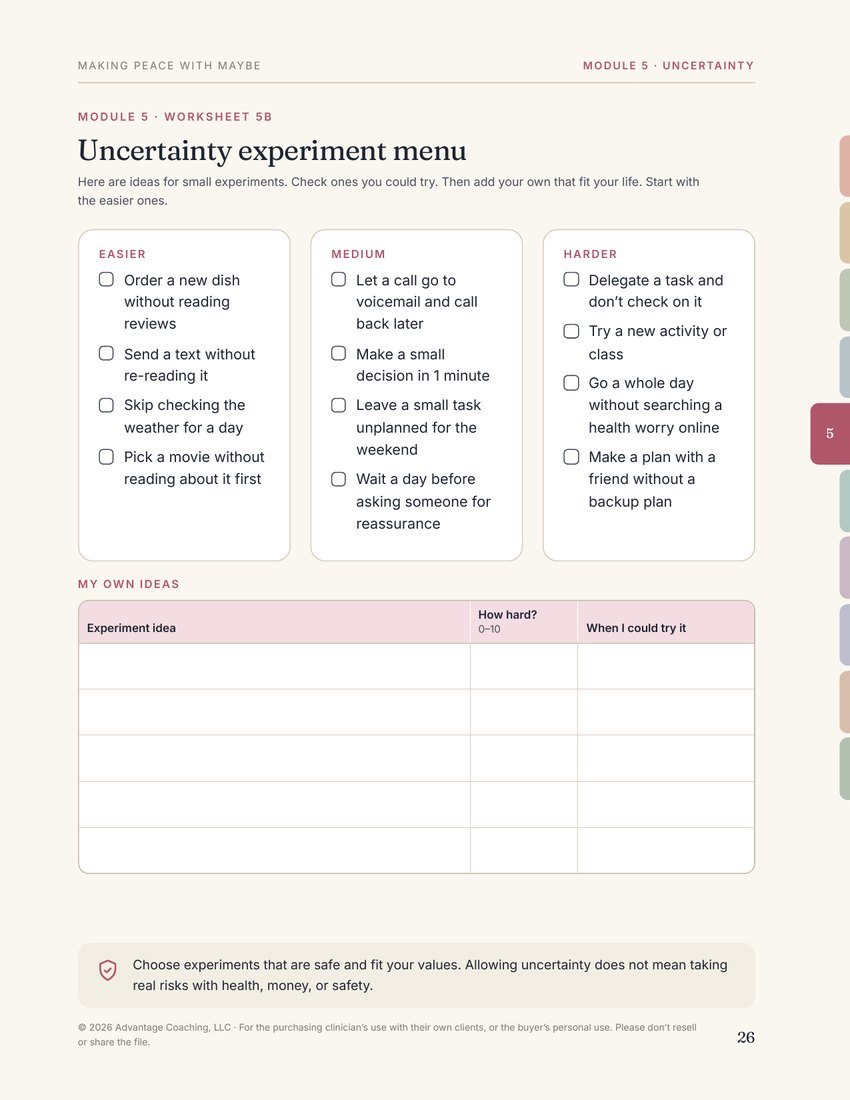
Page 26: Worksheet 5B: uncertainty experiment menu 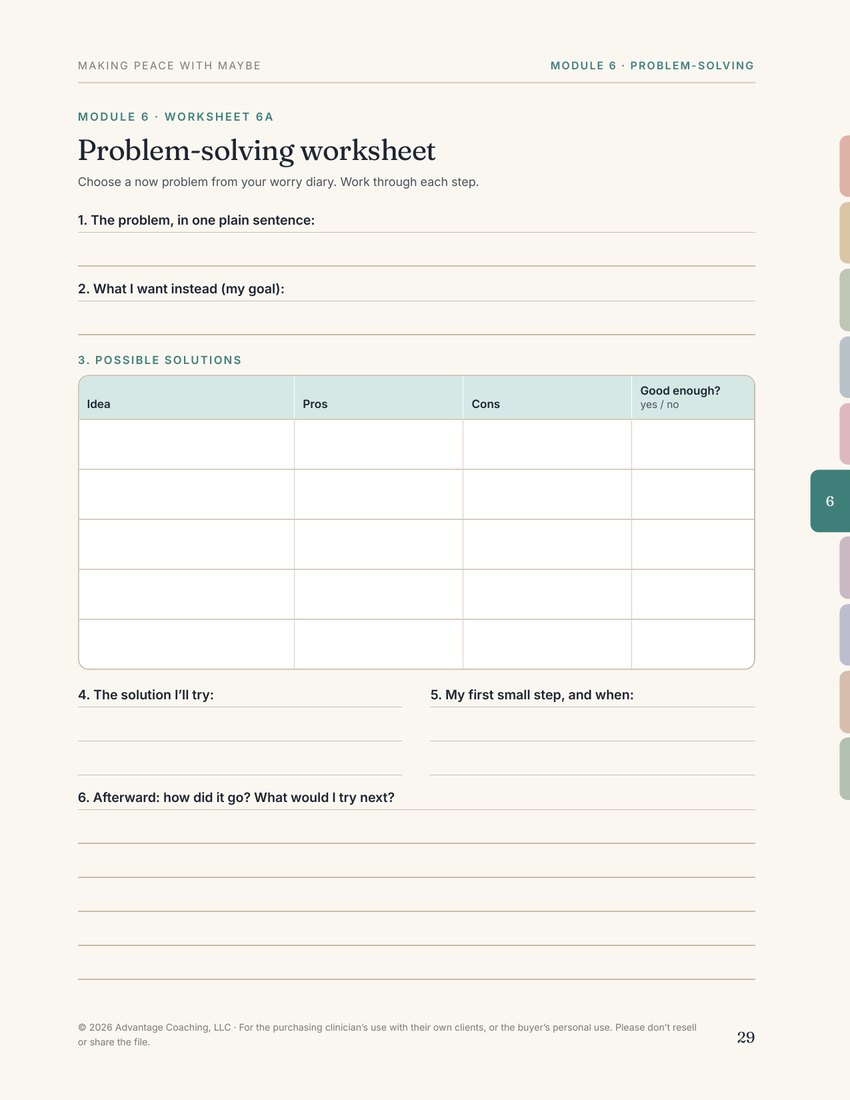
Page 29: Worksheet 6A: problem-solving worksheet 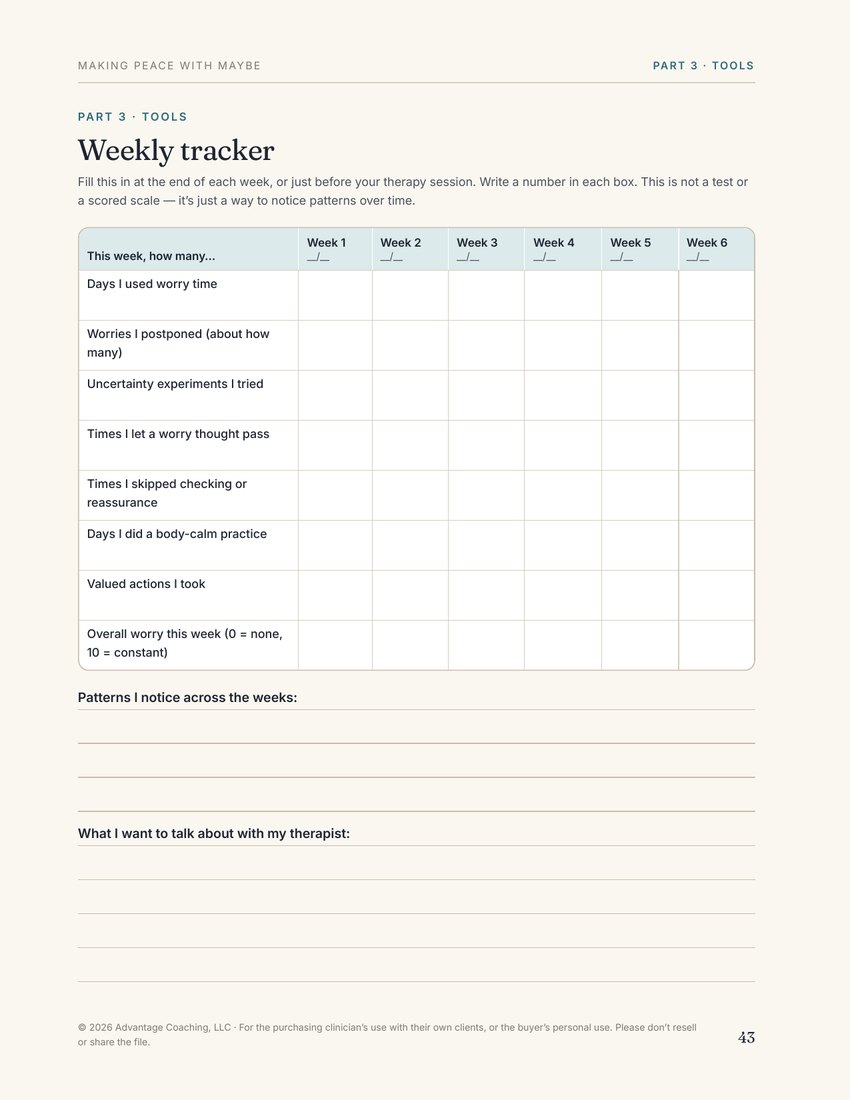
Page 43: Weekly tracker
How to use it
- Go slowlyOne module every week or two is plenty.
- Work with your therapistBring pages to sessions and plan the practice together.
- Practice, don’t just readSkills grow with small, repeated tries.
- Skip aroundYour therapist may suggest a different order. That’s fine.
- Go at a kind paceIf a page feels like too much, skip it and talk about it in session.
- Keep it privateWhat you write is yours. You choose what to share.
Who it’s for
Made for
- Adults whose worry or overthinking takes up lots of time, is hard to stop, or gets in the way of sleep, focus, and fun
- People working on worry or generalized anxiety with a therapist. A label is optional
- Therapists who want a structured between-session workbook. Purchase covers use with your own clients
Not made for
- Deciding whether you “have” anything. Only a licensed professional who knows you can do that
- Replacing therapy. It’s built to support therapy, not stand in for it
- A crisis. If you’re in danger, call or text 988 or call 911
An honest look at the evidence
The workbook grades each therapy approach in plain words (studies through 2026). Most of its skills come from the top five rows:
| Approach | Grade |
|---|---|
| Cognitive-behavioral therapy (CBT) for worry and GADAcross dozens of trials, CBT had large benefits for GAD and helped low mood too. Gains usually held at 6 and 12 months. Caveat: some studies with weak results may be unpublished. | Strong |
| Therapy that targets uncertaintyA focused 12-session program of uncertainty experiments helped, and gains held for a year. Caveat: mostly small trials. | Good, with limits |
| Metacognitive therapy (changing beliefs about worry)In trials, most people recovered or no longer met criteria for GAD. Caveat: small studies, often run by the method’s developers. | Good, with limits |
| Mindfulness- and acceptance-based therapyIn a trial with 208 adults, an 8-week mindfulness course helped lower anxiety. Acceptance-based therapy helped as much as applied relaxation. | Good, with limits |
| Applied relaxationLearning to relax the body quickly helped many people with GAD in several trials. Over the long run, CBT had slightly stronger support. | Good, with limits |
| Worry postponement (“worry time”) on its ownShort studies found less worry and anxiety after 1 to 2 weeks of practice. Best used as one tool among several. | Promising |
| Exercise and slow breathingAerobic exercise eased anxiety, and harder workouts helped more. Breathing practices had a small benefit, in studies with some bias risk. | Promising |
| Self-help and online CBTSelf-help helps anxiety, but face-to-face care works a bit better. For GAD, individual CBT beat remote CBT. | Helpful; best with support |
About medicine. This workbook does not rate or rank medicines. Medicine is one option for some people, alone or with therapy. A prescriber can talk through whether it fits you.
- When people with GAD tracked their worries, about 9 in 10 never came true, and when a worry did come true, people usually coped better than they expected (p. 10).
- 34 sources, each checked against PubMed or Crossref in October 2026. The worksheets and wording are original.
- No diagnostic manual text and no items from copyrighted questionnaires are reproduced. The weekly tracker is not a validated measure.
Get Making Peace with Maybe
Instant PDF download right after purchase (full-color and print-friendly versions). Questions or refunds: contact us. Checkout is by Stripe; the seller on your receipt is Advantage Coaching, LLC.
Mason’s own product; Therapist Front Page earns from these sales.
In crisis? If you’re thinking about suicide or are in danger, call or text 988 (US), chat at 988lifeline.org, or call 911 or your local emergency number now.
For education and skill-building alongside professional care. It is not a diagnosis, treatment plan, or substitute for therapy or medical care. The weekly tracker is not a validated measure. Questionnaires used in research are not reproduced.
Created by Mason Anglin, PsyD, LMFT #121211, Registered Psychological Associate #PSB94029529
© 2026 Advantage Coaching, LLC (Therapist Front Page). Licensed to the purchasing clinician for use with their own clients, or to the purchaser for personal use. You may print worksheets for those uses. Please don’t resell, post online, or share the file.