Client Workbook Series No. 01 · Perfectionism & OCPD patterns
Good Enough, on Purpose
A workbook for rigid perfectionism and obsessive-compulsive personality patterns (OCPD), to use with your therapist.
50 pages · full-color PDF + low-ink print-friendly PDF · 39 sources · edition 1.1 · by Mason Anglin, PsyD, LMFT
Instant PDF download right after purchase (full-color and print-friendly versions). Questions or refunds: contact us. Checkout is by Stripe; the seller on your receipt is Advantage Coaching, LLC.
Mason’s own product; Therapist Front Page earns from these sales.
You don’t have to be perfect to begin
If you care a lot about doing things well, that care is a strength. But many people with high standards feel tired, tense, or alone in a way that’s hard to explain. Work never feels finished. Rest feels like a waste. Other people seem careless. And the voice in your head is rarely satisfied.
None of that means something is wrong with you as a person. Patterns like these usually start for good reasons: they kept you safe, earned respect, or brought order. The goal isn’t to lower your values. It’s to give you more choice: when to push hard, and when “good enough” is the wiser move.
What’s inside
Part 1, Understanding the pattern. What it can look like (not a test, no score), a plain-language perfectionism loop, a cost-and-benefit worksheet, and where your rule book came from.
Part 2, Ten skill modules. Each has a short reading, one core skill, and worksheets.
Module 1: Values: your compass
Values compass; values vs. rules
Module 2: Mapping your rule book
Rule map; what my self-worth rests on
Module 3: Behavioral experiments
Experiment menu, planner, and results log
Module 4: Getting started & checking less
Start-ugly plan; checking log
Module 5: From inner critic to inner coach
Inner critic vs. inner coach; a letter from a kind friend
Module 6: Flexibility & openness
Openness journal; flexibility & play tracker
Module 7: Letting others do it their way
My way / their way; repair conversation planner
Module 8: Rest, play & work balance
My week, honestly; rest plan & stopping rule
Module 9: Feelings & showing warmth
Underneath the calm; warmth log
Module 10: Keeping your progress
My warning signs & plan; what helped & a letter to future me
Part 3, Tools. A weekly tracker, a weekly reflection, and pages for before and after your therapy sessions.
All 50 pages
- Cover, welcome & how to use, contents · pp. 1–3
- Before you begin: important notes · p. 4
- Part 1 · Understanding the pattern: what it can look like, the perfectionism loop, costs and benefits, where your rule book came from · pp. 5–8
- What the research says, and why this matters now · pp. 9–10
- Part 2 · Ten skill modules · pp. 11–42
- Part 3 · Tools: weekly tracker, weekly reflection, before and after my session · pp. 43–46
- References (39 sources) · pp. 47–49
- About & license · p. 50
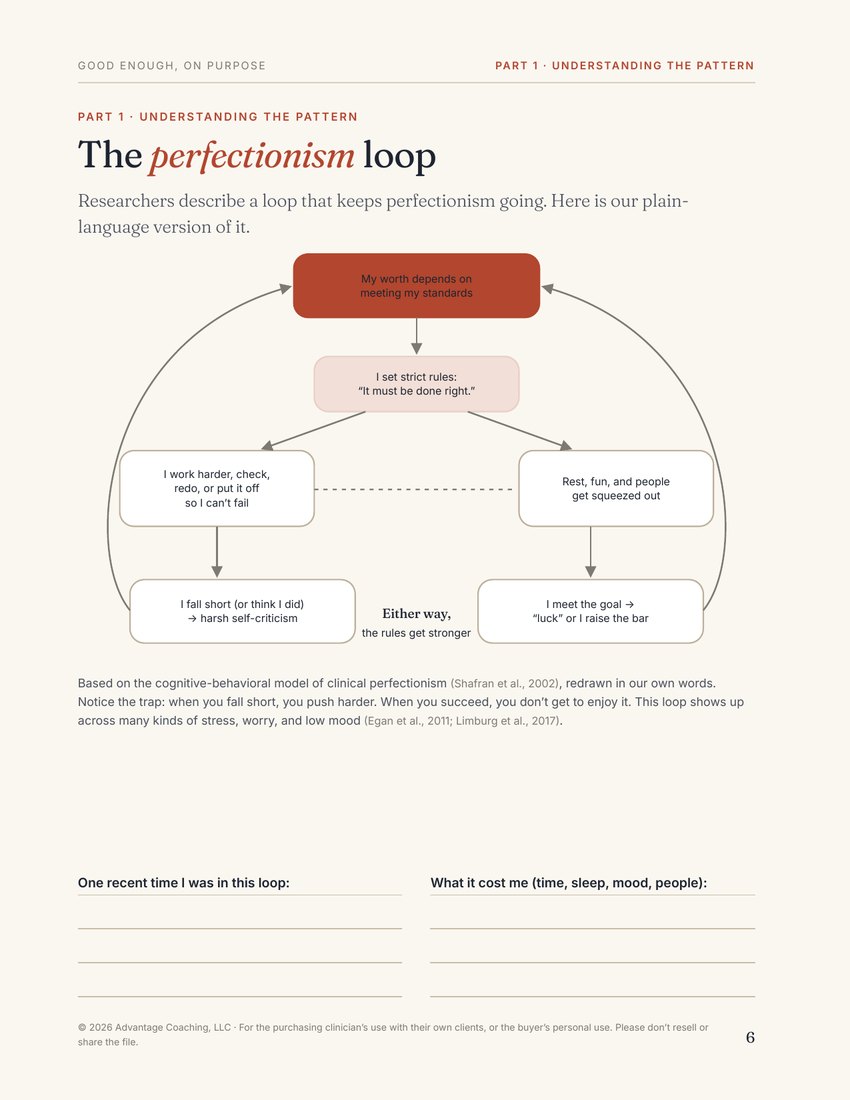
Page 6: The perfectionism loop 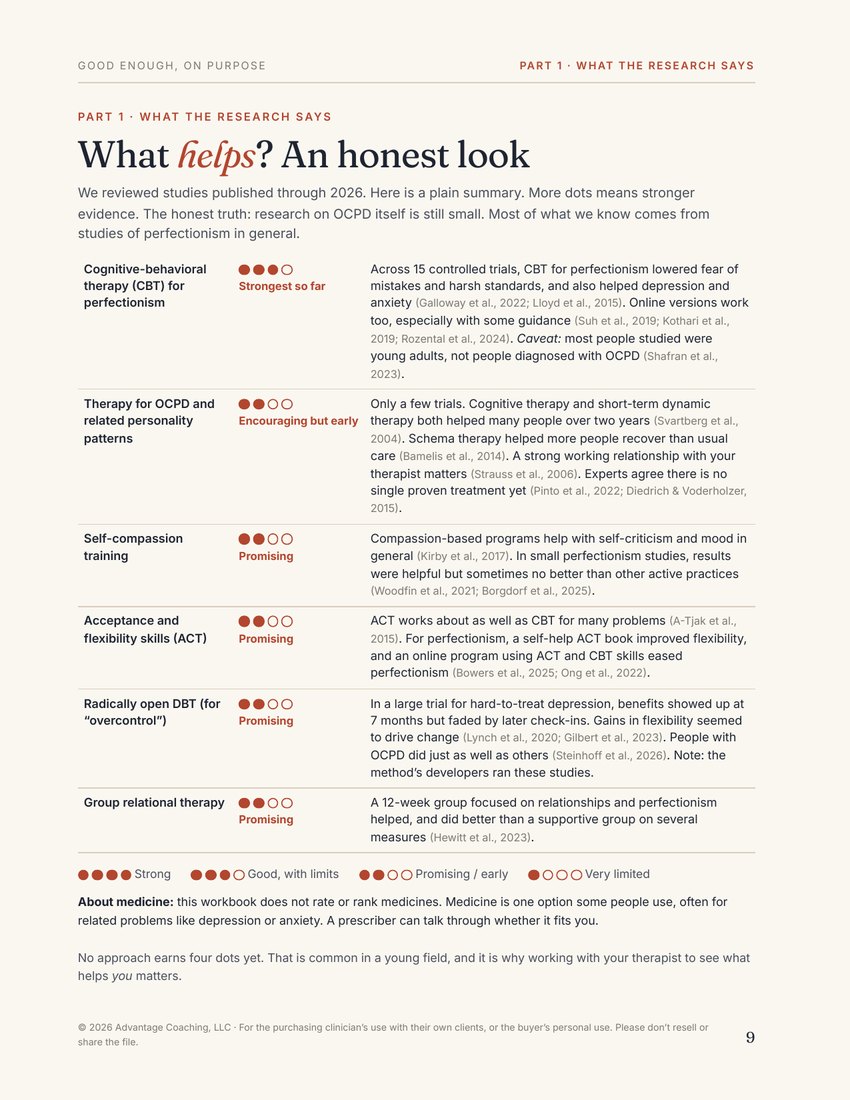
Page 9: What helps? An honest look 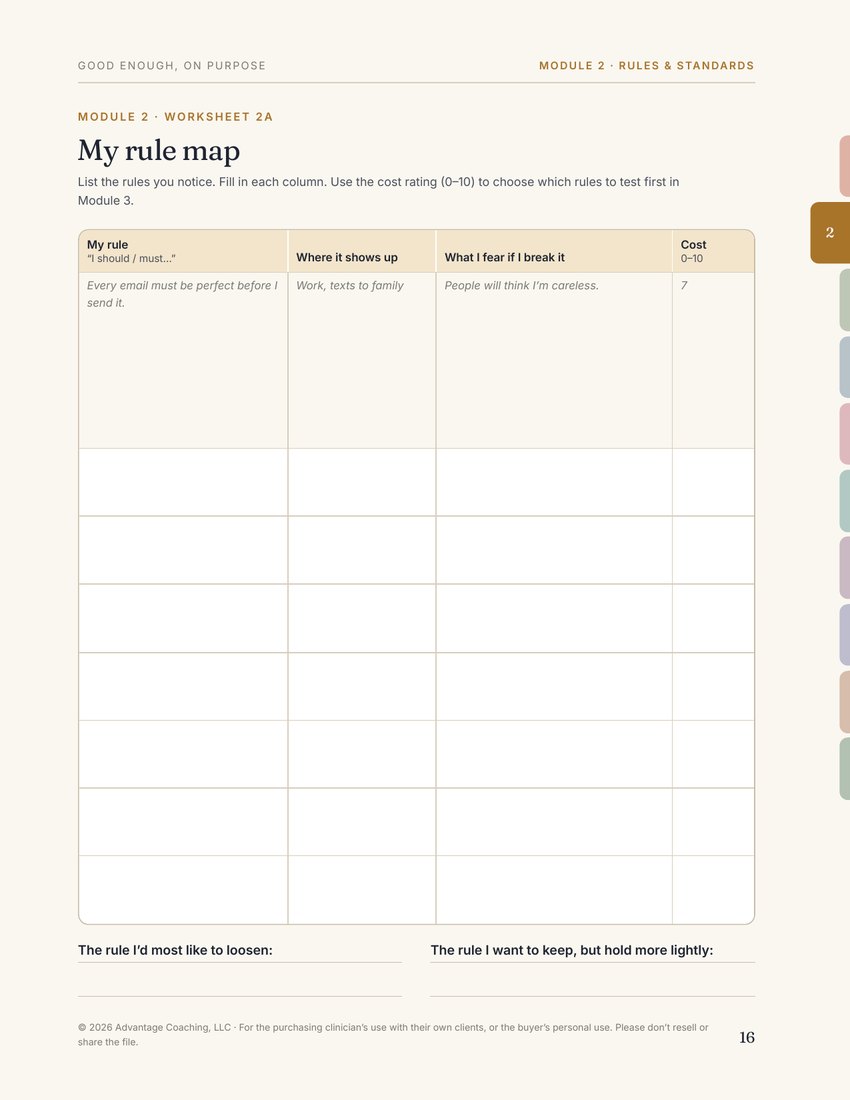
Page 16: Worksheet 2A: my rule map 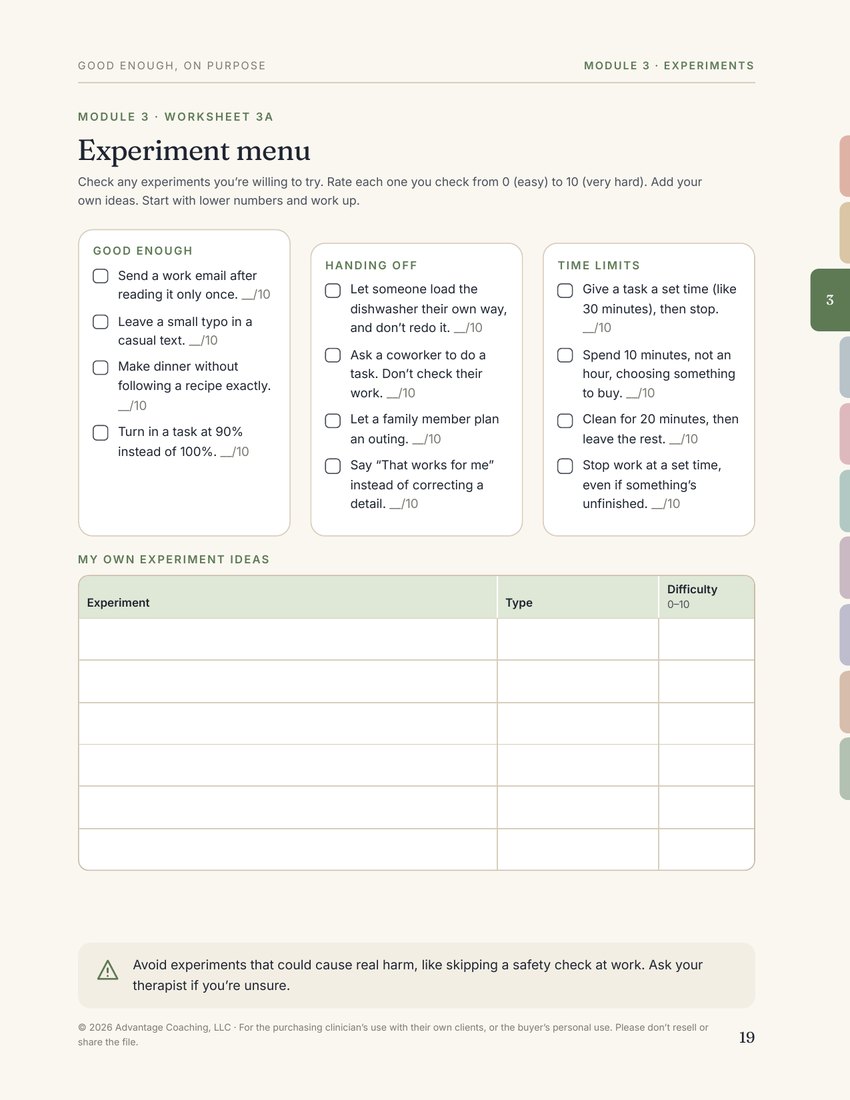
Page 19: Worksheet 3A: experiment menu 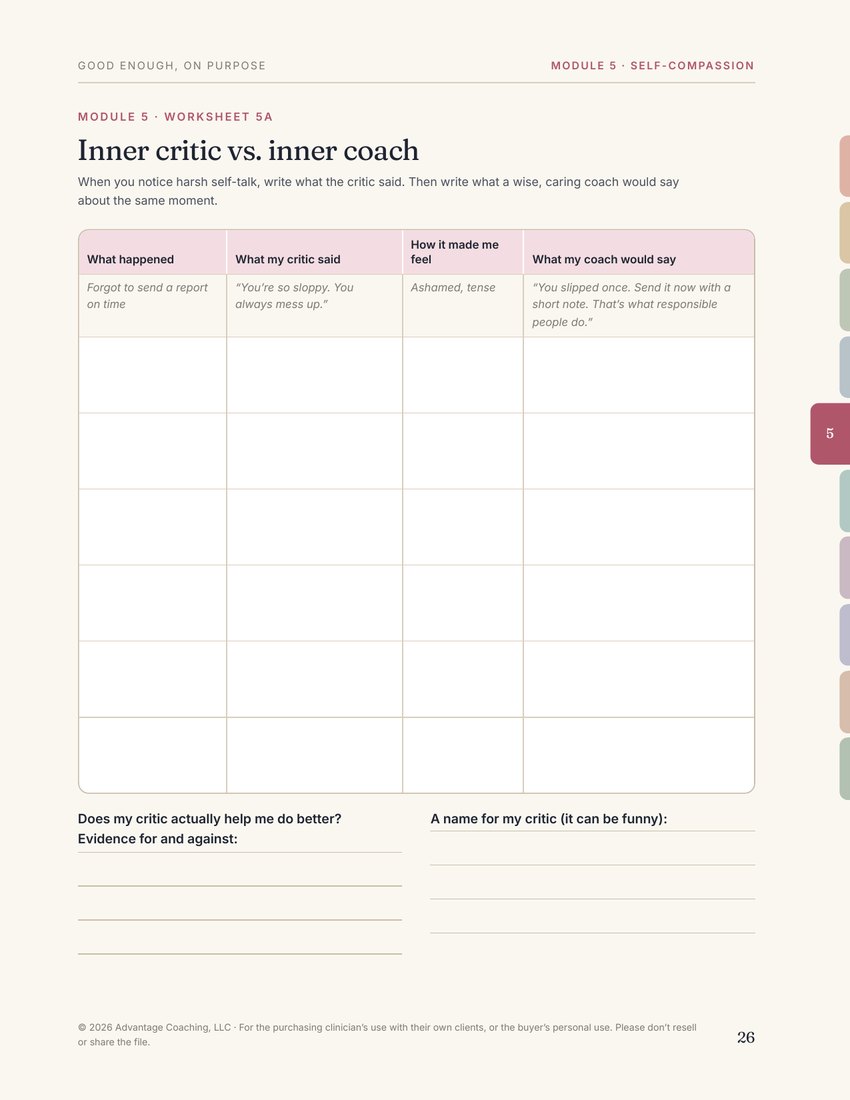
Page 26: Worksheet 5A: inner critic vs. inner coach 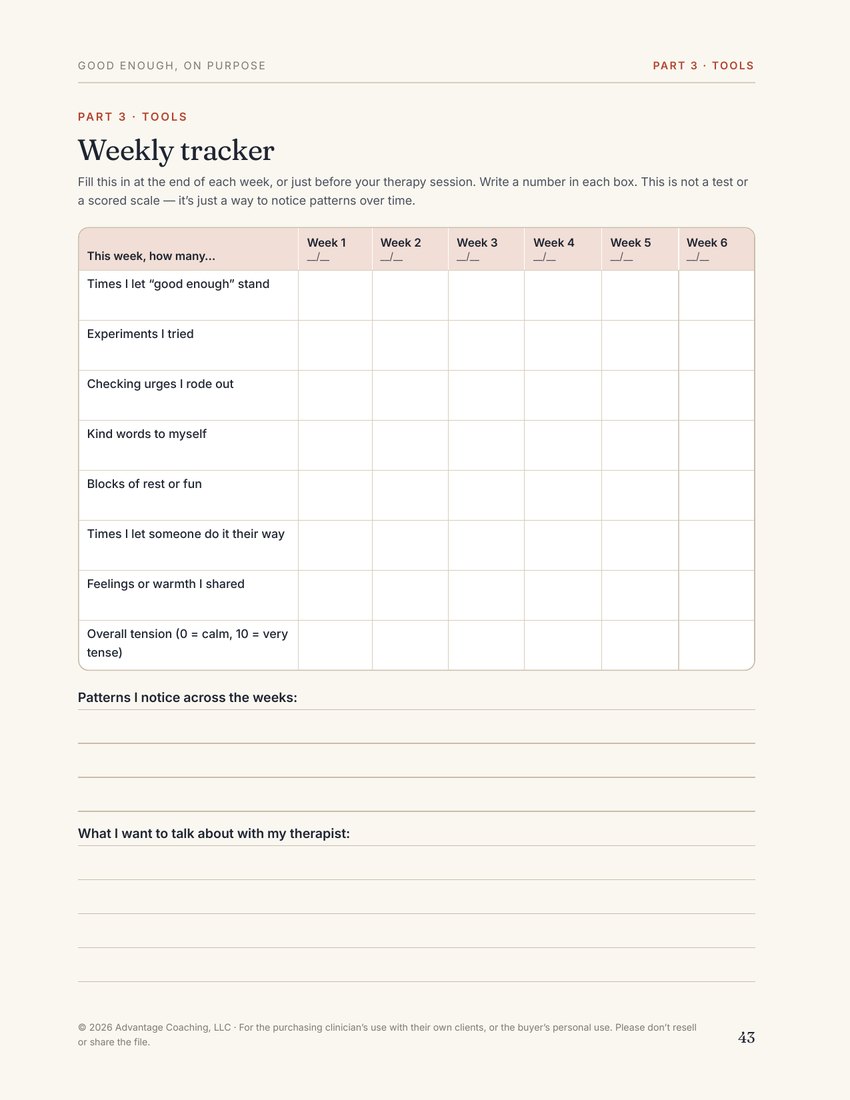
Page 43: Weekly tracker
How to use it
- Go slowlyOne module every week or two is plenty.
- Work with your therapistBring pages to sessions and plan the practice together.
- Practice, don’t just readSkills grow with small, repeated tries.
- Skip aroundYour therapist may suggest a different order. That’s fine.
- Go at a kind paceIf a page feels like too much, skip it and talk about it in session.
- Keep it privateWhat you write is yours. You choose what to share.
Who it’s for
Made for
- Adults whose high standards, rules, or self-criticism cost them too much at work, at home, or in relationships
- People working on perfectionism or OCPD patterns with a therapist. A label is optional; many people use these skills just because perfectionism gets in their way
- Therapists who want a structured between-session workbook. Purchase covers use with your own clients
Not made for
- Deciding whether you “have” anything. Only a licensed professional who knows you can do that
- Replacing therapy. It’s built to support therapy, not stand in for it
- Sorting out OCD on your own. OCPD isn’t the same as OCD, and some people have both; your therapist can help sort it out
- A crisis. If you’re in danger, call or text 988 or call 911
An honest look at the evidence
Research on OCPD itself is still small; most of what we know comes from studies of perfectionism in general. The workbook says so plainly and grades each therapy approach (studies reviewed through 2026):
| Approach | Grade |
|---|---|
| CBT for perfectionismAcross 15 controlled trials, it lowered fear of mistakes and harsh standards and also helped depression and anxiety. Caveat: most people studied were young adults, not people diagnosed with OCPD. | Strongest so far |
| Therapy for OCPD and related personality patternsOnly a few trials. Experts agree there is no single proven treatment yet. | Encouraging but early |
| Self-compassion trainingHelps with self-criticism and mood in general; small perfectionism studies were helpful but sometimes no better than other active practices. | Promising |
| Acceptance and flexibility skills (ACT)Works about as well as CBT for many problems. For perfectionism, a self-help ACT book improved flexibility, and an online ACT and CBT program eased perfectionism. | Promising |
| Radically open DBT (for “overcontrol”)Benefits in a large depression trial faded by later check-ins; the method’s developers ran the studies. | Promising |
| Group relational therapyA 12-week group did better than a supportive group on several measures. | Promising |
About medicine. This workbook does not rate or rank medicines. Medicine is one option some people use, often for related problems like depression or anxiety. A prescriber can talk through whether it fits you.
- No approach earns the top grade yet. That’s common in a young field, and it’s why working with your therapist to see what helps you matters.
- 39 sources, each checked against PubMed or Crossref in October 2026. The worksheets and wording are original.
- No diagnostic manual text and no items from copyrighted questionnaires are reproduced. The weekly tracker is not a validated measure.
Get Good Enough, on Purpose
Instant PDF download right after purchase (full-color and print-friendly versions). Questions or refunds: contact us. Checkout is by Stripe; the seller on your receipt is Advantage Coaching, LLC.
Mason’s own product; Therapist Front Page earns from these sales.
In crisis? If you’re thinking about suicide or are in danger, call or text 988 (US), chat at 988lifeline.org, or call 911 or your local emergency number now.
For education and skill-building alongside professional care. It is not a diagnosis, treatment plan, or substitute for therapy or medical care. The weekly tracker is not a validated measure. Questionnaires used in research are not reproduced.
Created by Mason Anglin, PsyD, LMFT #121211, Registered Psychological Associate #PSB94029529
© 2026 Advantage Coaching, LLC (Therapist Front Page). Licensed to the purchasing clinician for use with their own clients, or to the purchaser for personal use. You may print worksheets for those uses. Please don’t resell, post online, or share the file.