Where Is the Evidence? No. 01
The Thought Record
One page to check a hot thought against the facts, then take one small step.
6 pages · US Letter PDF, print and fillable versions · references with PMIDs
Where’s the evidence? CBT, which uses thought records, helped depression across 409 trials (Cuijpers 2023).
Instant PDF download right after purchase (print and fillable versions). Questions or refunds: contact us. Checkout is by Stripe; the seller on your receipt is Advantage Coaching, LLC.
Clinician use included. Licensed for personal use, or for one clinician to use with their own clients and students. Please don’t resell, redistribute, or upload it to shared drives or marketplaces.
Mason’s own product; Therapist Front Page earns from these sales.
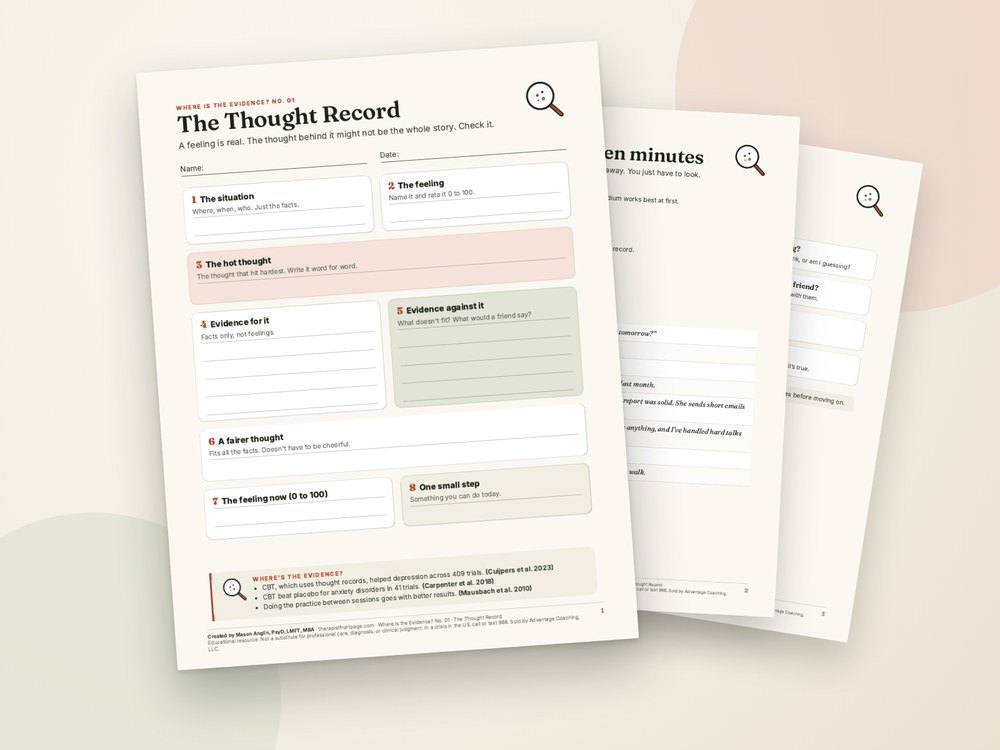
What’s inside
A clean, one page thought record that asks the question CBT is built on: where is the evidence? A small strip on the worksheet shows the research behind it in plain words. Add a one page how-to with a worked example, a quick card of evidence questions, a teen page, and one honest evidence page for clinicians with PubMed references.
- One page thought record with the evidence printed on it
- How-to plus a short worked example
- Quick card: 8 questions that find the evidence
- Teen thought check
- Clinician page: evidence, honest limits, when not to use
- References with PMIDs and DOIs
All 6 pages, and who each is for
- The Thought Record · Client
- Five steps, about ten minutes · Client
- Questions that find the evidence · Client
- Thought Check · Client
- Where's the evidence? · Clinician
- References · Clinician
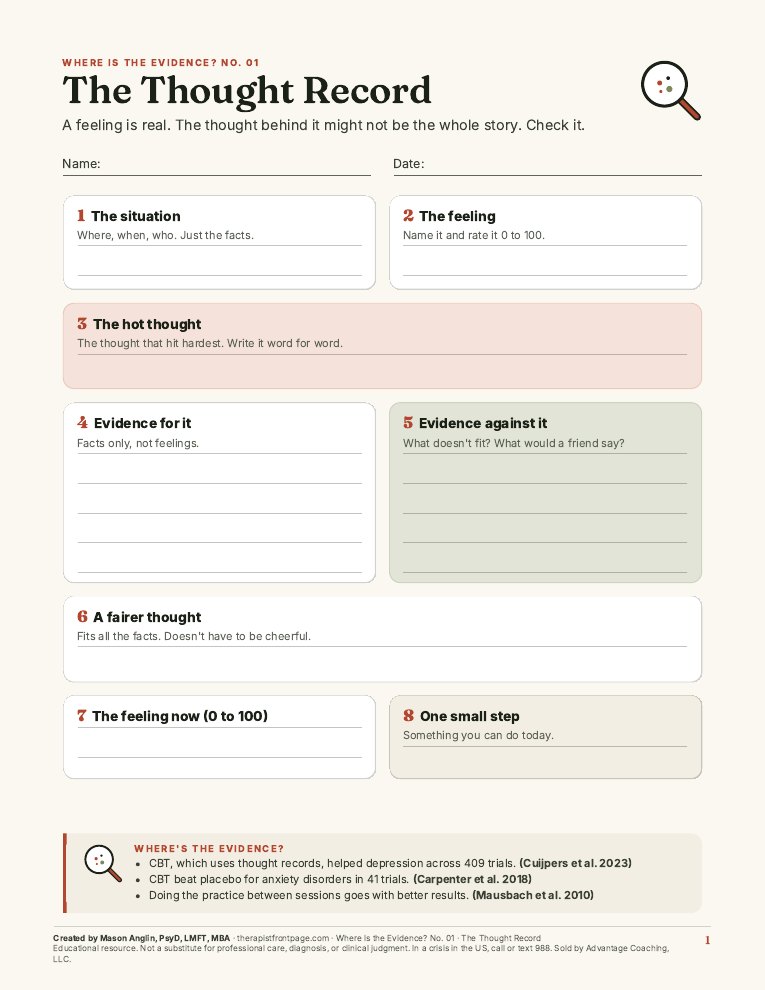
Page 1: The Thought Record 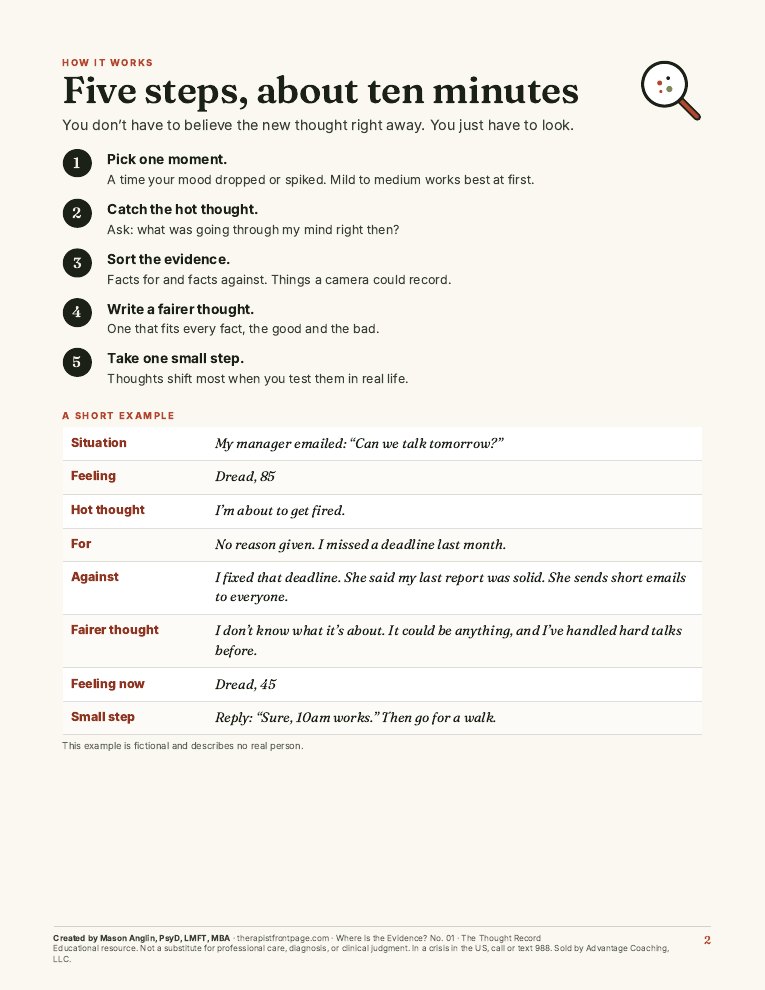
Page 2: Five steps, about ten minutes 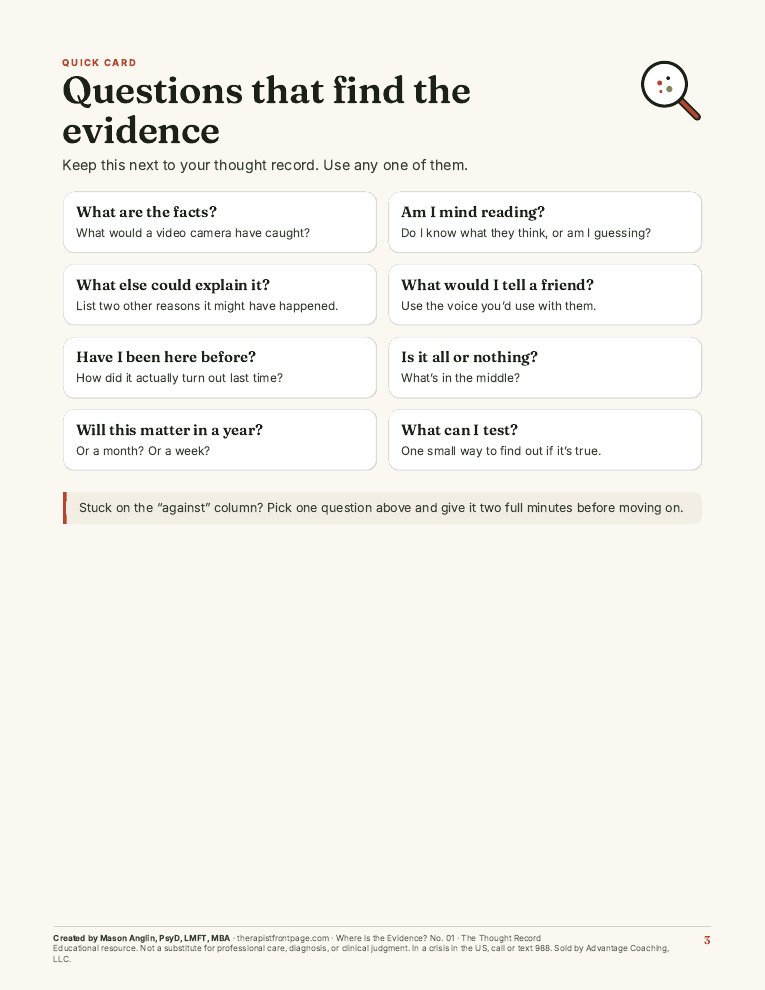
Page 3: Questions that find the evidence 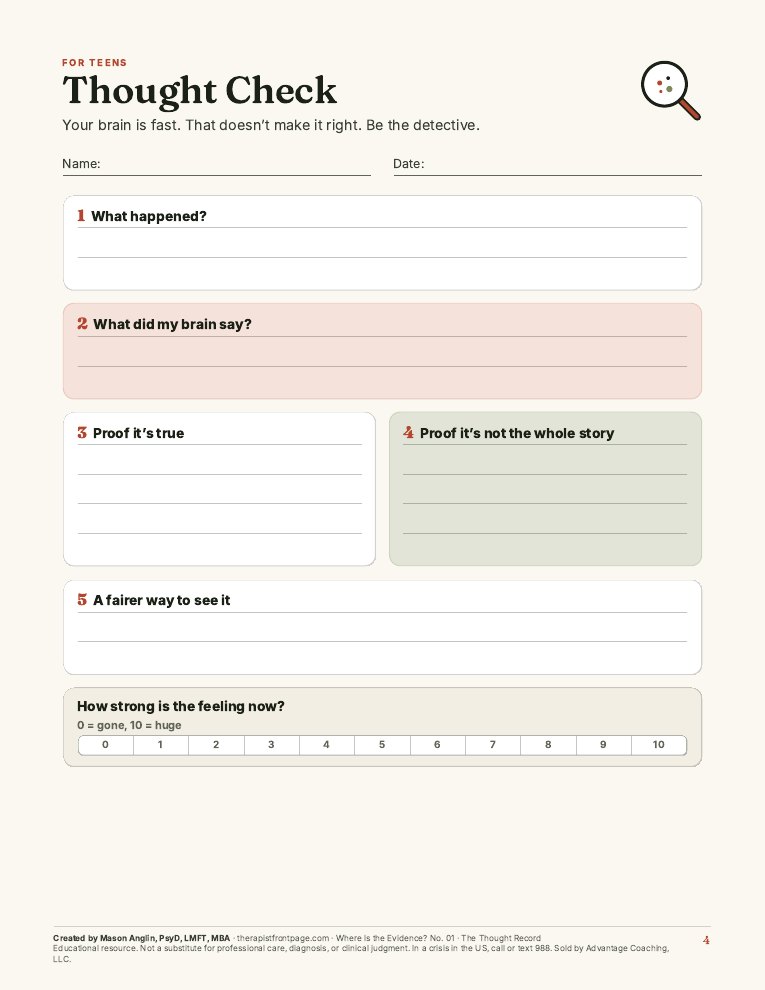
Page 4: Thought Check 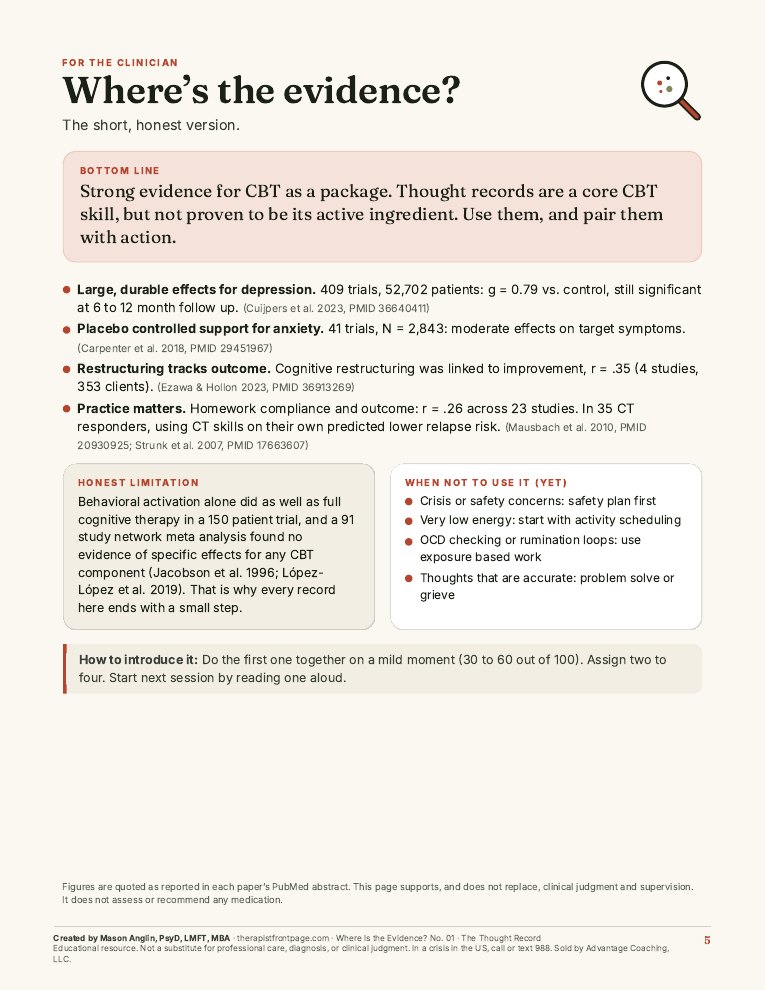
Page 5: Where's the evidence? 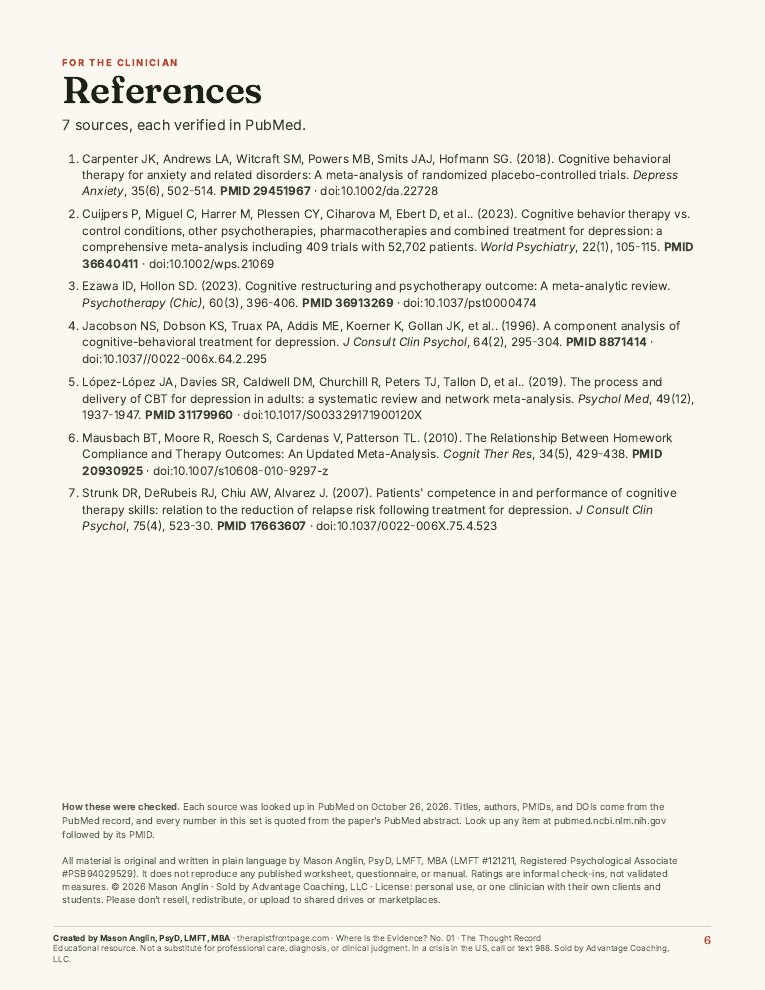
Page 6: References
Where’s the evidence?
Strong evidence for CBT as a package. Thought records are a core CBT skill, but not proven to be its active ingredient. Use them, and pair them with action.
On the worksheet itself
- CBT, which uses thought records, helped depression across 409 trials. (Cuijpers et al. 2023)
- CBT beat placebo for anxiety disorders in 41 trials. (Carpenter et al. 2018)
- Doing the practice between sessions goes with better results. (Mausbach et al. 2010)
On the clinician page
- Large, durable effects for depression. 409 trials, 52,702 patients: g = 0.79 vs. control, still significant at 6 to 12 month follow up. (Cuijpers et al. 2023)
- Placebo controlled support for anxiety. 41 trials, N = 2,843: moderate effects on target symptoms. (Carpenter et al. 2018)
- Restructuring tracks outcome. Cognitive restructuring was linked to improvement, r = .35 (4 studies, 353 clients). (Ezawa & Hollon 2023)
- Practice matters. Homework compliance and outcome: r = .26 across 23 studies. In 35 CT responders, using CT skills on their own predicted lower relapse risk. (Mausbach et al. 2010; Strunk et al. 2007)
Honest limitation
Behavioral activation alone did as well as full cognitive therapy in a 150 patient trial, and a 91 study network meta analysis found no evidence of specific effects for any CBT component (Jacobson et al. 1996; López-López et al. 2019). That is why every record here ends with a small step.
When not to use it (yet)
- Crisis or safety concerns: safety plan first
- Very low energy: start with activity scheduling
- OCD checking or rumination loops: use exposure based work
- Thoughts that are accurate: problem solve or grieve
Figures are quoted as reported in each paper’s PubMed abstract. Every source below was checked in PubMed on October 26, 2026.
References (7 sources, with PMIDs)
- Carpenter JK, Andrews LA, Witcraft SM, et al. (2018). Cognitive behavioral therapy for anxiety and related disorders: A meta-analysis of randomized placebo-controlled trials. Depress Anxiety. PMID 29451967
- Cuijpers P, Miguel C, Harrer M, et al. (2023). Cognitive behavior therapy vs. control conditions, other psychotherapies, pharmacotherapies and combined treatment for depression: a comprehensive meta-analysis including 409 trials with 52,702 patients. World Psychiatry. PMID 36640411
- Ezawa ID, Hollon SD (2023). Cognitive restructuring and psychotherapy outcome: A meta-analytic review. Psychotherapy (Chic). PMID 36913269
- Jacobson NS, Dobson KS, Truax PA, et al. (1996). A component analysis of cognitive-behavioral treatment for depression. J Consult Clin Psychol. PMID 8871414
- López-López JA, Davies SR, Caldwell DM, et al. (2019). The process and delivery of CBT for depression in adults: a systematic review and network meta-analysis. Psychol Med. PMID 31179960
- Mausbach BT, Moore R, Roesch S, et al. (2010). The Relationship Between Homework Compliance and Therapy Outcomes: An Updated Meta-Analysis. Cognit Ther Res. PMID 20930925
- Strunk DR, DeRubeis RJ, Chiu AW, et al. (2007). Patients' competence in and performance of cognitive therapy skills: relation to the reduction of relapse risk following treatment for depression. J Consult Clin Psychol. PMID 17663607
The clinician page
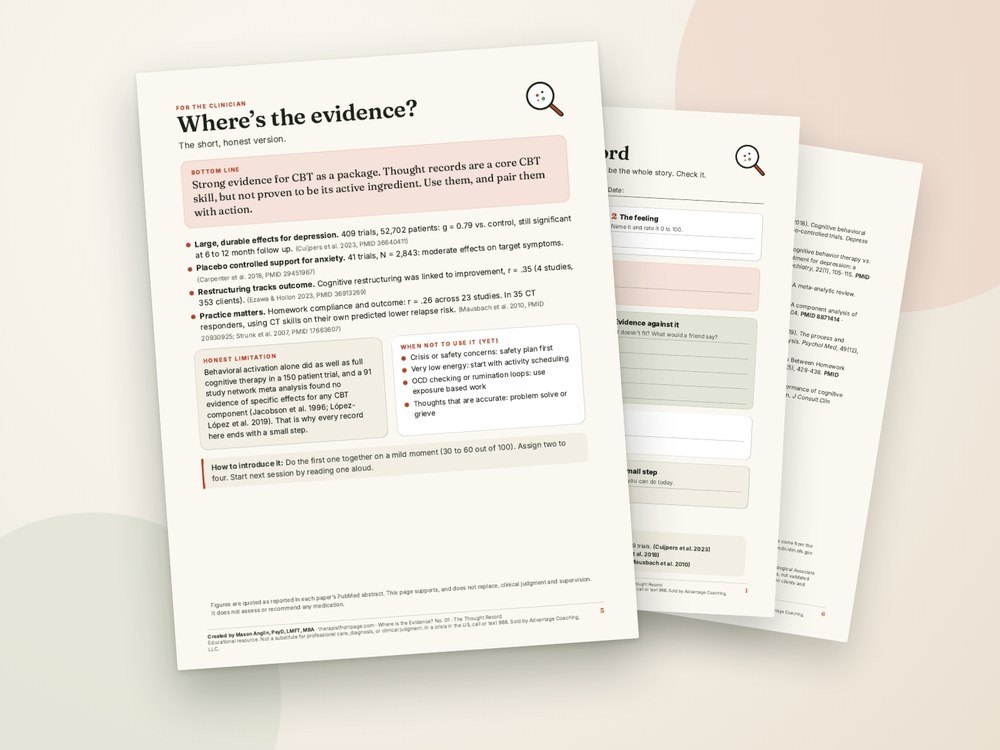
Every worksheet in the series ends with one clinician page and a references page. The numbers come straight from each study’s PubMed abstract, and thin evidence is labeled as thin.
How it’s used
Built for
- Clients working on anxious or low mood
- Therapists, counselors, and coaches
- Teens with an adult's support
- Anyone learning CBT skills
A simple flow
- Catch a moment when your mood shifted
- Write the hottest thought
- Sort the facts for and against
- Write a fairer thought and one small step
License: clinician use included
Clinician use included. Licensed for personal use, or for one clinician to use with their own clients and students. Please don’t resell, redistribute, or upload it to shared drives or marketplaces.
Get The Thought Record
Instant PDF download right after purchase (print and fillable versions). Questions or refunds: contact us. Checkout is by Stripe; the seller on your receipt is Advantage Coaching, LLC.
Mason’s own product; Therapist Front Page earns from these sales.
Created by Mason Anglin, PsyD, LMFT, MBA · LMFT #121211 · Registered Psychological Associate #PSB94029529
Educational, not a substitute for care. In a crisis in the US, call or text 988.