Where Is the Evidence? No. 30
Talk to Yourself Like a Friend
Catch the inner critic, then answer a hard moment the way you would answer a friend.
5 pages · US Letter PDF, print and fillable versions · references with PMIDs
Where’s the evidence? Across 21 randomized trials, compassion based programs improved self-compassion, depression, and anxiety (Kirby 2017).
Instant PDF download right after purchase (print and fillable versions). Questions or refunds: contact us. Checkout is by Stripe; the seller on your receipt is Advantage Coaching, LLC.
Clinician use included. Licensed for personal use, or for one clinician to use with their own clients and students. Please don’t resell, redistribute, or upload it to shared drives or marketplaces.
Mason’s own product; Therapist Front Page earns from these sales.
What’s inside
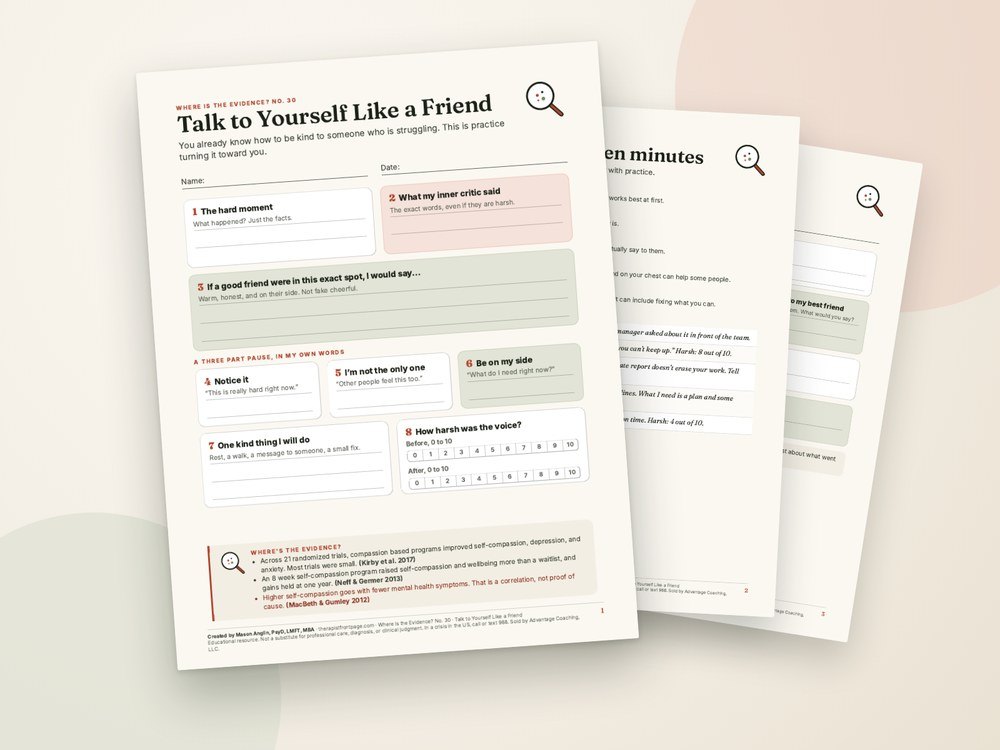
Many people are far harsher with themselves than they would ever be with a friend, and that harsh voice tends to make hard moments heavier. This worksheet helps clients catch what the inner critic says, write what they would say to a friend in the same spot, and turn it into a short three part pause and one kind action. A short strip on the page shows the research on compassion based approaches. Includes a how-to with a worked example, a teen version, and one honest clinician evidence page with PubMed references.
- One page self compassion worksheet with the evidence printed on it
- How-to plus a short worked example
- Teen page: the friend test
- Clinician page: evidence, honest limits, when not to use
- References with PMIDs and DOIs
All 5 pages, and who each is for
- Talk to Yourself Like a Friend · Client
- Five steps, about ten minutes · Client
- The friend test · Client
- Where's the evidence? · Clinician
- References · Clinician
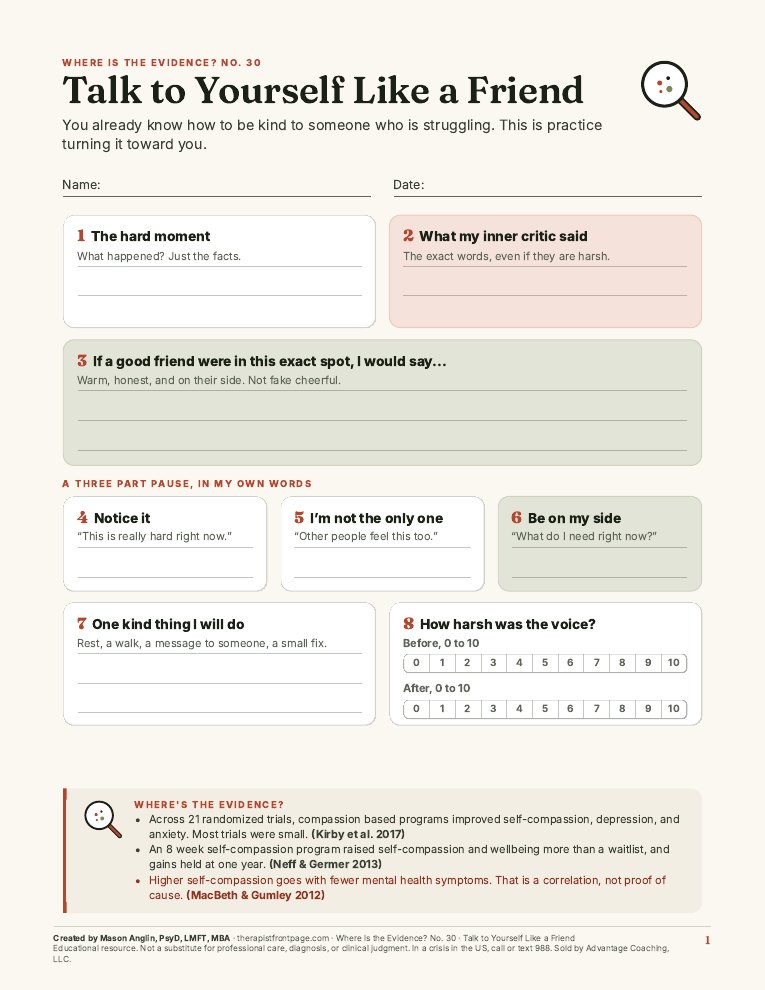
Page 1: Talk to Yourself Like a Friend 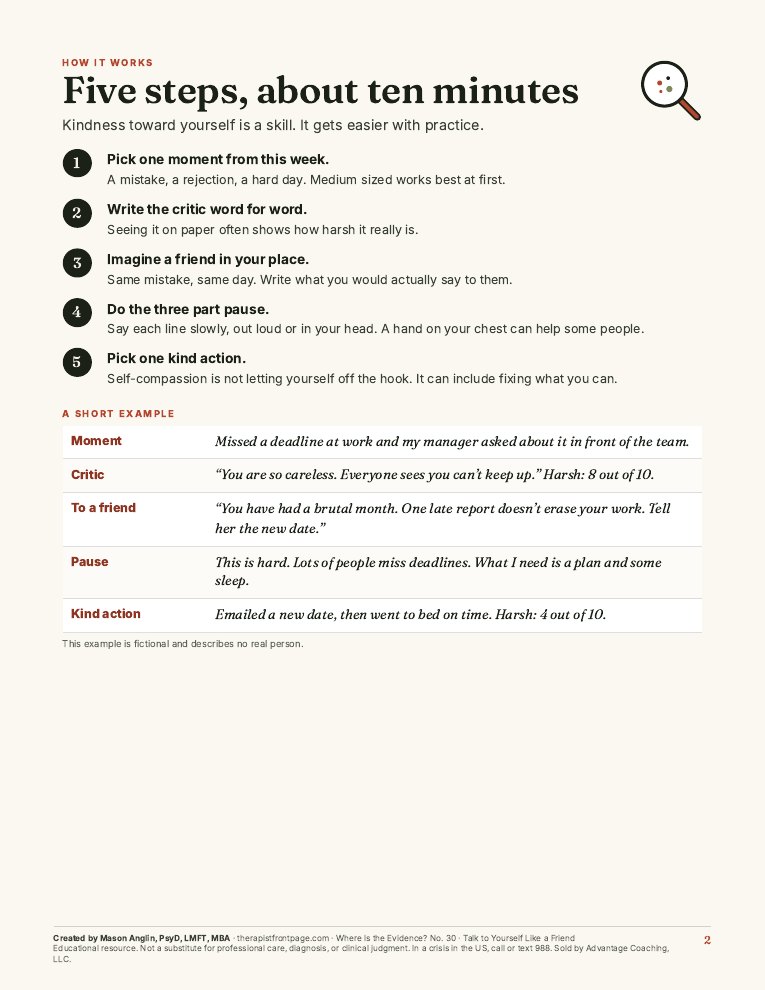
Page 2: Five steps, about ten minutes 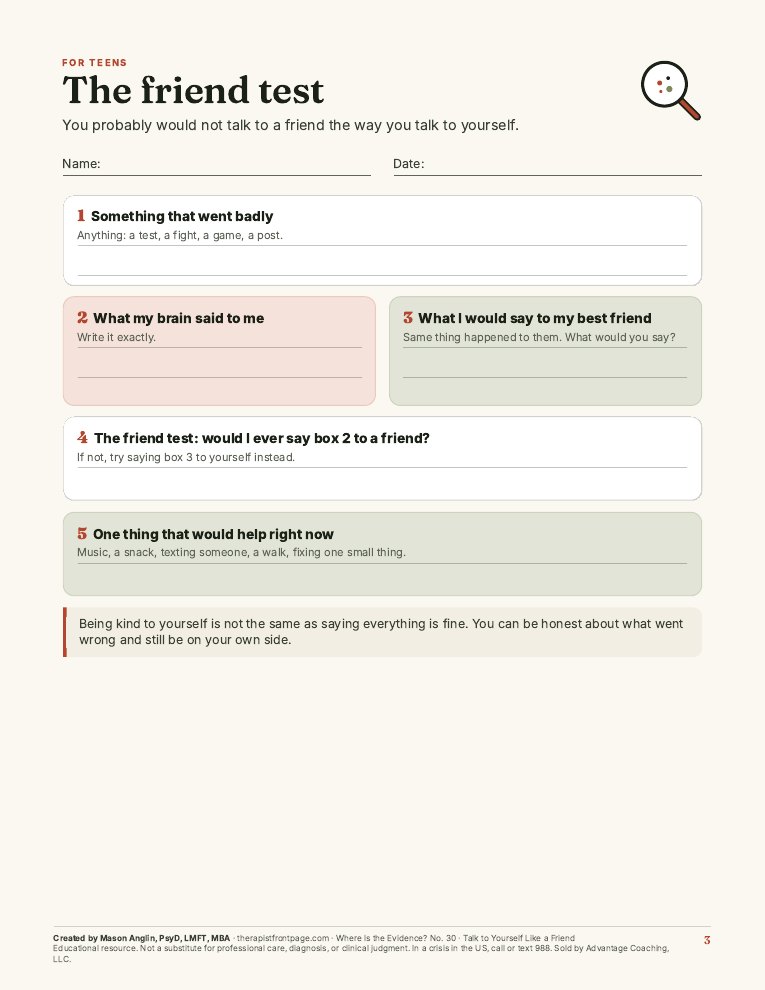
Page 3: The friend test 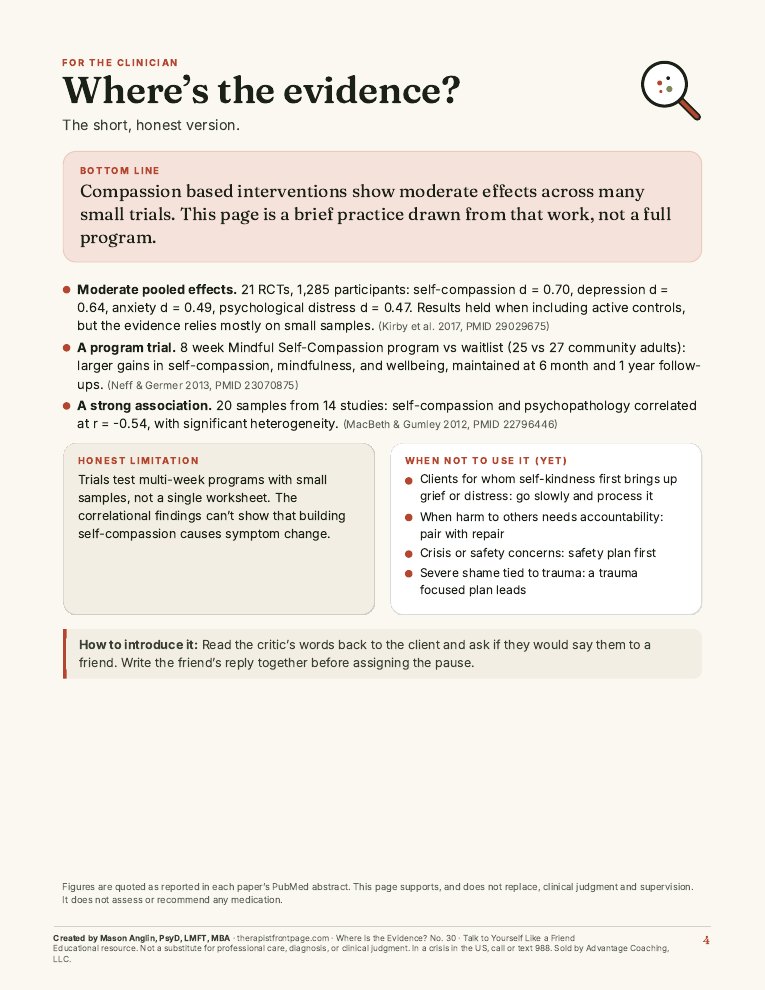
Page 4: Where's the evidence? 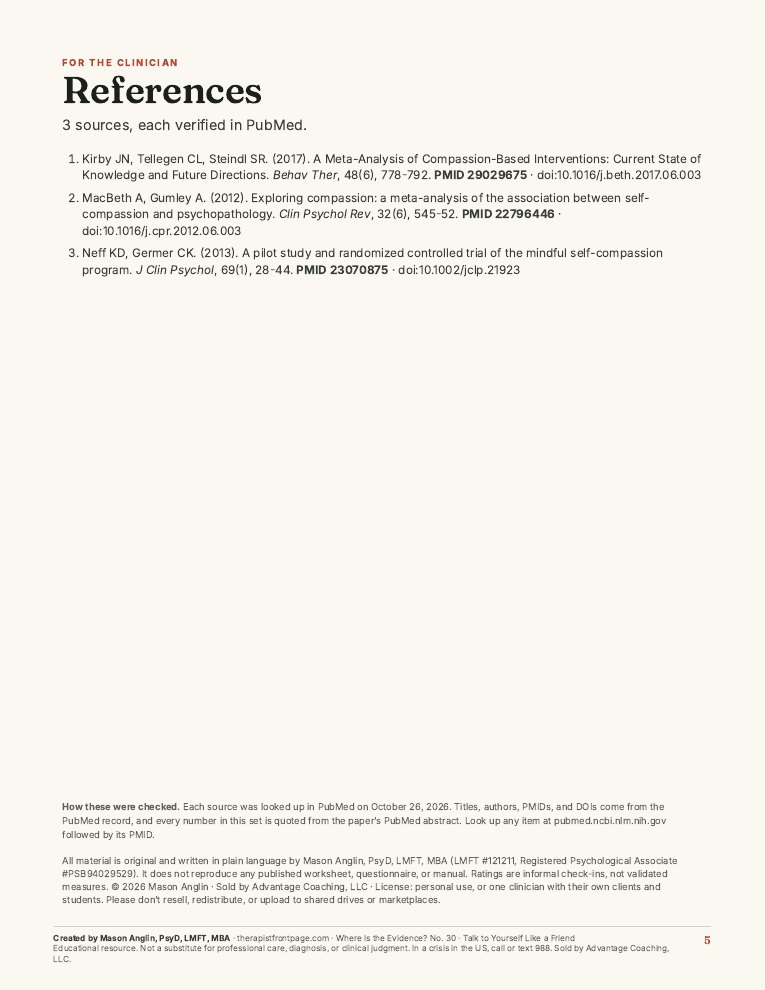
Page 5: References
Where’s the evidence?
Compassion based interventions show moderate effects across many small trials. This page is a brief practice drawn from that work, not a full program.
On the worksheet itself
- Across 21 randomized trials, compassion based programs improved self-compassion, depression, and anxiety. Most trials were small. (Kirby et al. 2017)
- An 8 week self-compassion program raised self-compassion and wellbeing more than a waitlist, and gains held at one year. (Neff & Germer 2013)
- Higher self-compassion goes with fewer mental health symptoms. That is a correlation, not proof of cause. (MacBeth & Gumley 2012)
On the clinician page
- Moderate pooled effects. 21 RCTs, 1,285 participants: self-compassion d = 0.70, depression d = 0.64, anxiety d = 0.49, psychological distress d = 0.47. Results held when including active controls, but the evidence relies mostly on small samples. (Kirby et al. 2017)
- A program trial. 8 week Mindful Self-Compassion program vs waitlist (25 vs 27 community adults): larger gains in self-compassion, mindfulness, and wellbeing, maintained at 6 month and 1 year follow-ups. (Neff & Germer 2013)
- A strong association. 20 samples from 14 studies: self-compassion and psychopathology correlated at r = -0.54, with significant heterogeneity. (MacBeth & Gumley 2012)
Honest limitation
Trials test multi-week programs with small samples, not a single worksheet. The correlational findings can’t show that building self-compassion causes symptom change.
When not to use it (yet)
- Clients for whom self-kindness first brings up grief or distress: go slowly and process it
- When harm to others needs accountability: pair with repair
- Crisis or safety concerns: safety plan first
- Severe shame tied to trauma: a trauma focused plan leads
Figures are quoted as reported in each paper’s PubMed abstract. Every source below was checked in PubMed on October 26, 2026.
References (3 sources, with PMIDs)
- Kirby JN, Tellegen CL, Steindl SR (2017). A Meta-Analysis of Compassion-Based Interventions: Current State of Knowledge and Future Directions. Behav Ther. PMID 29029675
- MacBeth A, Gumley A (2012). Exploring compassion: a meta-analysis of the association between self-compassion and psychopathology. Clin Psychol Rev. PMID 22796446
- Neff KD, Germer CK (2013). A pilot study and randomized controlled trial of the mindful self-compassion program. J Clin Psychol. PMID 23070875
The clinician page
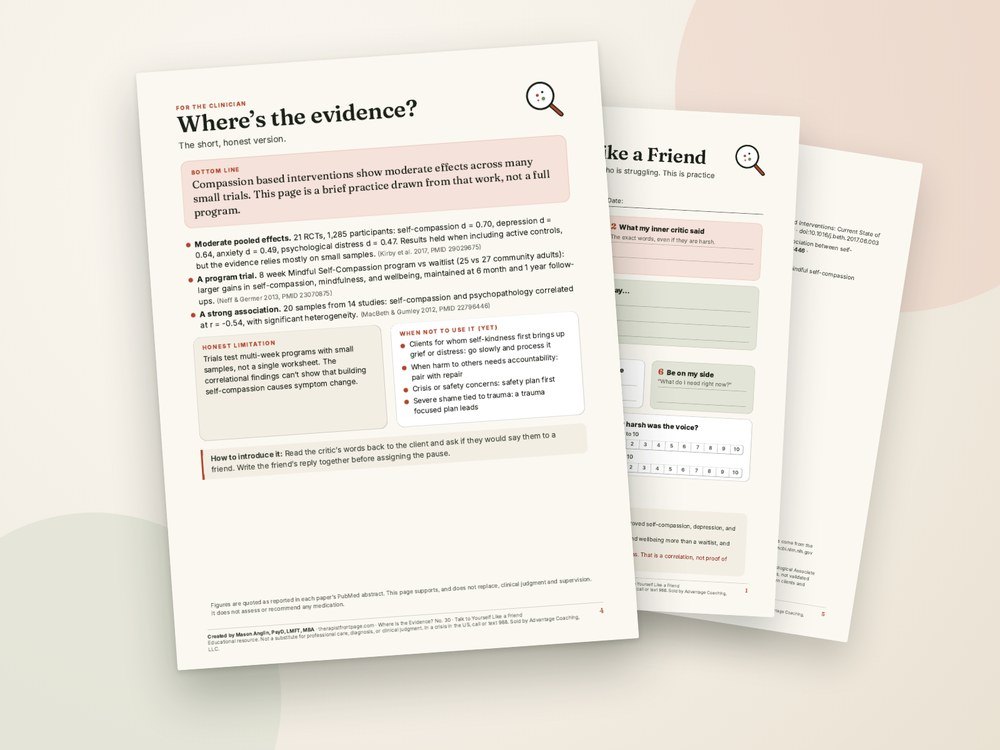
Every worksheet in the series ends with one clinician page and a references page. The numbers come straight from each study’s PubMed abstract, and thin evidence is labeled as thin.
How it’s used
Built for
- Adults and teens with harsh self-criticism
- Clients with depression, anxiety, or shame
- Therapists, counselors, and coaches
- Group skills sessions
A simple flow
- Name the hard moment
- Write what the critic said
- Write what you would tell a friend
- Pause, then take one kind step
License: clinician use included
Clinician use included. Licensed for personal use, or for one clinician to use with their own clients and students. Please don’t resell, redistribute, or upload it to shared drives or marketplaces.
Get Talk to Yourself Like a Friend
Instant PDF download right after purchase (print and fillable versions). Questions or refunds: contact us. Checkout is by Stripe; the seller on your receipt is Advantage Coaching, LLC.
Mason’s own product; Therapist Front Page earns from these sales.
Created by Mason Anglin, PsyD, LMFT, MBA · LMFT #121211 · Registered Psychological Associate #PSB94029529
Educational, not a substitute for care. In a crisis in the US, call or text 988.