Where Is the Evidence? No. 27
The Panic Cycle
Map how body sensations and scary thoughts feed each other, then practice the sensations on purpose.
5 pages · US Letter PDF, print and fillable versions · references with PMIDs
Where’s the evidence? Across 136 trials, CBT was one of the best supported therapies for panic and held up in the low bias trials (Papola 2022).
Instant PDF download right after purchase (print and fillable versions). Questions or refunds: contact us. Checkout is by Stripe; the seller on your receipt is Advantage Coaching, LLC.
Clinician use included. Licensed for personal use, or for one clinician to use with their own clients and students. Please don’t resell, redistribute, or upload it to shared drives or marketplaces.
Mason’s own product; Therapist Front Page earns from these sales.
What’s inside
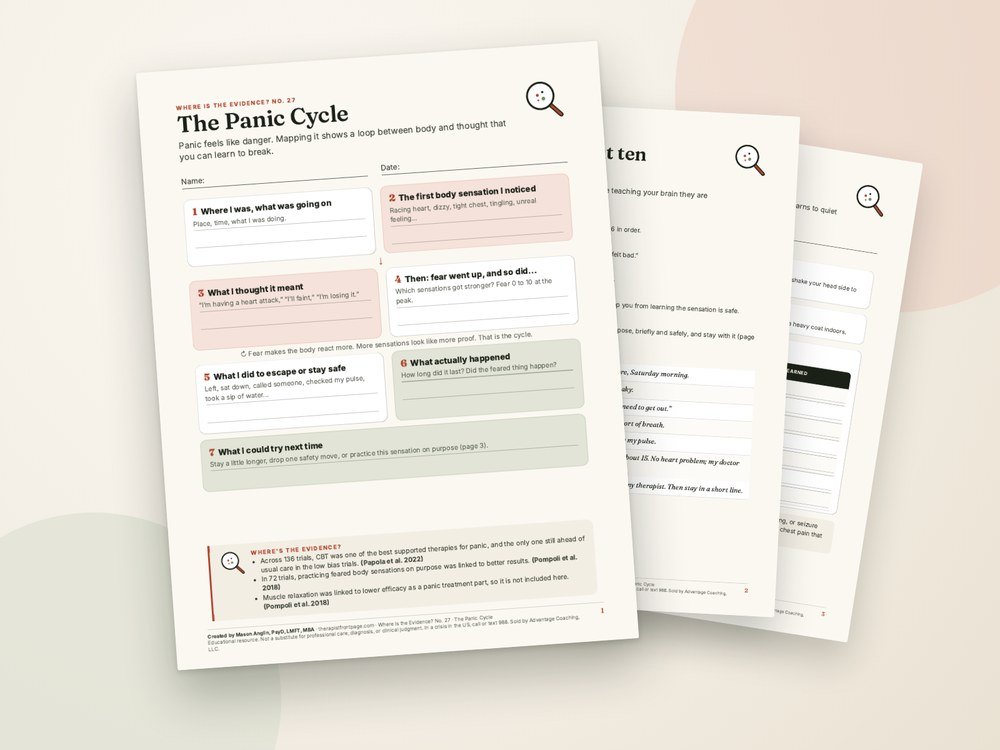
A panic attack often starts with an ordinary body sensation that gets read as danger, which makes fear and sensations climb together. This worksheet helps clients map their own panic cycle from a recent attack, spot the escape moves that keep it going, and log short, planned practice with the feared sensations. A short strip on the page shows the research on CBT for panic. Includes a how-to with a worked example, a sensation practice log, and one honest clinician evidence page with PubMed references.
- One page panic cycle worksheet with the evidence printed on it
- How-to plus a short worked example
- Sensation practice log with a medical safety note
- Clinician page: evidence, honest limits, when not to use
- References with PMIDs and DOIs
All 5 pages, and who each is for
- The Panic Cycle · Client
- Seven boxes, about ten minutes · Client
- Feel it on purpose · Client
- Where's the evidence? · Clinician
- References · Clinician
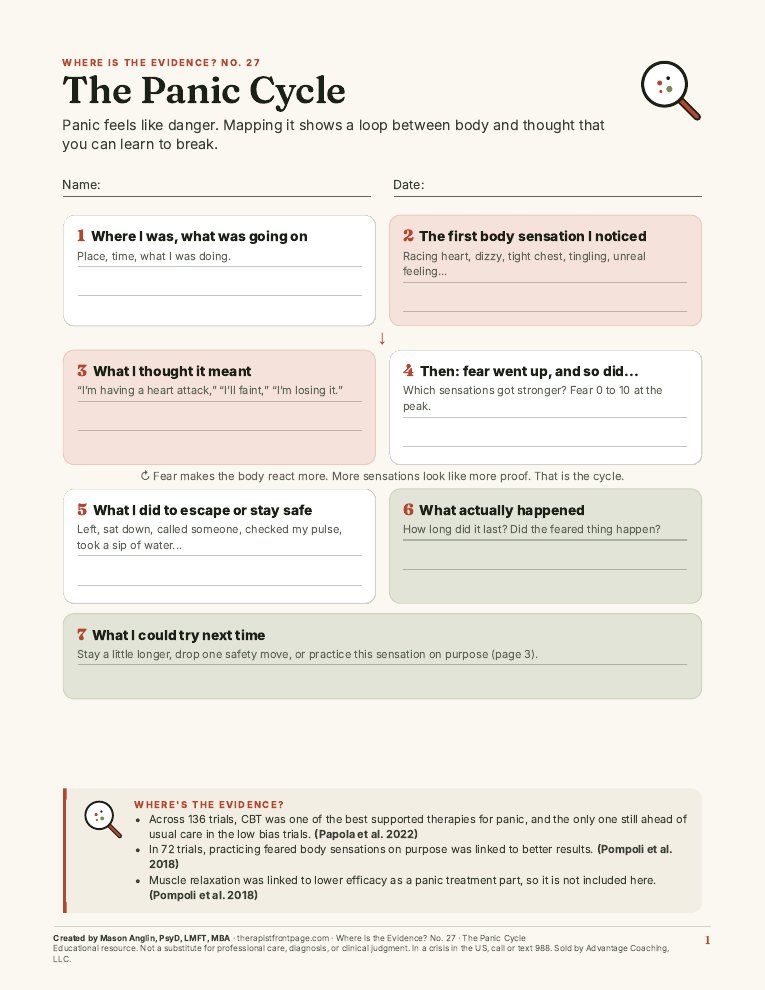
Page 1: The Panic Cycle 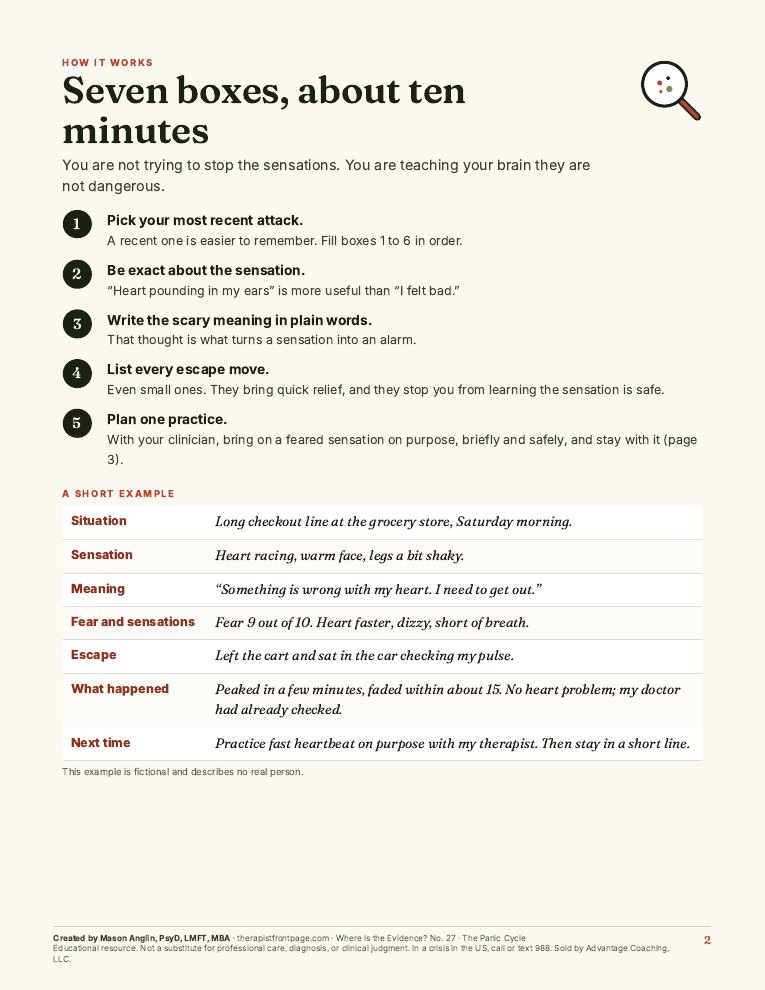
Page 2: Seven boxes, about ten minutes 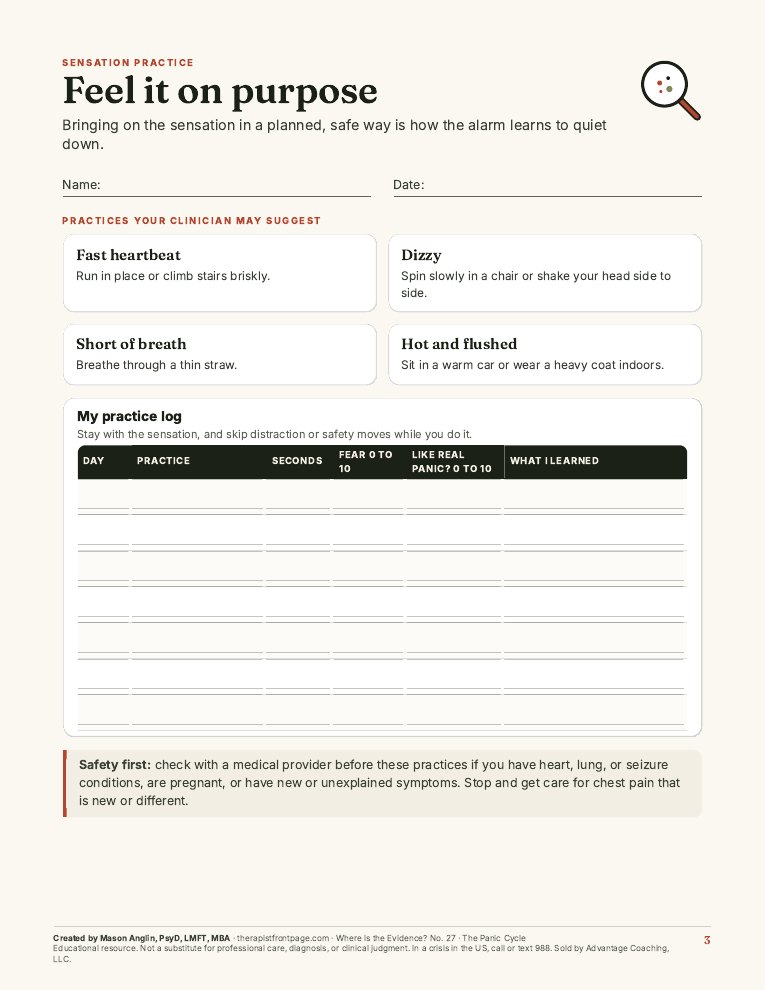
Page 3: Feel it on purpose 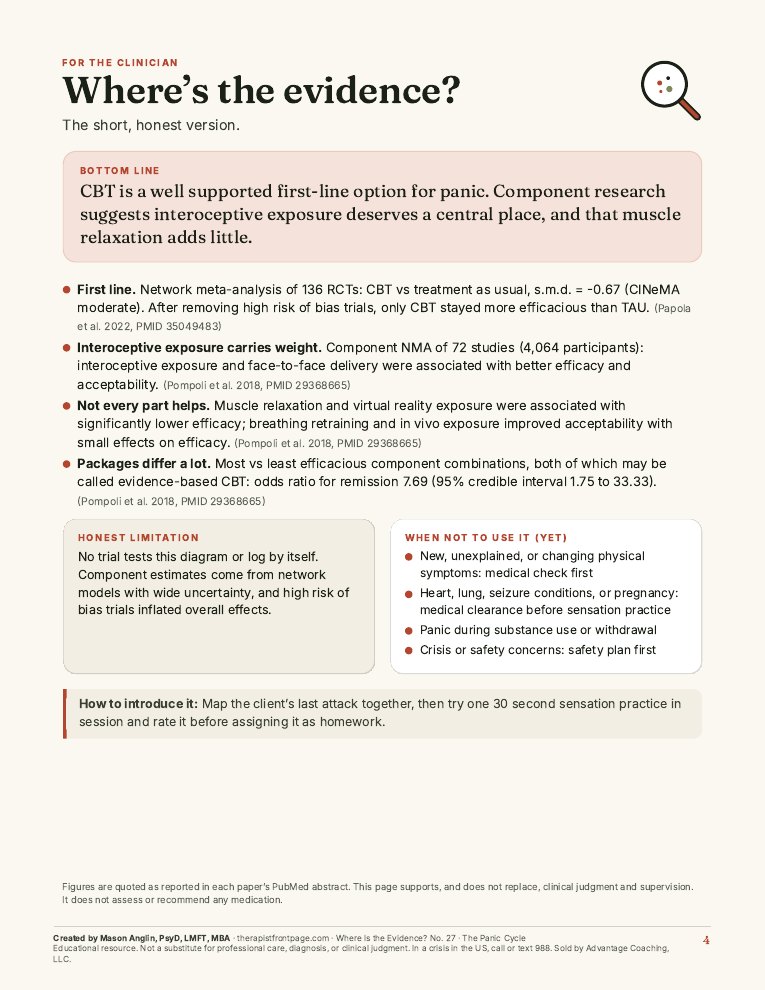
Page 4: Where's the evidence? 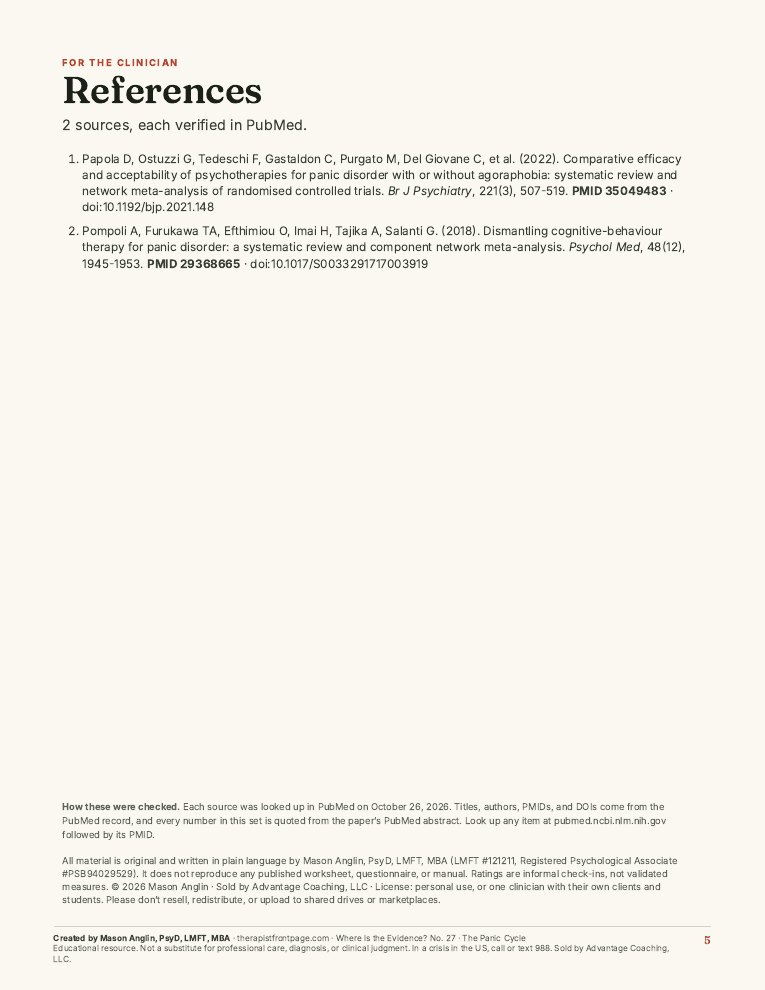
Page 5: References
Where’s the evidence?
CBT is a well supported first-line option for panic. Component research suggests interoceptive exposure deserves a central place, and that muscle relaxation adds little.
On the worksheet itself
- Across 136 trials, CBT was one of the best supported therapies for panic, and the only one still ahead of usual care in the low bias trials. (Papola et al. 2022)
- In 72 trials, practicing feared body sensations on purpose was linked to better results. (Pompoli et al. 2018)
- Muscle relaxation was linked to lower efficacy as a panic treatment part, so it is not included here. (Pompoli et al. 2018)
On the clinician page
- First line. Network meta-analysis of 136 RCTs: CBT vs treatment as usual, s.m.d. = -0.67 (CINeMA moderate). After removing high risk of bias trials, only CBT stayed more efficacious than TAU. (Papola et al. 2022)
- Interoceptive exposure carries weight. Component NMA of 72 studies (4,064 participants): interoceptive exposure and face-to-face delivery were associated with better efficacy and acceptability. (Pompoli et al. 2018)
- Not every part helps. Muscle relaxation and virtual reality exposure were associated with significantly lower efficacy; breathing retraining and in vivo exposure improved acceptability with small effects on efficacy. (Pompoli et al. 2018)
- Packages differ a lot. Most vs least efficacious component combinations, both of which may be called evidence-based CBT: odds ratio for remission 7.69 (95% credible interval 1.75 to 33.33). (Pompoli et al. 2018)
Honest limitation
No trial tests this diagram or log by itself. Component estimates come from network models with wide uncertainty, and high risk of bias trials inflated overall effects.
When not to use it (yet)
- New, unexplained, or changing physical symptoms: medical check first
- Heart, lung, seizure conditions, or pregnancy: medical clearance before sensation practice
- Panic during substance use or withdrawal
- Crisis or safety concerns: safety plan first
Figures are quoted as reported in each paper’s PubMed abstract. Every source below was checked in PubMed on October 26, 2026.
References (2 sources, with PMIDs)
- Papola D, Ostuzzi G, Tedeschi F, et al. (2022). Comparative efficacy and acceptability of psychotherapies for panic disorder with or without agoraphobia: systematic review and network meta-analysis of randomised controlled trials. Br J Psychiatry. PMID 35049483
- Pompoli A, Furukawa TA, Efthimiou O, et al. (2018). Dismantling cognitive-behaviour therapy for panic disorder: a systematic review and component network meta-analysis. Psychol Med. PMID 29368665
The clinician page
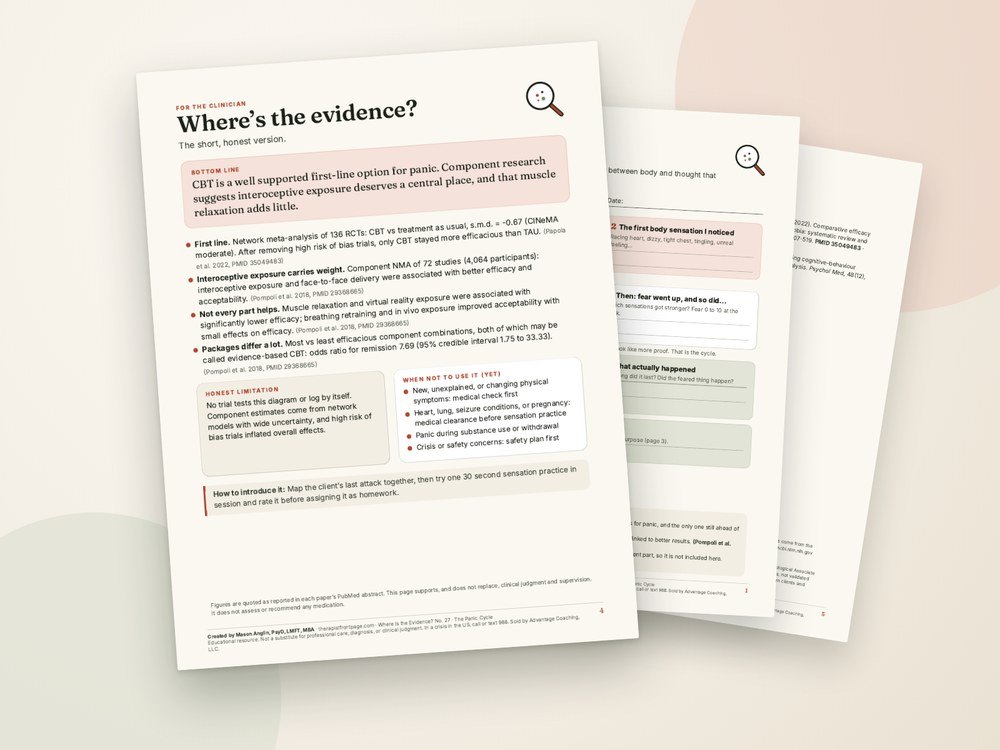
Every worksheet in the series ends with one clinician page and a references page. The numbers come straight from each study’s PubMed abstract, and thin evidence is labeled as thin.
How it’s used
Built for
- Adults with panic attacks or fear of body sensations
- Therapists, counselors, and coaches
- Older teens with an adult's support
- Primary care behavioral health
A simple flow
- Map the sensation and the scary thought
- Notice how fear and sensations feed each other
- Name the escape moves
- Practice the sensations on purpose
License: clinician use included
Clinician use included. Licensed for personal use, or for one clinician to use with their own clients and students. Please don’t resell, redistribute, or upload it to shared drives or marketplaces.
Get The Panic Cycle
Instant PDF download right after purchase (print and fillable versions). Questions or refunds: contact us. Checkout is by Stripe; the seller on your receipt is Advantage Coaching, LLC.
Mason’s own product; Therapist Front Page earns from these sales.
Created by Mason Anglin, PsyD, LMFT, MBA · LMFT #121211 · Registered Psychological Associate #PSB94029529
Educational, not a substitute for care. In a crisis in the US, call or text 988.