Where Is the Evidence? No. 11
Back to the Room: Grounding
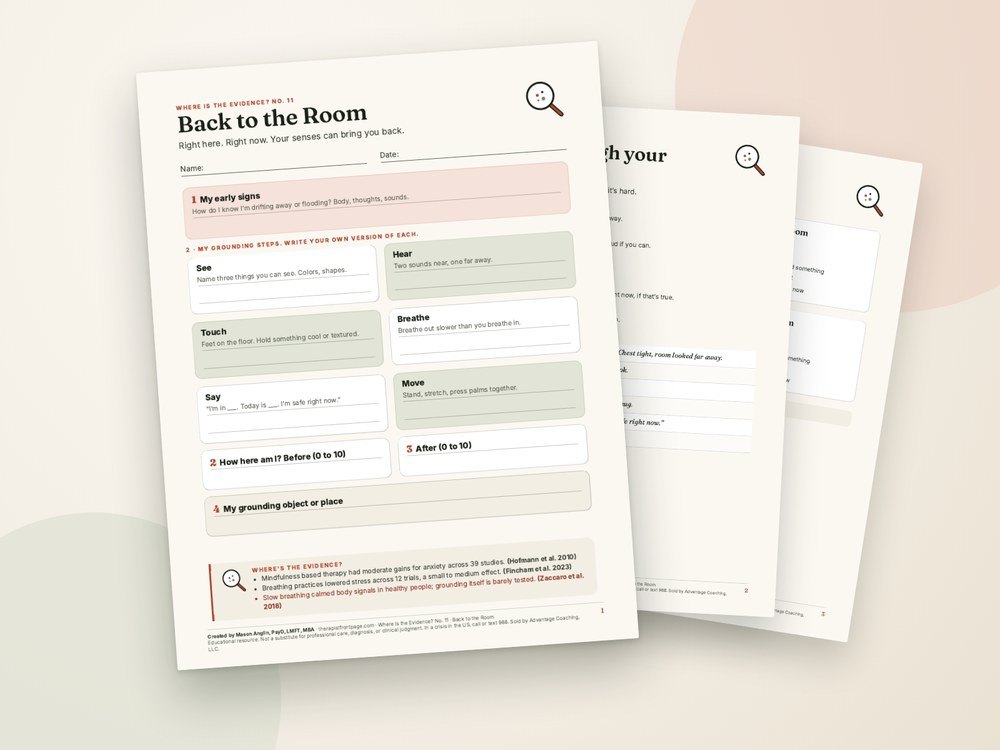
A one page grounding plan for when you feel far away, flooded, or stuck in the past.
6 pages · US Letter PDF, print and fillable versions · references with PMIDs
Where’s the evidence? Mindfulness based therapy showed moderate gains for anxiety across 39 studies (Hofmann 2010).
Instant PDF download right after purchase (print and fillable versions). Questions or refunds: contact us. Checkout is by Stripe; the seller on your receipt is Advantage Coaching, LLC.
Clinician use included. Licensed for personal use, or for one clinician to use with their own clients and students. Please don’t resell, redistribute, or upload it to shared drives or marketplaces.
Mason’s own product; Therapist Front Page earns from these sales.
What’s inside
When you feel far away, flooded, or pulled into the past, grounding brings you back to right here, right now. This one page plan helps you build your own senses, body, and words steps. The evidence strip is honest: the ideas borrow from mindfulness and breathing research, and specific grounding exercises have little direct testing.
- One page grounding plan with the evidence printed on it
- How-to plus a short worked example
- Pocket cards
- Teen page: Come Back to Now
- Clinician page: evidence, honest limits, when not to use
- References with PMIDs and DOIs
All 6 pages, and who each is for
- Back to the Room · Client
- Come back through your senses · Client
- Pocket cards · Client
- Come Back to Now · Client
- Where's the evidence? · Clinician
- References · Clinician
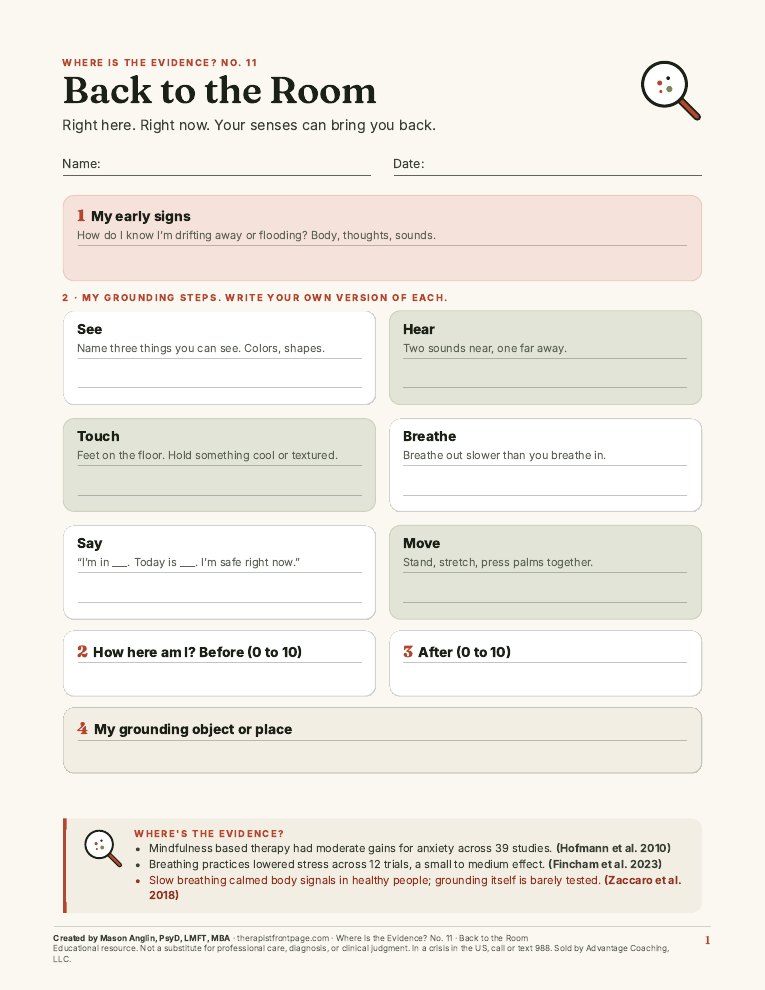
Page 1: Back to the Room 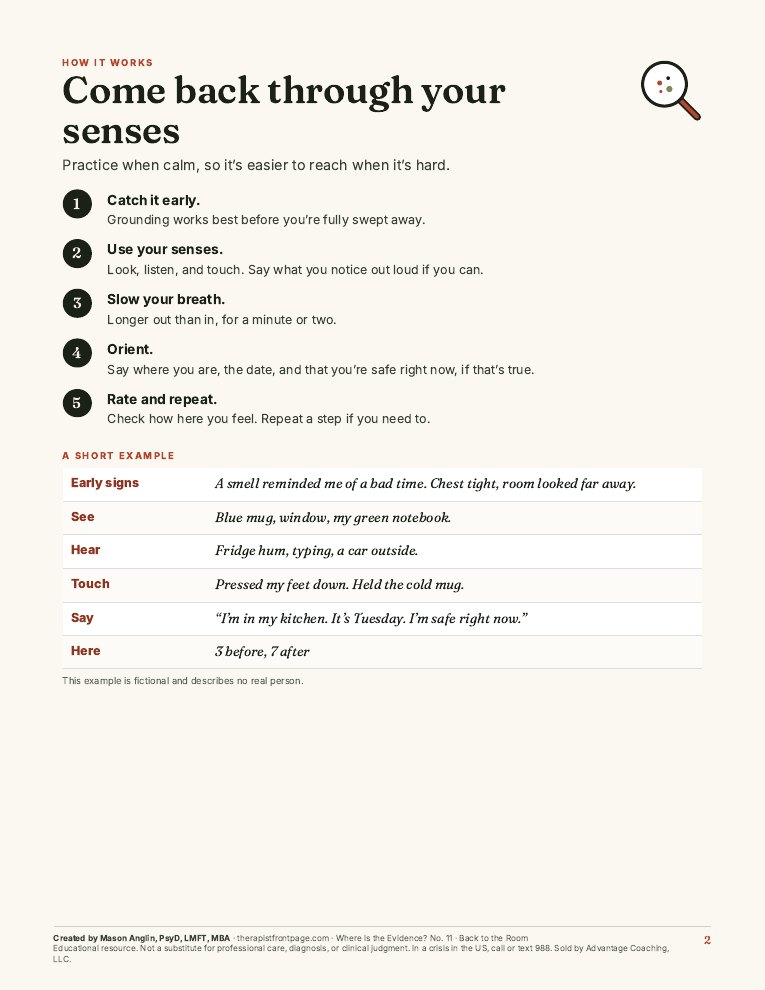
Page 2: Come back through your senses 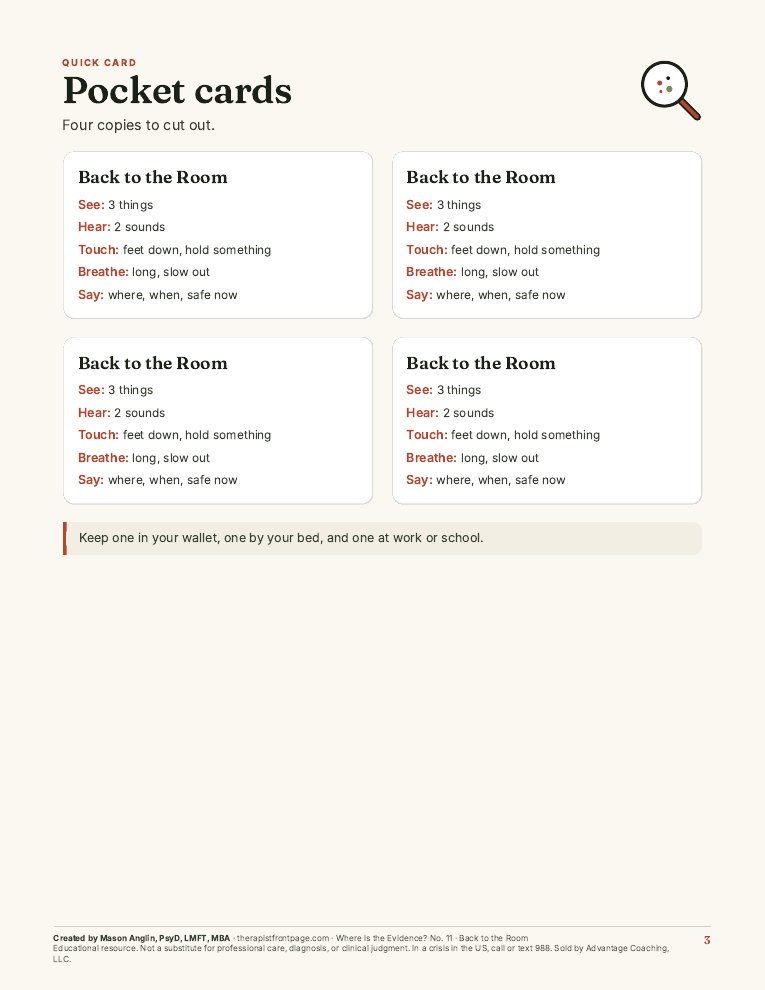
Page 3: Pocket cards 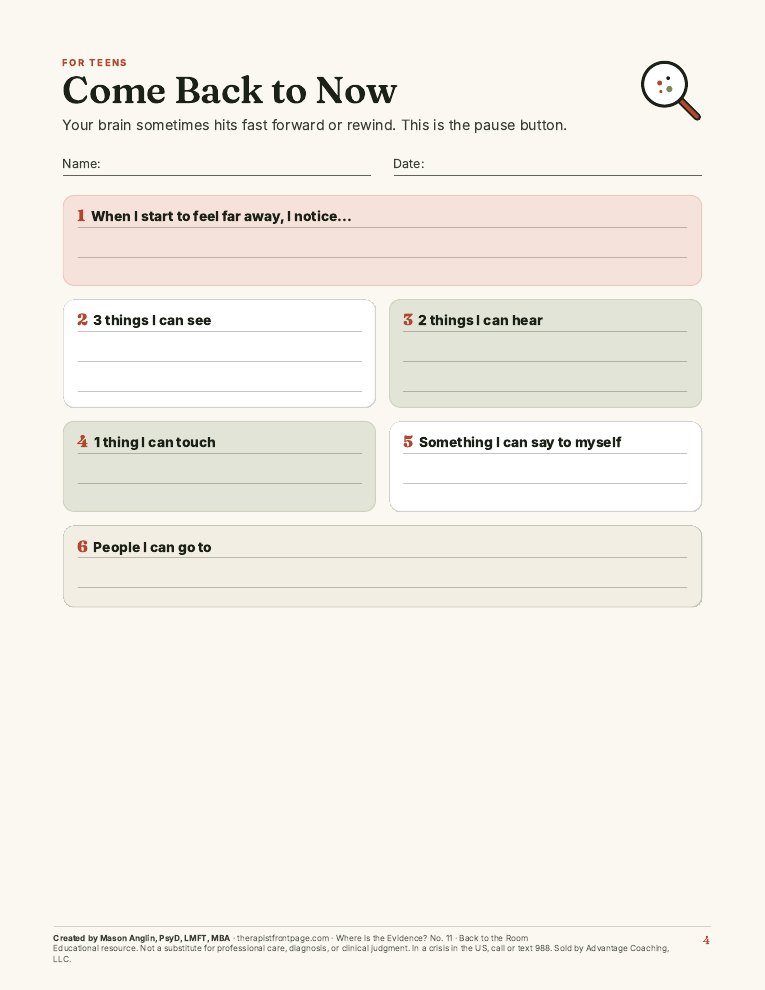
Page 4: Come Back to Now 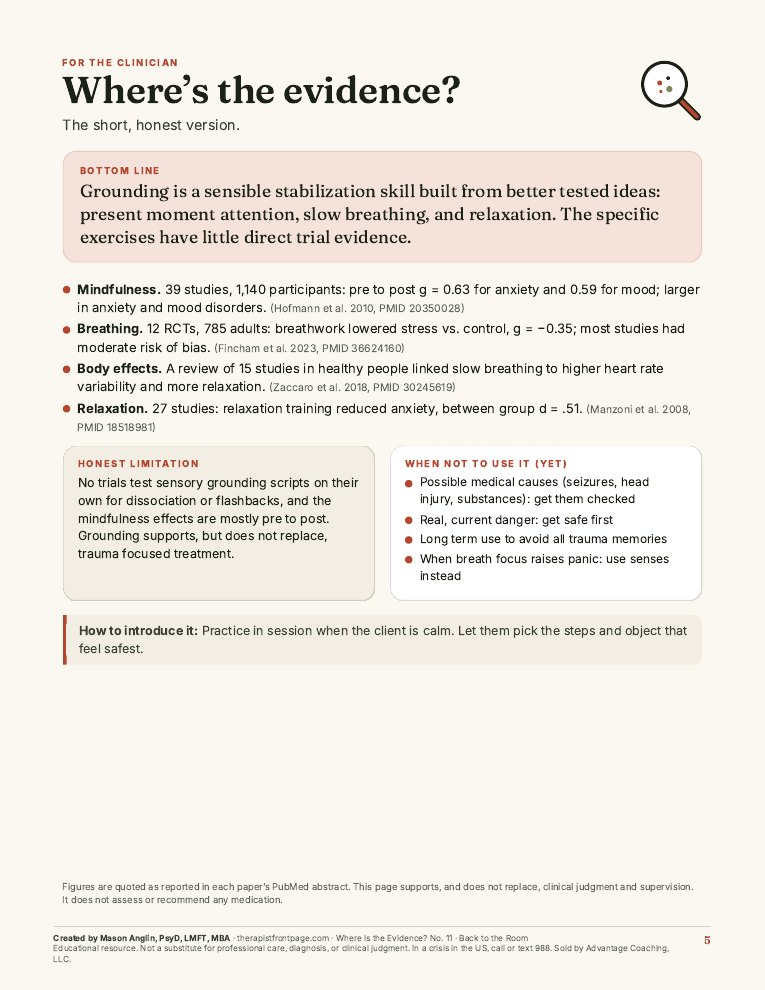
Page 5: Where's the evidence? 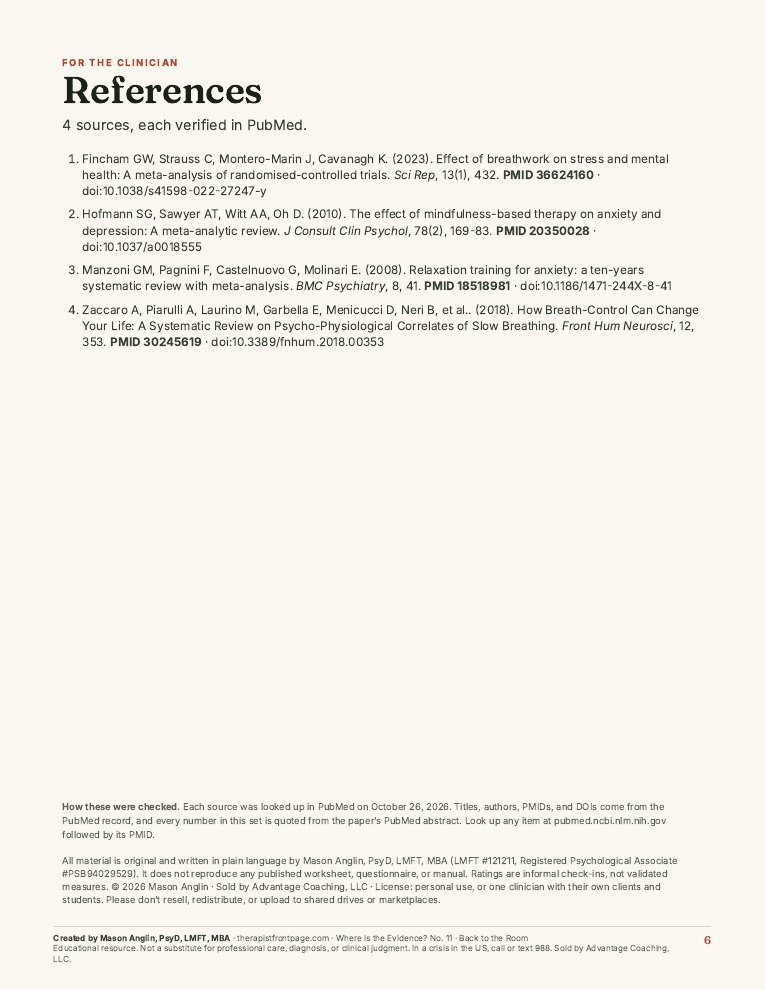
Page 6: References
Where’s the evidence?
Grounding is a sensible stabilization skill built from better tested ideas: present moment attention, slow breathing, and relaxation. The specific exercises have little direct trial evidence.
On the worksheet itself
- Mindfulness based therapy had moderate gains for anxiety across 39 studies. (Hofmann et al. 2010)
- Breathing practices lowered stress across 12 trials, a small to medium effect. (Fincham et al. 2023)
- Slow breathing calmed body signals in healthy people; grounding itself is barely tested. (Zaccaro et al. 2018)
On the clinician page
- Mindfulness. 39 studies, 1,140 participants: pre to post g = 0.63 for anxiety and 0.59 for mood; larger in anxiety and mood disorders. (Hofmann et al. 2010)
- Breathing. 12 RCTs, 785 adults: breathwork lowered stress vs. control, g = −0.35; most studies had moderate risk of bias. (Fincham et al. 2023)
- Body effects. A review of 15 studies in healthy people linked slow breathing to higher heart rate variability and more relaxation. (Zaccaro et al. 2018)
- Relaxation. 27 studies: relaxation training reduced anxiety, between group d = .51. (Manzoni et al. 2008)
Honest limitation
No trials test sensory grounding scripts on their own for dissociation or flashbacks, and the mindfulness effects are mostly pre to post. Grounding supports, but does not replace, trauma focused treatment.
When not to use it (yet)
- Possible medical causes (seizures, head injury, substances): get them checked
- Real, current danger: get safe first
- Long term use to avoid all trauma memories
- When breath focus raises panic: use senses instead
Figures are quoted as reported in each paper’s PubMed abstract. Every source below was checked in PubMed on October 26, 2026.
References (4 sources, with PMIDs)
- Fincham GW, Strauss C, Montero-Marin J, et al. (2023). Effect of breathwork on stress and mental health: A meta-analysis of randomised-controlled trials. Sci Rep. PMID 36624160
- Hofmann SG, Sawyer AT, Witt AA, et al. (2010). The effect of mindfulness-based therapy on anxiety and depression: A meta-analytic review. J Consult Clin Psychol. PMID 20350028
- Manzoni GM, Pagnini F, Castelnuovo G, et al. (2008). Relaxation training for anxiety: a ten-years systematic review with meta-analysis. BMC Psychiatry. PMID 18518981
- Zaccaro A, Piarulli A, Laurino M, et al. (2018). How Breath-Control Can Change Your Life: A Systematic Review on Psycho-Physiological Correlates of Slow Breathing. Front Hum Neurosci. PMID 30245619
The clinician page
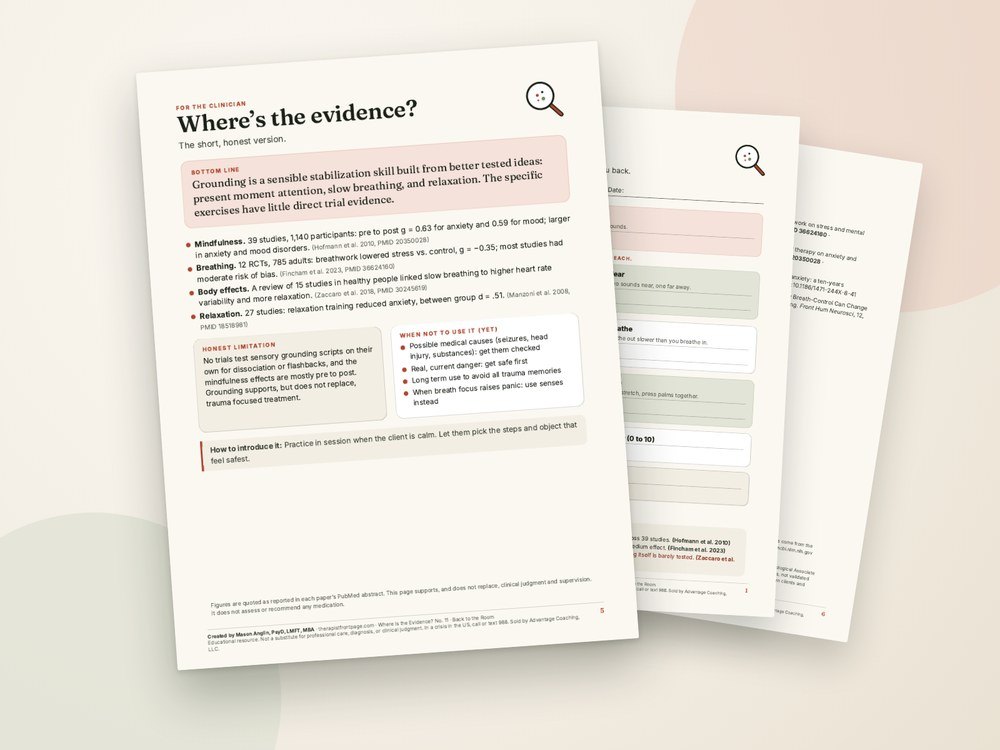
Every worksheet in the series ends with one clinician page and a references page. The numbers come straight from each study’s PubMed abstract, and thin evidence is labeled as thin.
How it’s used
Built for
- Clients with anxiety, panic, or trauma reminders
- Trauma informed therapists
- Teens and adults
- School and group settings
A simple flow
- Notice the early signs
- Use your senses
- Use your body and breath
- Say where and when you are
License: clinician use included
Clinician use included. Licensed for personal use, or for one clinician to use with their own clients and students. Please don’t resell, redistribute, or upload it to shared drives or marketplaces.
Get Back to the Room: Grounding
Instant PDF download right after purchase (print and fillable versions). Questions or refunds: contact us. Checkout is by Stripe; the seller on your receipt is Advantage Coaching, LLC.
Mason’s own product; Therapist Front Page earns from these sales.
Created by Mason Anglin, PsyD, LMFT, MBA · LMFT #121211 · Registered Psychological Associate #PSB94029529
Educational, not a substitute for care. In a crisis in the US, call or text 988.