Where Is the Evidence? No. 25
Formulation on One Page
A one page case formulation sheet for clinicians and supervisees, with honest evidence.
5 pages · US Letter PDF, print and fillable versions · references with PMIDs
Where’s the evidence? Only 44% of formulations were rated good enough in a 115 clinician study (Kuyken 2005). Outcome links are unproven (Easden 2018).
Instant PDF download right after purchase (print and fillable versions). Questions or refunds: contact us. Checkout is by Stripe; the seller on your receipt is Advantage Coaching, LLC.
Clinician use included. Licensed for personal use, or for one clinician to use with their own clients and students. Please don’t resell, redistribute, or upload it to shared drives or marketplaces.
Mason’s own product; Therapist Front Page earns from these sales.
What’s inside
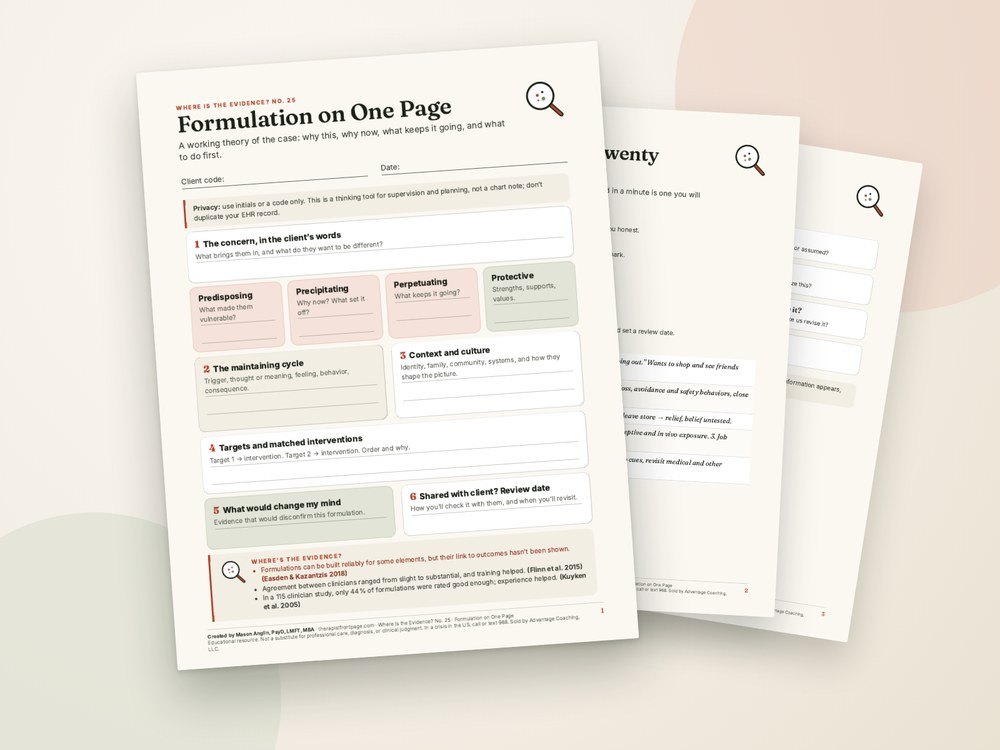
A good formulation turns a pile of intake notes into a working theory you can test. This one page sheet for clinicians and supervisees covers the presenting concern in the client’s words, the 5 Ps, the maintaining cycle, strengths and context, and treatment targets matched to interventions, plus a line for what would change your mind. The evidence strip is honest: formulation reliability varies and its link to outcomes has not been shown, which is exactly why it helps to write it down and test it. Includes a how-to with a fictional worked example, a supervision question card, and a clinician evidence page with PubMed references.
- One page case formulation sheet with the evidence printed on it
- How-to plus a fictional worked example
- Quick card: supervision questions to test a formulation
- Evidence page: reliability, quality, and outcomes, honestly
- References with PMIDs and DOIs
All 5 pages, and who each is for
- Formulation on One Page · Client
- Five steps, about twenty minutes · Client
- Test the formulation · Client
- Where's the evidence? · Clinician
- References · Clinician
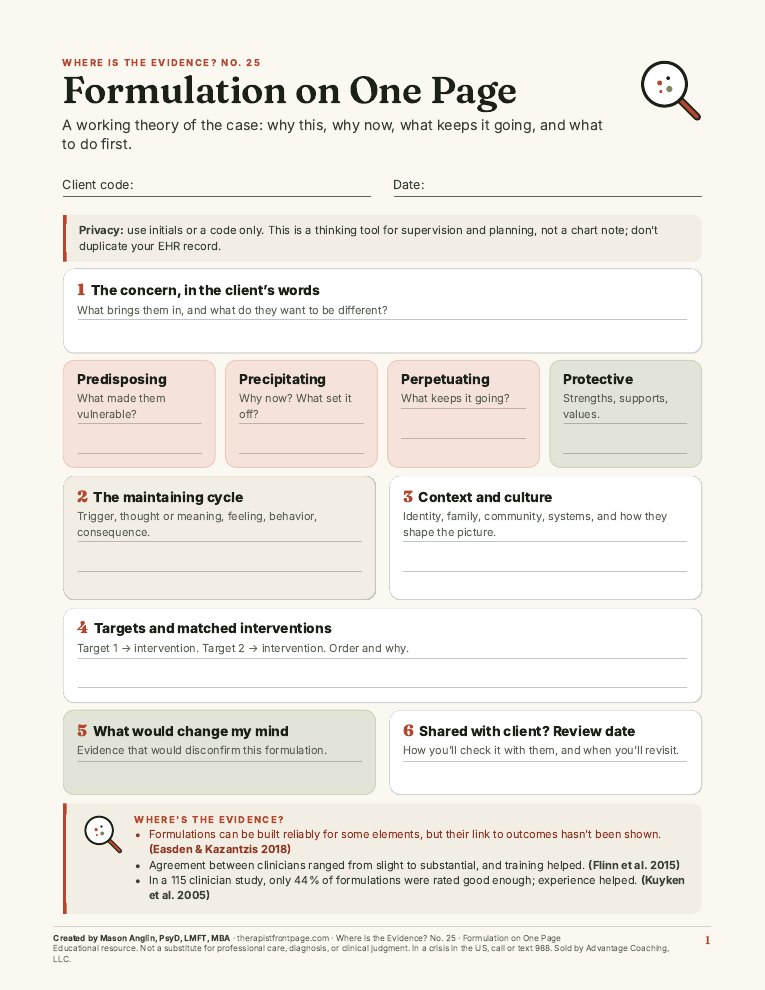
Page 1: Formulation on One Page 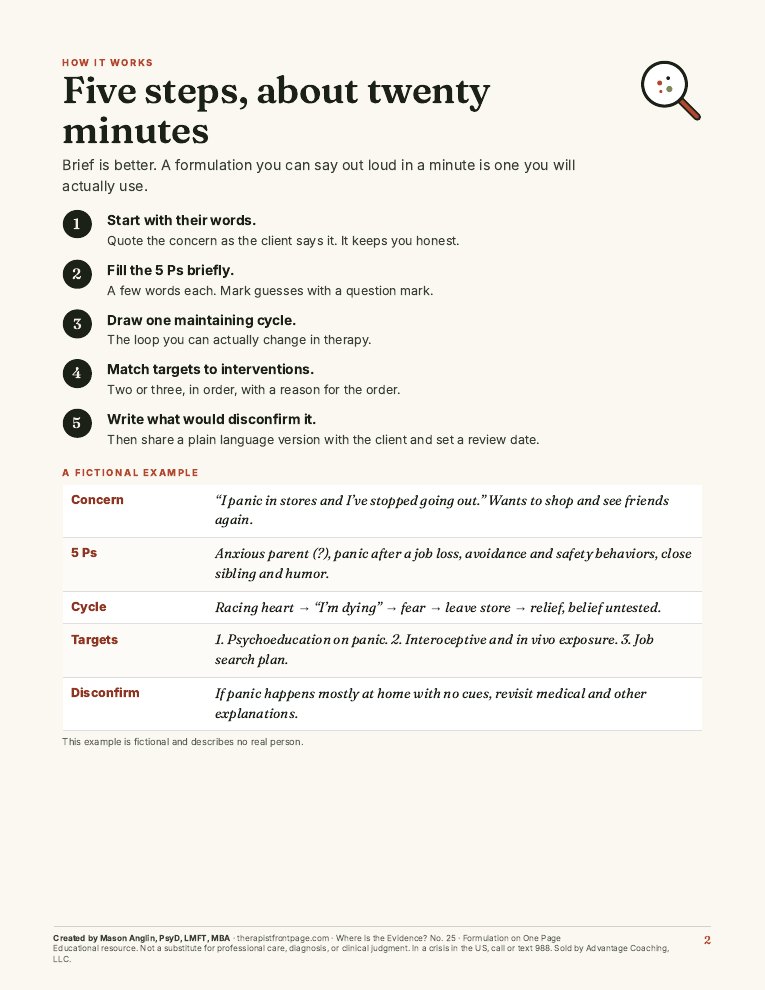
Page 2: Five steps, about twenty minutes 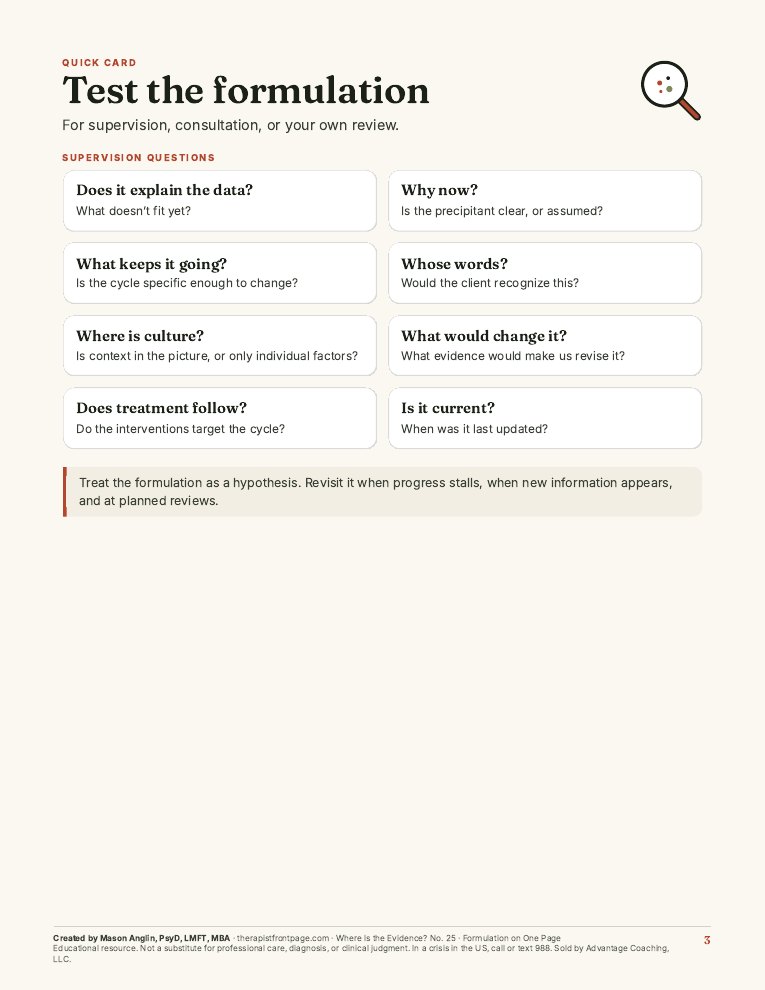
Page 3: Test the formulation 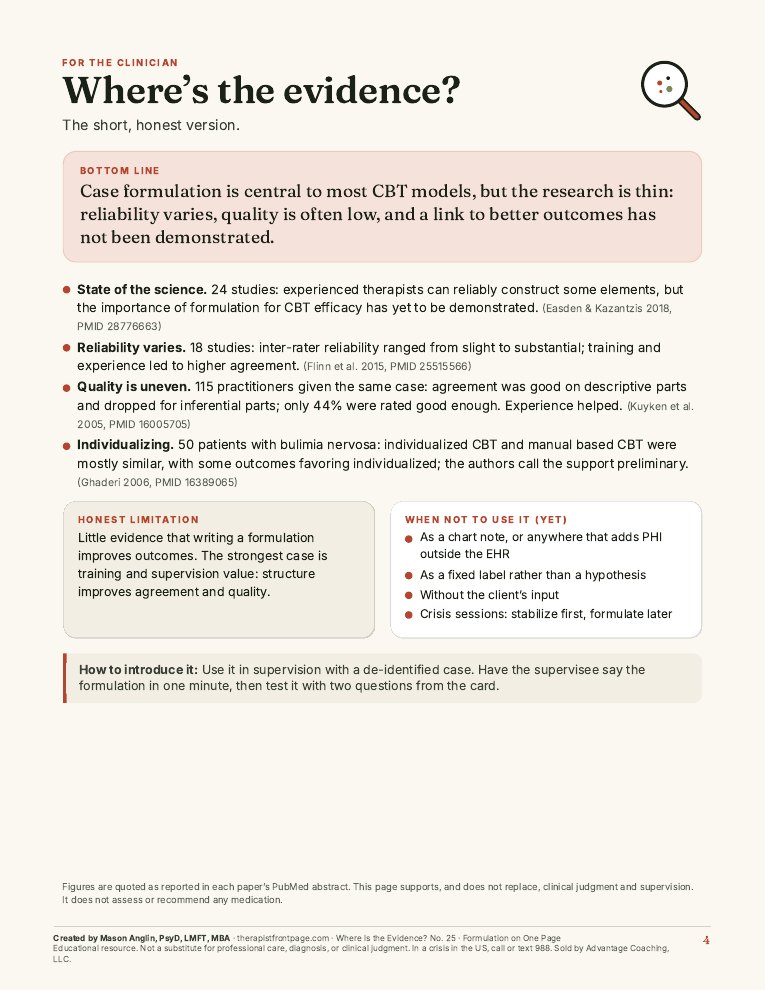
Page 4: Where's the evidence? 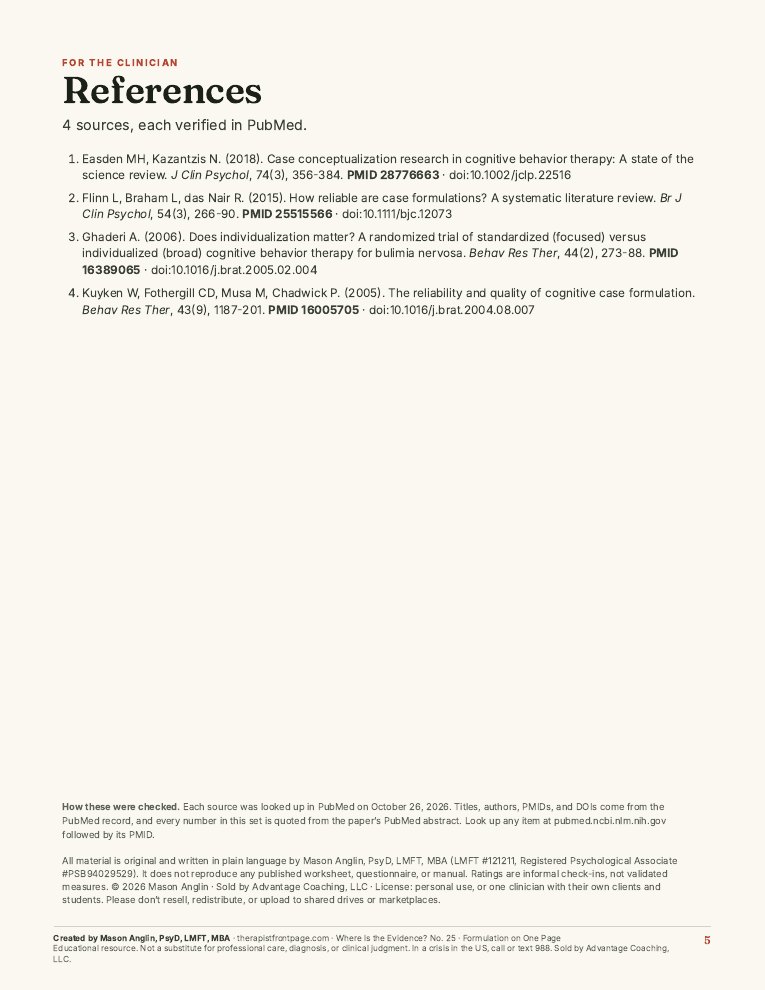
Page 5: References
Where’s the evidence?
Case formulation is central to most CBT models, but the research is thin: reliability varies, quality is often low, and a link to better outcomes has not been demonstrated.
On the worksheet itself
- Formulations can be built reliably for some elements, but their link to outcomes hasn’t been shown. (Easden & Kazantzis 2018)
- Agreement between clinicians ranged from slight to substantial, and training helped. (Flinn et al. 2015)
- In a 115 clinician study, only 44% of formulations were rated good enough; experience helped. (Kuyken et al. 2005)
On the clinician page
- State of the science. 24 studies: experienced therapists can reliably construct some elements, but the importance of formulation for CBT efficacy has yet to be demonstrated. (Easden & Kazantzis 2018)
- Reliability varies. 18 studies: inter-rater reliability ranged from slight to substantial; training and experience led to higher agreement. (Flinn et al. 2015)
- Quality is uneven. 115 practitioners given the same case: agreement was good on descriptive parts and dropped for inferential parts; only 44% were rated good enough. Experience helped. (Kuyken et al. 2005)
- Individualizing. 50 patients with bulimia nervosa: individualized CBT and manual based CBT were mostly similar, with some outcomes favoring individualized; the authors call the support preliminary. (Ghaderi 2006)
Honest limitation
Little evidence that writing a formulation improves outcomes. The strongest case is training and supervision value: structure improves agreement and quality.
When not to use it (yet)
- As a chart note, or anywhere that adds PHI outside the EHR
- As a fixed label rather than a hypothesis
- Without the client’s input
- Crisis sessions: stabilize first, formulate later
Figures are quoted as reported in each paper’s PubMed abstract. Every source below was checked in PubMed on October 26, 2026.
References (4 sources, with PMIDs)
- Easden MH, Kazantzis N (2018). Case conceptualization research in cognitive behavior therapy: A state of the science review. J Clin Psychol. PMID 28776663
- Flinn L, Braham L, das Nair R (2015). How reliable are case formulations? A systematic literature review. Br J Clin Psychol. PMID 25515566
- Ghaderi A (2006). Does individualization matter? A randomized trial of standardized (focused) versus individualized (broad) cognitive behavior therapy for bulimia nervosa. Behav Res Ther. PMID 16389065
- Kuyken W, Fothergill CD, Musa M, et al. (2005). The reliability and quality of cognitive case formulation. Behav Res Ther. PMID 16005705
The clinician page
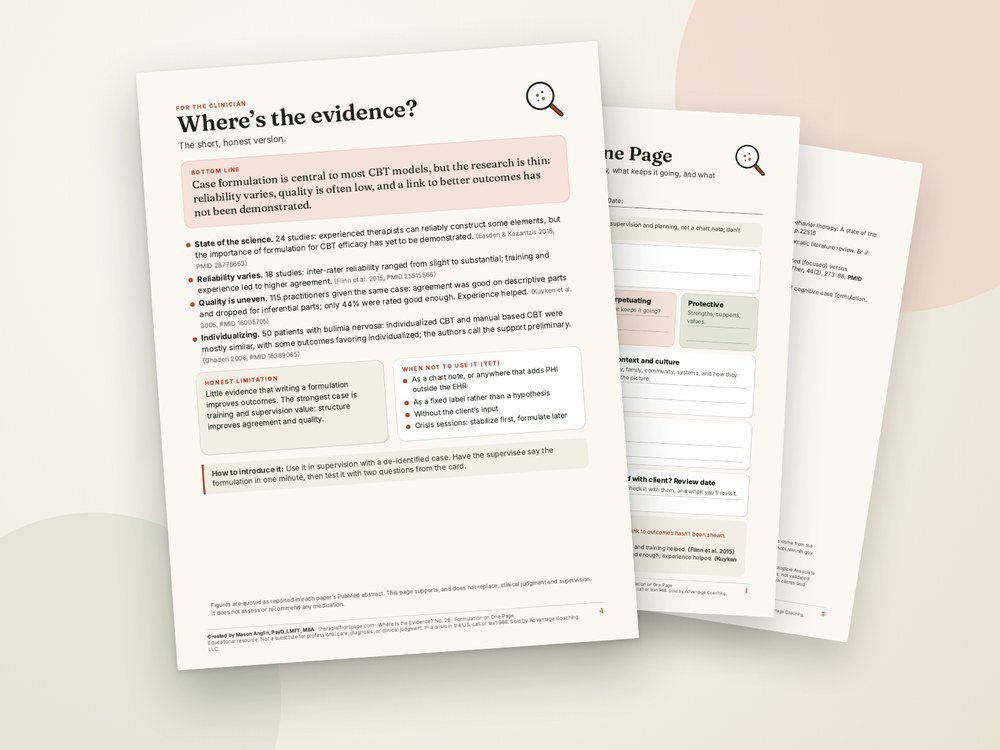
Every worksheet in the series ends with one clinician page and a references page. The numbers come straight from each study’s PubMed abstract, and thin evidence is labeled as thin.
How it’s used
Built for
- Therapists and counselors
- Supervisees and trainees
- Clinical supervisors
- Graduate training programs
A simple flow
- Write the concern in the client's words
- Fill the 5 Ps and the maintaining cycle
- Match targets to interventions
- Name what would disconfirm it
License: clinician use included
Clinician use included. Licensed for personal use, or for one clinician to use with their own clients and students. Please don’t resell, redistribute, or upload it to shared drives or marketplaces.
Get Formulation on One Page
Instant PDF download right after purchase (print and fillable versions). Questions or refunds: contact us. Checkout is by Stripe; the seller on your receipt is Advantage Coaching, LLC.
Mason’s own product; Therapist Front Page earns from these sales.
Created by Mason Anglin, PsyD, LMFT, MBA · LMFT #121211 · Registered Psychological Associate #PSB94029529
Educational, not a substitute for care. In a crisis in the US, call or text 988.