Where Is the Evidence? No. 03
Plan the Week, Not the Mood
A one page weekly planner for behavioral activation, with the research printed on it.
6 pages · US Letter PDF, print and fillable versions · references with PMIDs
Where’s the evidence? Activity scheduling had a large effect on depression across 16 trials (Cuijpers 2007).
Instant PDF download right after purchase (print and fillable versions). Questions or refunds: contact us. Checkout is by Stripe; the seller on your receipt is Advantage Coaching, LLC.
Clinician use included. Licensed for personal use, or for one clinician to use with their own clients and students. Please don’t resell, redistribute, or upload it to shared drives or marketplaces.
Mason’s own product; Therapist Front Page earns from these sales.
What’s inside
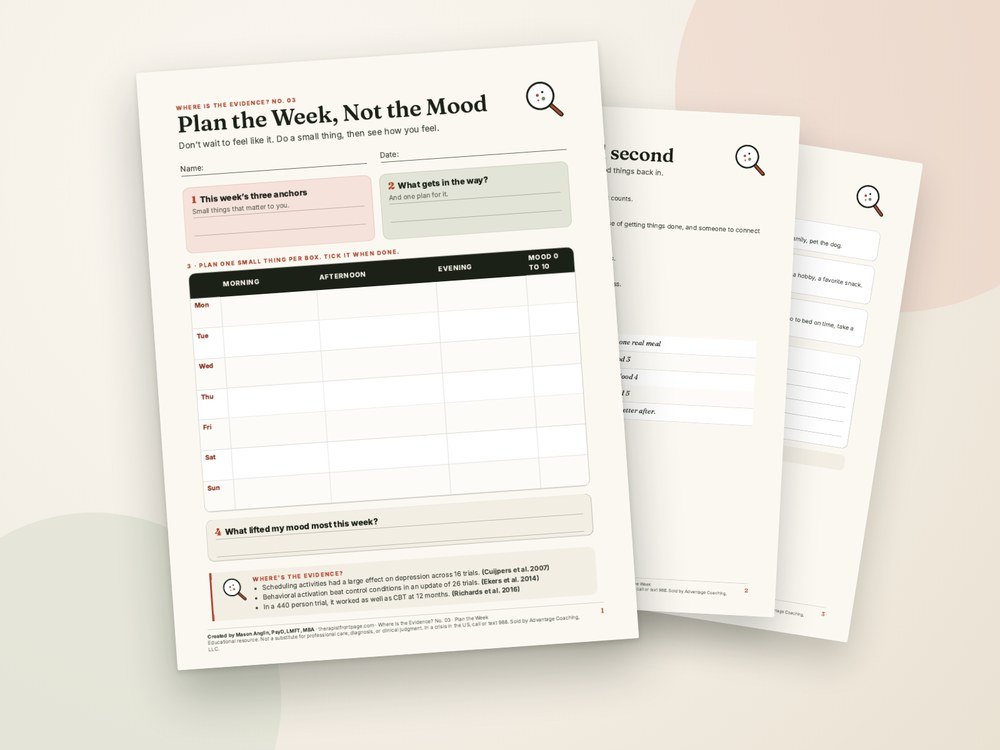
When mood is low, waiting to feel like it usually means waiting a long time. This one page weekly planner flips the order: plan small, doable activities first and let mood follow. A short evidence strip on the page shows why, and the clinician page sums up a strong research base honestly.
- One page weekly planner with the evidence printed on it
- How-to plus a short worked example
- Activity menu: six kinds of activity
- Low energy day plan
- Clinician page: evidence, honest limits, when not to use
- References with PMIDs and DOIs
All 6 pages, and who each is for
- Plan the Week, Not the Mood · Client
- Action first, mood second · Client
- Things to plan · Client
- Low Energy Day Plan · Client
- Where's the evidence? · Clinician
- References · Clinician
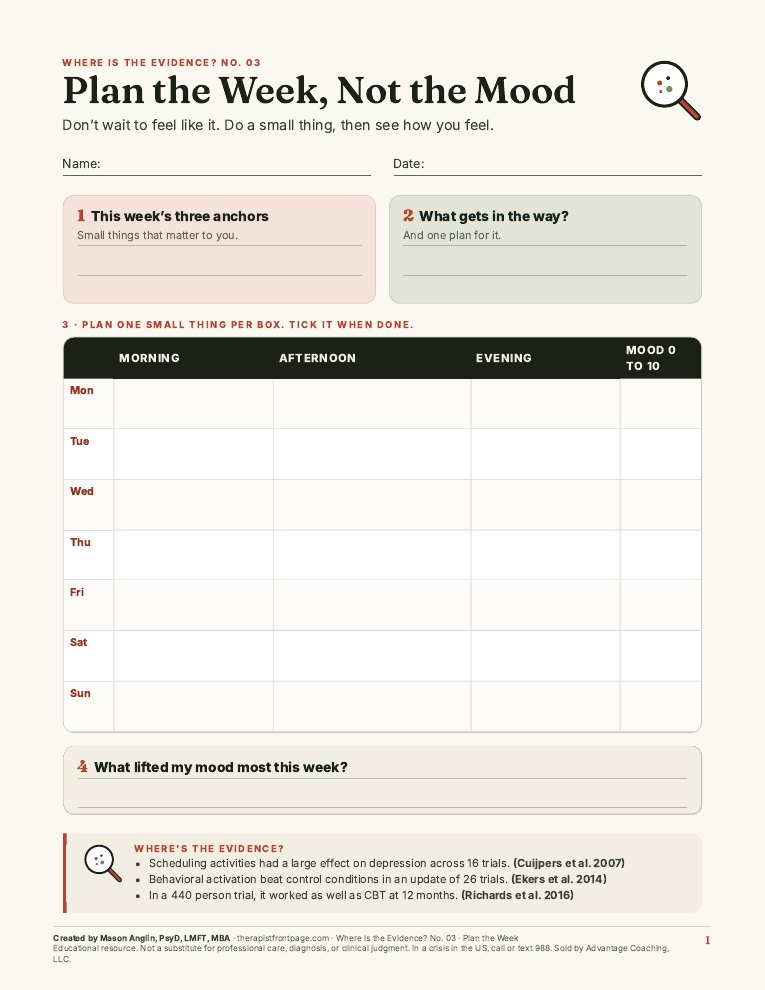
Page 1: Plan the Week, Not the Mood 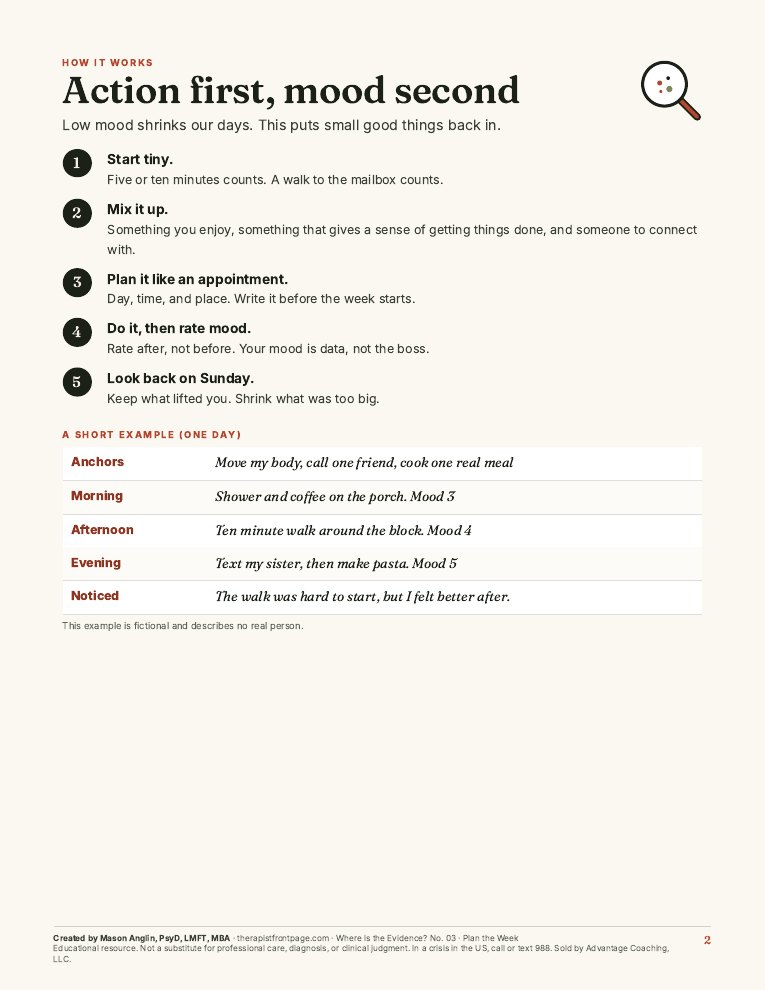
Page 2: Action first, mood second 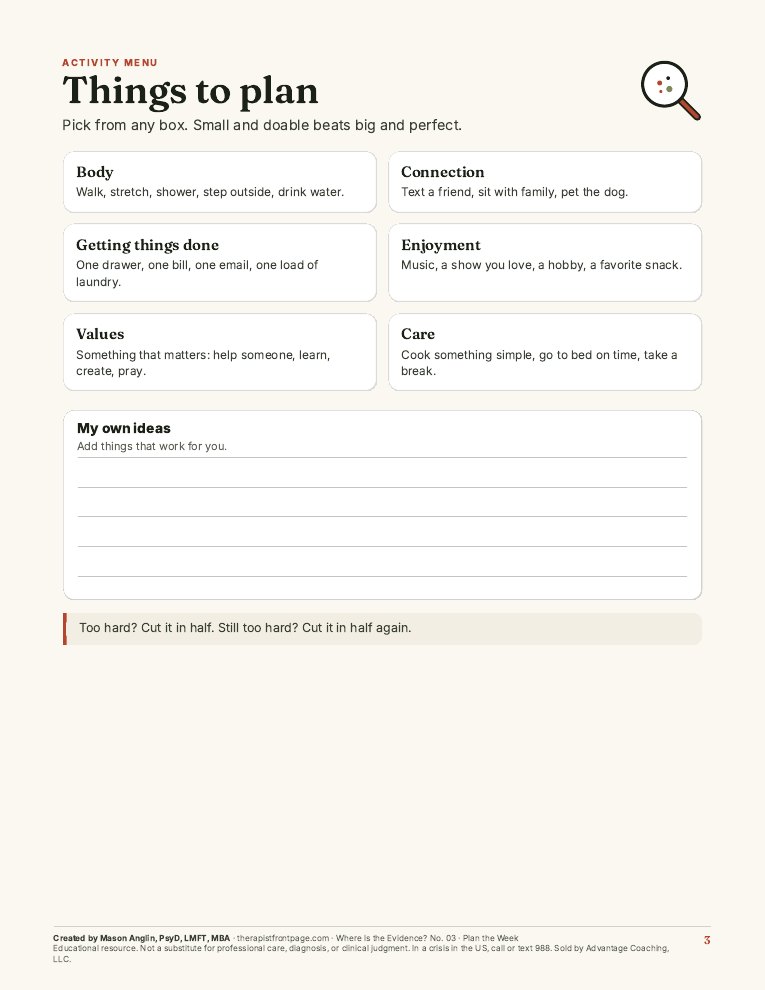
Page 3: Things to plan 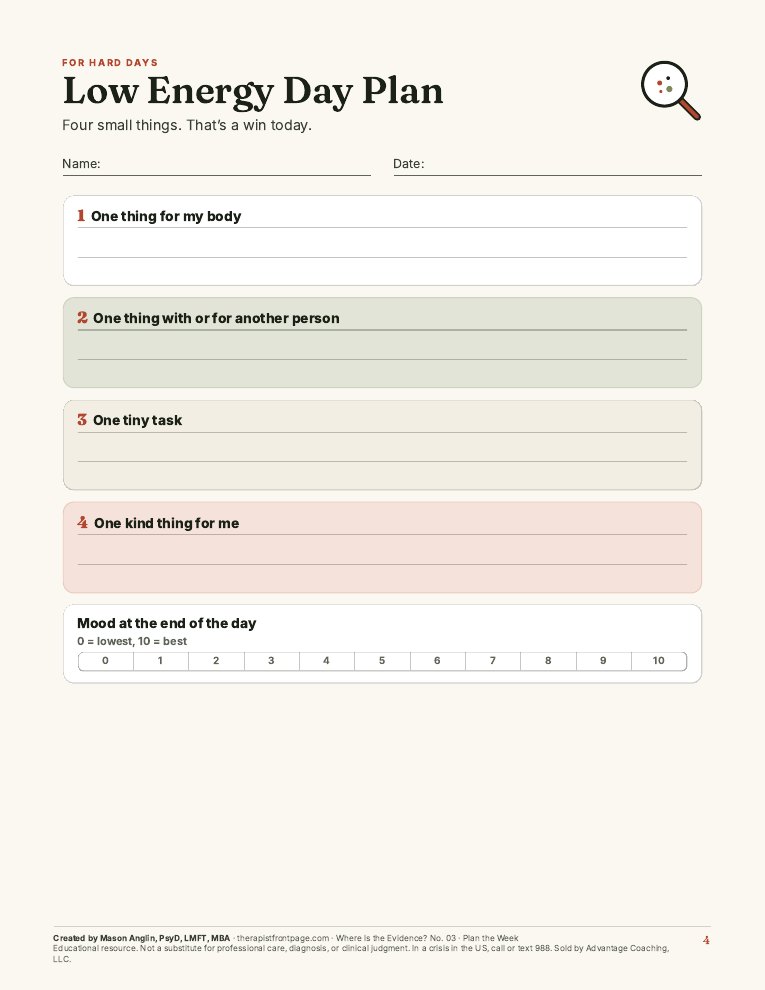
Page 4: Low Energy Day Plan 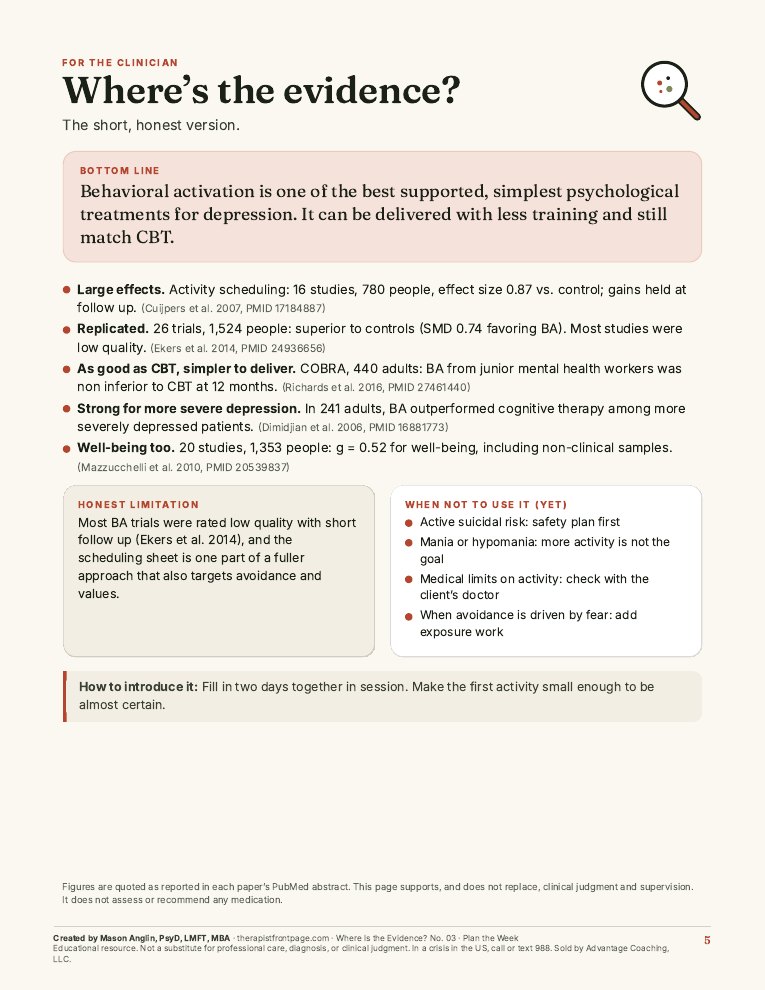
Page 5: Where's the evidence? 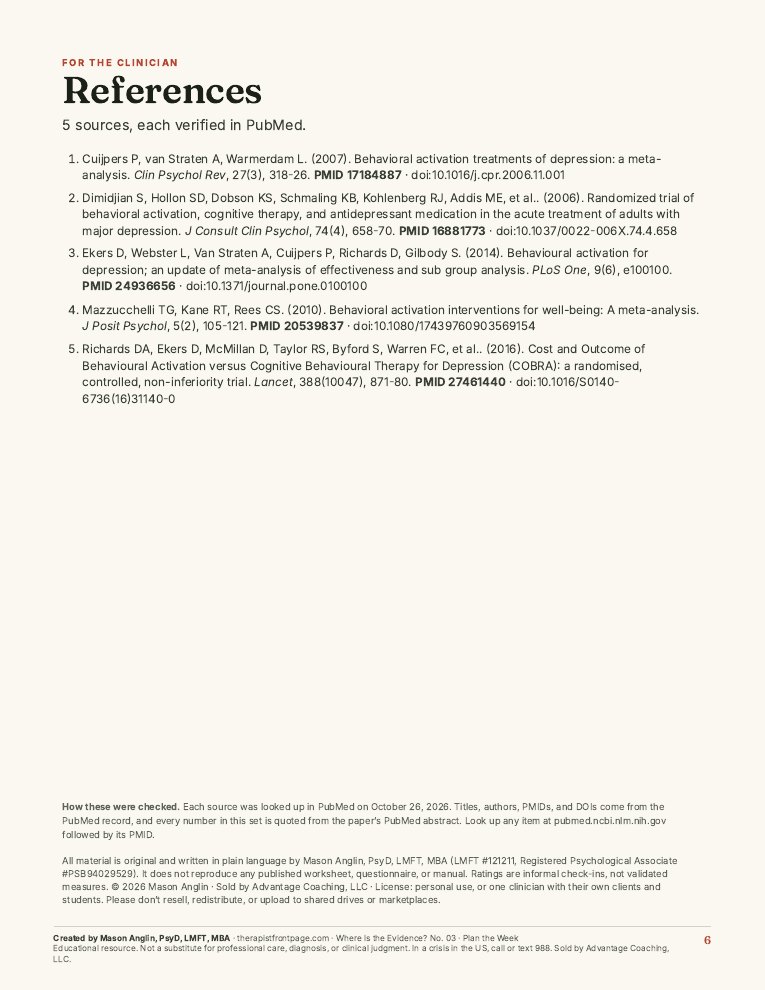
Page 6: References
Where’s the evidence?
Behavioral activation is one of the best supported, simplest psychological treatments for depression. It can be delivered with less training and still match CBT.
On the worksheet itself
- Scheduling activities had a large effect on depression across 16 trials. (Cuijpers et al. 2007)
- Behavioral activation beat control conditions in an update of 26 trials. (Ekers et al. 2014)
- In a 440 person trial, it worked as well as CBT at 12 months. (Richards et al. 2016)
On the clinician page
- Large effects. Activity scheduling: 16 studies, 780 people, effect size 0.87 vs. control; gains held at follow up. (Cuijpers et al. 2007)
- Replicated. 26 trials, 1,524 people: superior to controls (SMD 0.74 favoring BA). Most studies were low quality. (Ekers et al. 2014)
- As good as CBT, simpler to deliver. COBRA, 440 adults: BA from junior mental health workers was non inferior to CBT at 12 months. (Richards et al. 2016)
- Strong for more severe depression. In 241 adults, BA outperformed cognitive therapy among more severely depressed patients. (Dimidjian et al. 2006)
- Well-being too. 20 studies, 1,353 people: g = 0.52 for well-being, including non-clinical samples. (Mazzucchelli et al. 2010)
Honest limitation
Most BA trials were rated low quality with short follow up (Ekers et al. 2014), and the scheduling sheet is one part of a fuller approach that also targets avoidance and values.
When not to use it (yet)
- Active suicidal risk: safety plan first
- Mania or hypomania: more activity is not the goal
- Medical limits on activity: check with the client’s doctor
- When avoidance is driven by fear: add exposure work
Figures are quoted as reported in each paper’s PubMed abstract. Every source below was checked in PubMed on October 26, 2026.
References (5 sources, with PMIDs)
- Cuijpers P, van Straten A, Warmerdam L (2007). Behavioral activation treatments of depression: a meta-analysis. Clin Psychol Rev. PMID 17184887
- Dimidjian S, Hollon SD, Dobson KS, et al. (2006). Randomized trial of behavioral activation, cognitive therapy, and antidepressant medication in the acute treatment of adults with major depression. J Consult Clin Psychol. PMID 16881773
- Ekers D, Webster L, Van Straten A, et al. (2014). Behavioural activation for depression; an update of meta-analysis of effectiveness and sub group analysis. PLoS One. PMID 24936656
- Mazzucchelli TG, Kane RT, Rees CS (2010). Behavioral activation interventions for well-being: A meta-analysis. J Posit Psychol. PMID 20539837
- Richards DA, Ekers D, McMillan D, et al. (2016). Cost and Outcome of Behavioural Activation versus Cognitive Behavioural Therapy for Depression (COBRA): a randomised, controlled, non-inferiority trial. Lancet. PMID 27461440
The clinician page
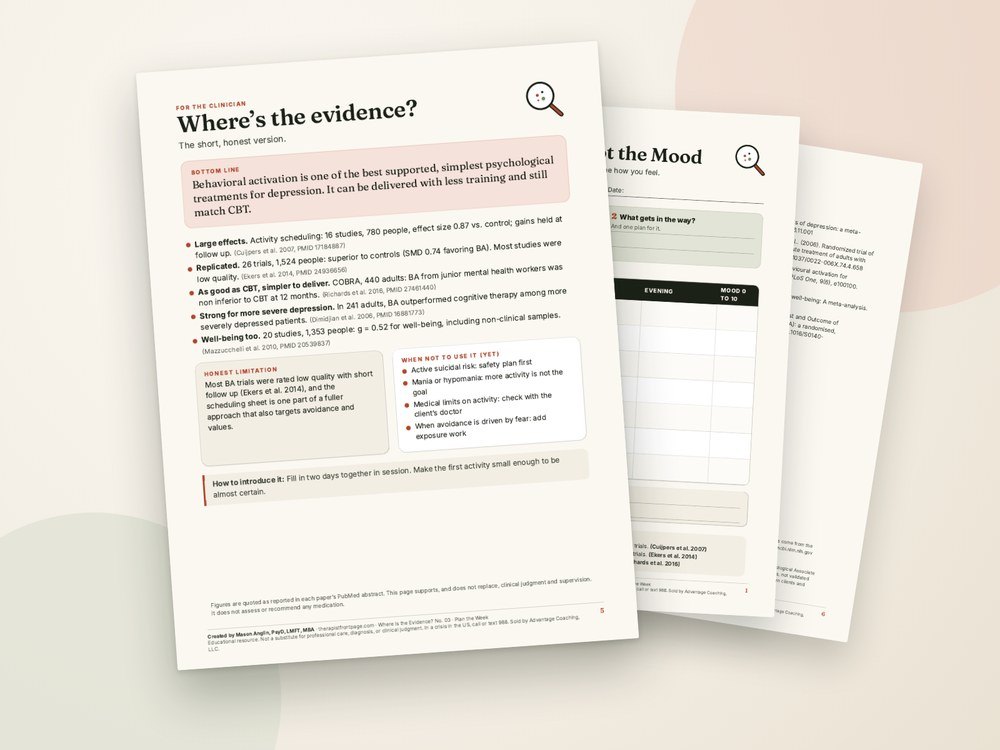
Every worksheet in the series ends with one clinician page and a references page. The numbers come straight from each study’s PubMed abstract, and thin evidence is labeled as thin.
How it’s used
Built for
- Clients with low mood or depression
- Therapists, counselors, and coaches
- Anyone stuck in a slump
- Primary care and group settings
A simple flow
- Pick three small anchors for the week
- Plan one thing per part of the day
- Tick it and rate your mood
- Notice what lifts you
License: clinician use included
Clinician use included. Licensed for personal use, or for one clinician to use with their own clients and students. Please don’t resell, redistribute, or upload it to shared drives or marketplaces.
Get Plan the Week, Not the Mood
Instant PDF download right after purchase (print and fillable versions). Questions or refunds: contact us. Checkout is by Stripe; the seller on your receipt is Advantage Coaching, LLC.
Mason’s own product; Therapist Front Page earns from these sales.
Created by Mason Anglin, PsyD, LMFT, MBA · LMFT #121211 · Registered Psychological Associate #PSB94029529
Educational, not a substitute for care. In a crisis in the US, call or text 988.