Where Is the Evidence? No. 04
Test the Prediction
A one page worksheet for anxious thoughts: check the odds, plan to cope, then test it.
6 pages · US Letter PDF, print and fillable versions · references with PMIDs
Where’s the evidence? Cognitive therapy cut pathological worry compared with no therapy (Hanrahan 2013).
Instant PDF download right after purchase (print and fillable versions). Questions or refunds: contact us. Checkout is by Stripe; the seller on your receipt is Advantage Coaching, LLC.
Clinician use included. Licensed for personal use, or for one clinician to use with their own clients and students. Please don’t resell, redistribute, or upload it to shared drives or marketplaces.
Mason’s own product; Therapist Front Page earns from these sales.
What’s inside
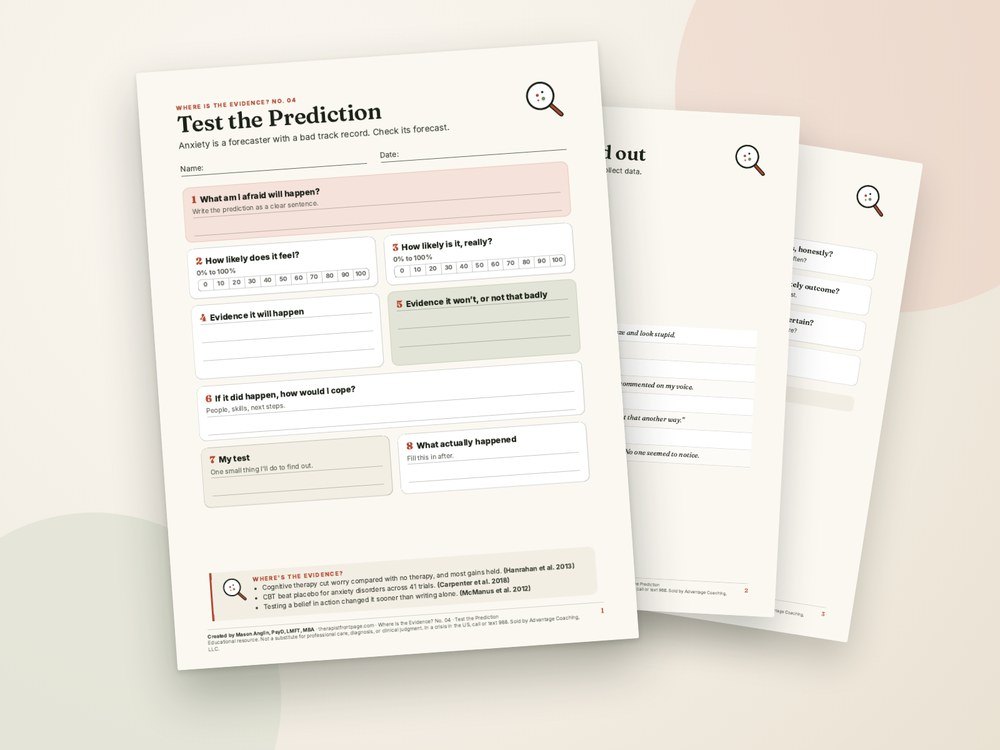
Anxiety makes predictions: it will go wrong, and you won't cope. This one page worksheet checks both, then turns the worry into a small real world test. A short evidence strip sits right on the page, and the clinician page gives the honest picture of cognitive therapy for worry.
- One page Test the Prediction worksheet with the evidence printed on it
- How-to plus a short worked example
- Quick card: questions for anxious thoughts
- Teen page: Worry Detective
- Clinician page: evidence, honest limits, when not to use
- References with PMIDs and DOIs
All 6 pages, and who each is for
- Test the Prediction · Client
- Forecast, then find out · Client
- Questions for anxious thoughts · Client
- Worry Detective · Client
- Where's the evidence? · Clinician
- References · Clinician
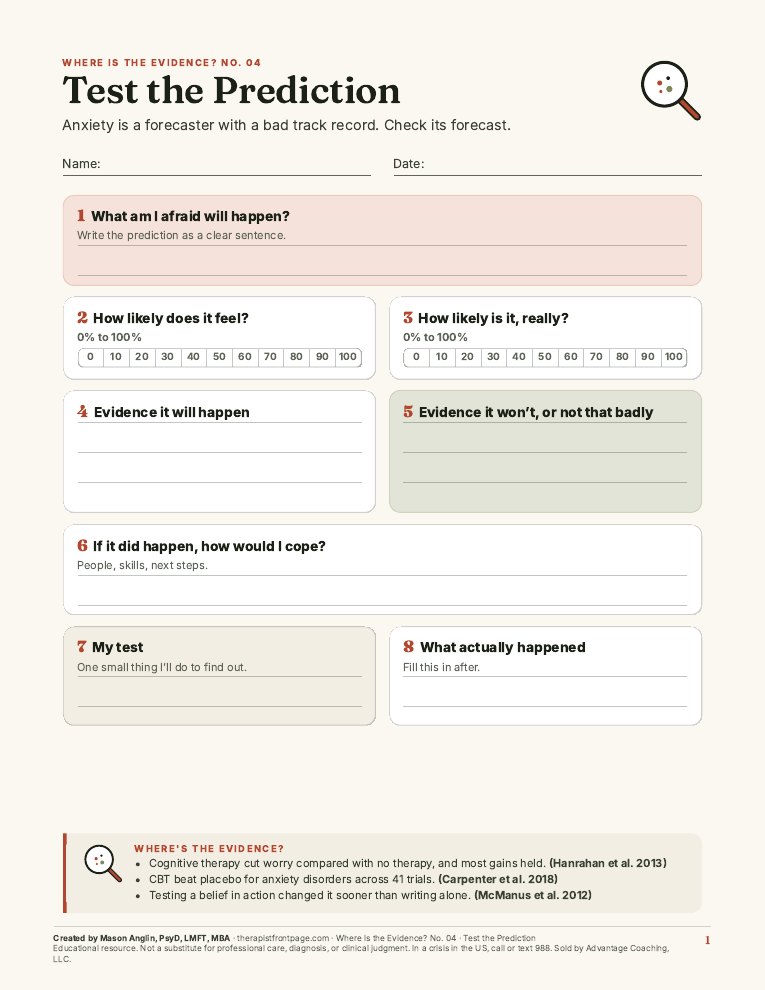
Page 1: Test the Prediction 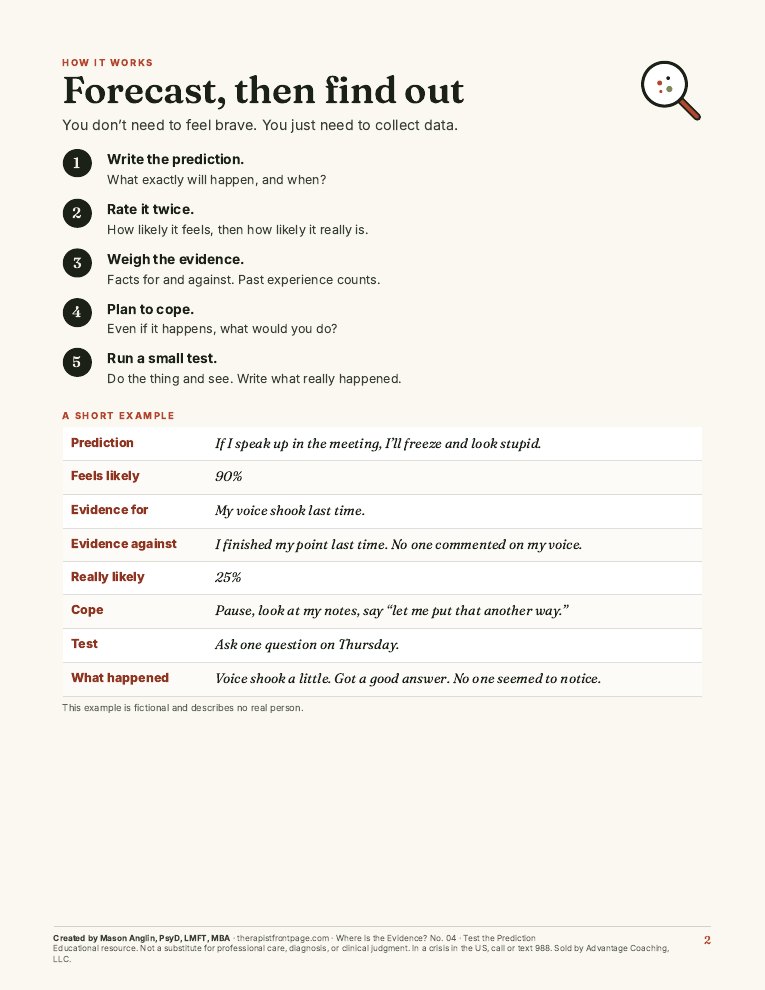
Page 2: Forecast, then find out 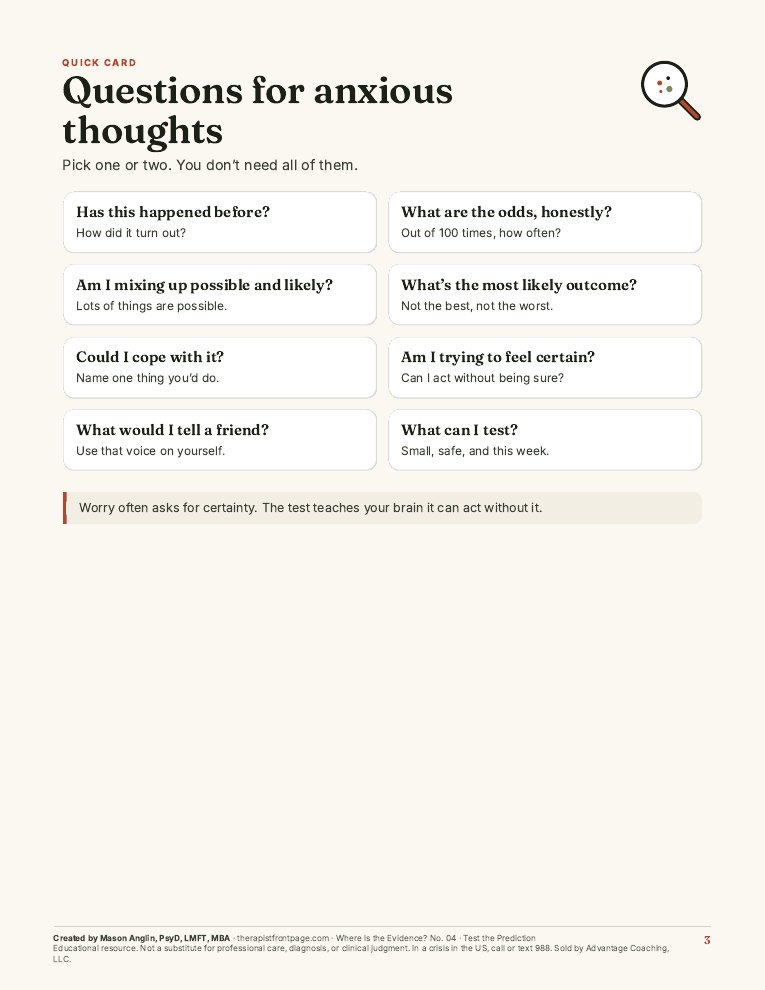
Page 3: Questions for anxious thoughts 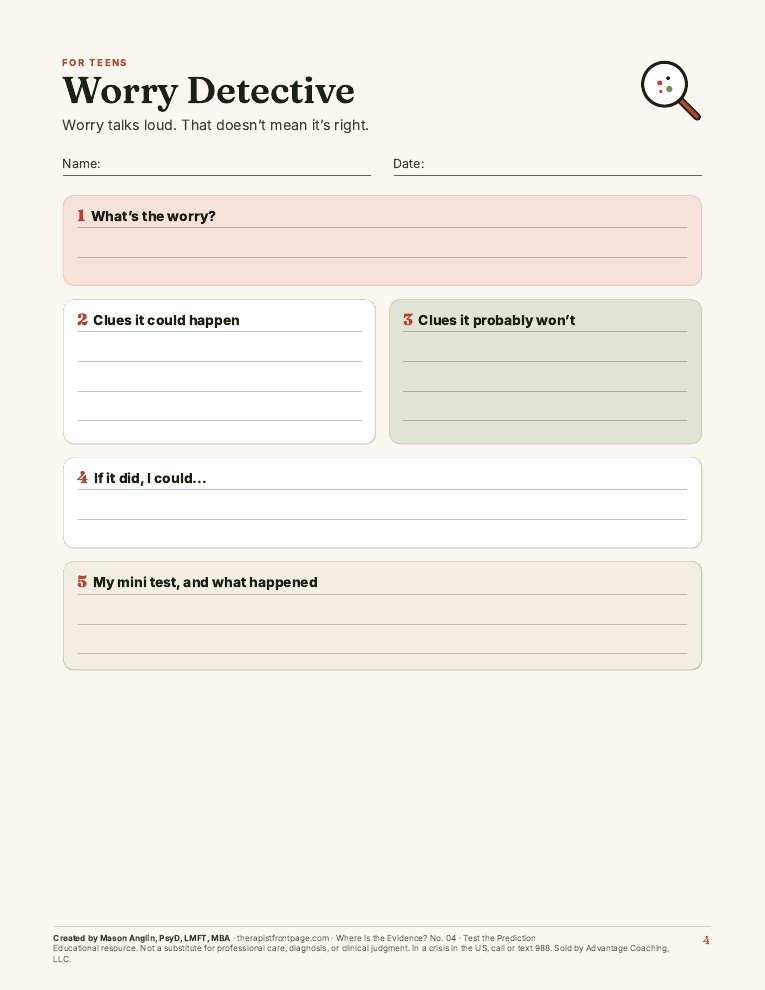
Page 4: Worry Detective 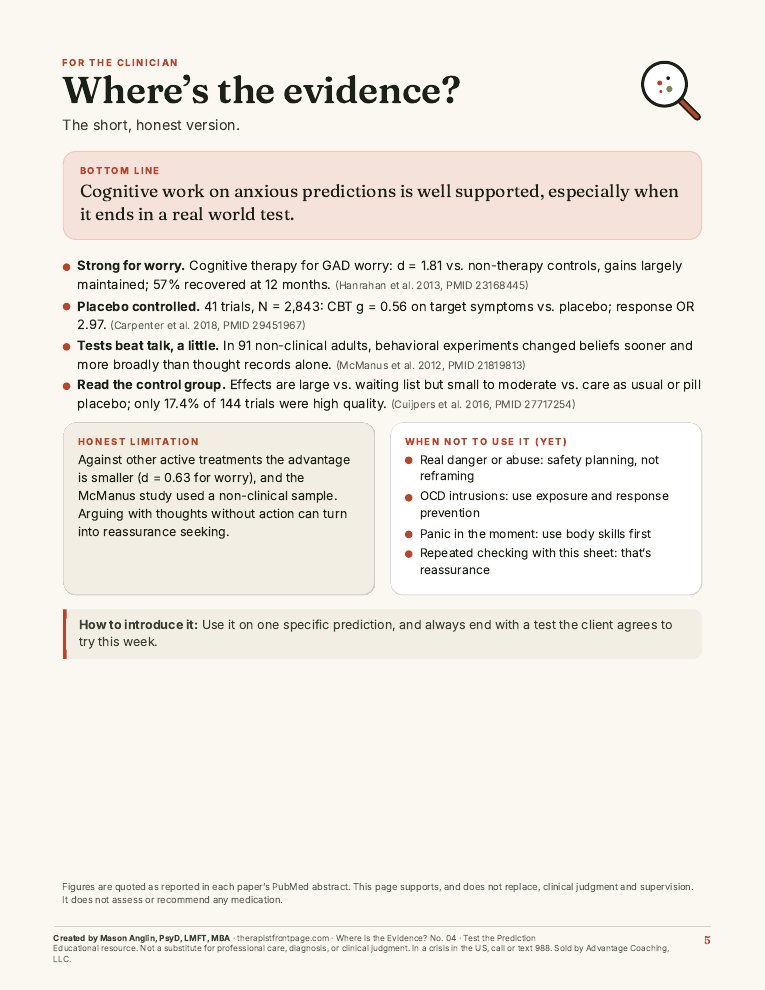
Page 5: Where's the evidence? 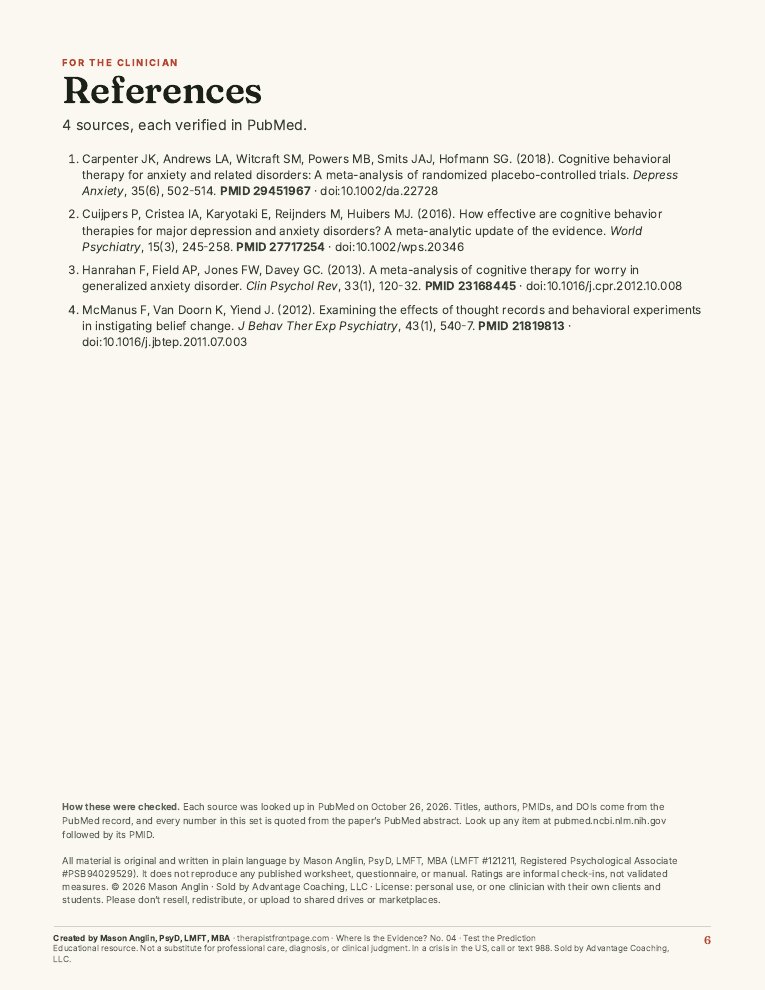
Page 6: References
Where’s the evidence?
Cognitive work on anxious predictions is well supported, especially when it ends in a real world test.
On the worksheet itself
- Cognitive therapy cut worry compared with no therapy, and most gains held. (Hanrahan et al. 2013)
- CBT beat placebo for anxiety disorders across 41 trials. (Carpenter et al. 2018)
- Testing a belief in action changed it sooner than writing alone. (McManus et al. 2012)
On the clinician page
- Strong for worry. Cognitive therapy for GAD worry: d = 1.81 vs. non-therapy controls, gains largely maintained; 57% recovered at 12 months. (Hanrahan et al. 2013)
- Placebo controlled. 41 trials, N = 2,843: CBT g = 0.56 on target symptoms vs. placebo; response OR 2.97. (Carpenter et al. 2018)
- Tests beat talk, a little. In 91 non-clinical adults, behavioral experiments changed beliefs sooner and more broadly than thought records alone. (McManus et al. 2012)
- Read the control group. Effects are large vs. waiting list but small to moderate vs. care as usual or pill placebo; only 17.4% of 144 trials were high quality. (Cuijpers et al. 2016)
Honest limitation
Against other active treatments the advantage is smaller (d = 0.63 for worry), and the McManus study used a non-clinical sample. Arguing with thoughts without action can turn into reassurance seeking.
When not to use it (yet)
- Real danger or abuse: safety planning, not reframing
- OCD intrusions: use exposure and response prevention
- Panic in the moment: use body skills first
- Repeated checking with this sheet: that’s reassurance
Figures are quoted as reported in each paper’s PubMed abstract. Every source below was checked in PubMed on October 26, 2026.
References (4 sources, with PMIDs)
- Carpenter JK, Andrews LA, Witcraft SM, et al. (2018). Cognitive behavioral therapy for anxiety and related disorders: A meta-analysis of randomized placebo-controlled trials. Depress Anxiety. PMID 29451967
- Cuijpers P, Cristea IA, Karyotaki E, et al. (2016). How effective are cognitive behavior therapies for major depression and anxiety disorders? A meta-analytic update of the evidence. World Psychiatry. PMID 27717254
- Hanrahan F, Field AP, Jones FW, et al. (2013). A meta-analysis of cognitive therapy for worry in generalized anxiety disorder. Clin Psychol Rev. PMID 23168445
- McManus F, Van Doorn K, Yiend J (2012). Examining the effects of thought records and behavioral experiments in instigating belief change. J Behav Ther Exp Psychiatry. PMID 21819813
The clinician page
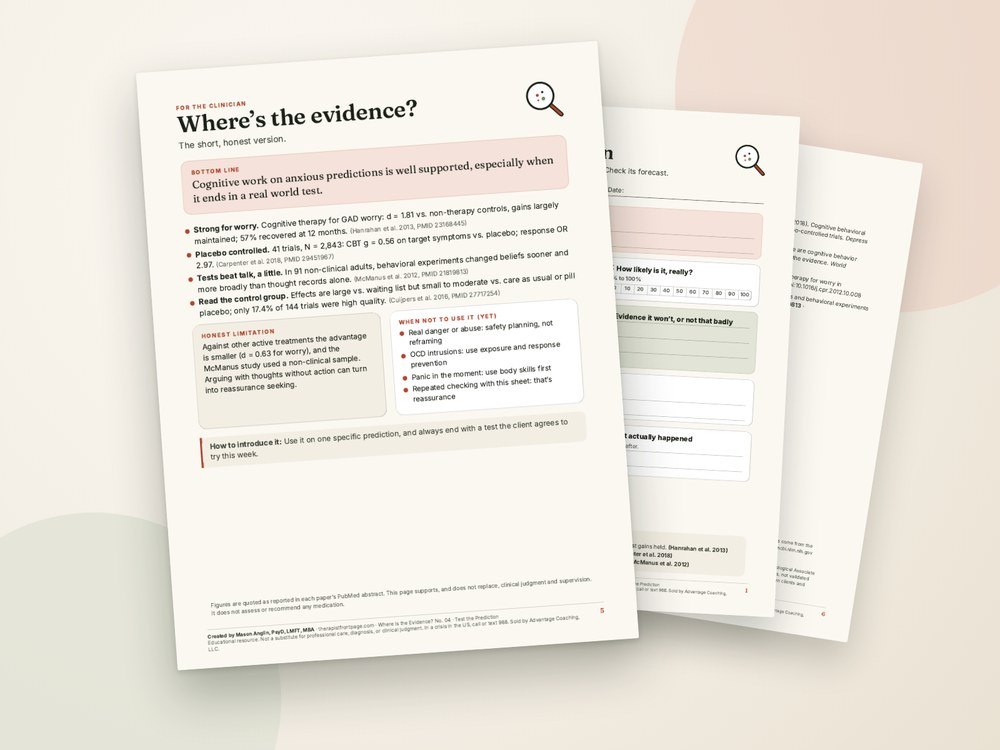
Every worksheet in the series ends with one clinician page and a references page. The numbers come straight from each study’s PubMed abstract, and thin evidence is labeled as thin.
How it’s used
Built for
- Clients with worry or anxiety
- Therapists, counselors, and coaches
- Teens with an adult's support
- Anyone who overthinks
A simple flow
- Write the prediction
- Rate the odds and the worst case
- Plan how you'd cope
- Test it and compare
License: clinician use included
Clinician use included. Licensed for personal use, or for one clinician to use with their own clients and students. Please don’t resell, redistribute, or upload it to shared drives or marketplaces.
Get Test the Prediction
Instant PDF download right after purchase (print and fillable versions). Questions or refunds: contact us. Checkout is by Stripe; the seller on your receipt is Advantage Coaching, LLC.
Mason’s own product; Therapist Front Page earns from these sales.
Created by Mason Anglin, PsyD, LMFT, MBA · LMFT #121211 · Registered Psychological Associate #PSB94029529
Educational, not a substitute for care. In a crisis in the US, call or text 988.