Depression & low mood · ages 8–17
Little Lights: Child & Teen Mood Kit
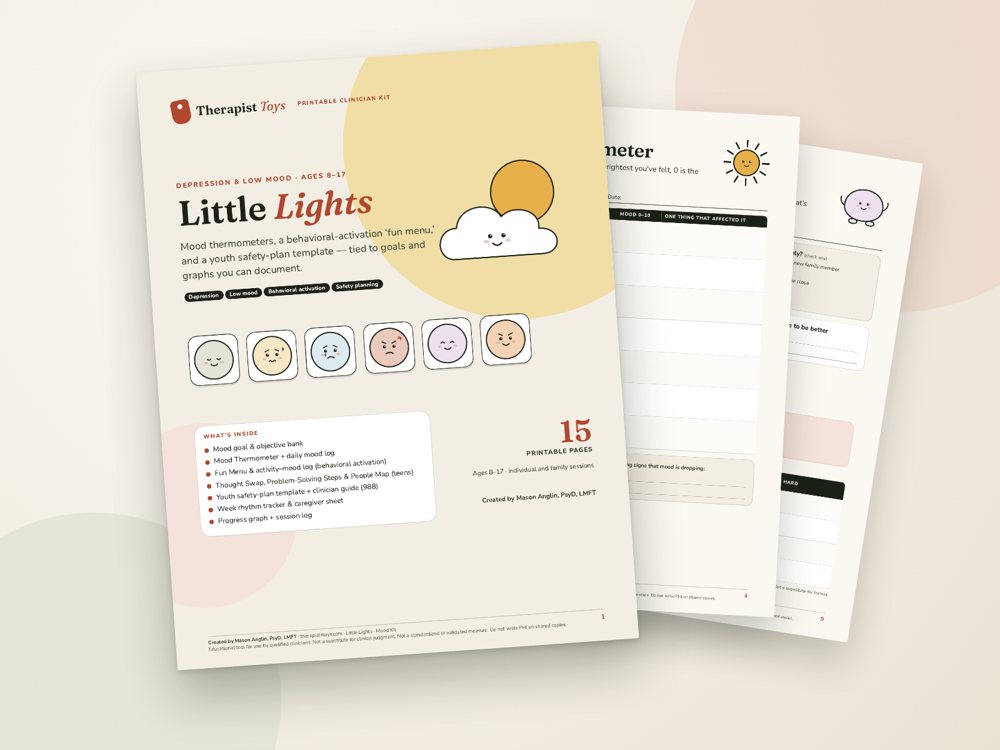
Mood thermometers, a behavioral-activation ‘fun menu,’ and a youth safety-plan template — tied to goals and graphs you can document.
15 printable pages · US Letter PDF · Ages 8–17 · individual and family sessions
Digital PDF, delivered right after purchase. Questions or refunds: contact us. Checkout is by Stripe; the seller on your receipt is Advantage Coaching, LLC. After paying you’ll go straight to your download page, delivered through our sister shop, Therapist Toys.
Mason’s own product; Therapist Front Page earns from these sales.
What’s inside
Low mood and depression tools for kids and teens: mood thermometer, Fun Menu and activity–mood log, Thought Swap, Problem-Solving Steps, a People Map for relationship stress, a Strengths Garden, and a youth safety plan with 988, 741741, and 911, plus a clinician guide and caregiver sheet.
- Mood goal & objective bank
- Mood Thermometer + daily mood log
- Fun Menu & activity–mood log (behavioral activation)
- Thought Swap, Problem-Solving Steps & People Map (teens)
- Youth safety-plan template + clinician guide (988)
- Week rhythm tracker & caregiver sheet
- Progress graph + session log
All 15 pages, and who each is for
- Cover · cover
- How to use this kit · Clinician
- Mood goal & objective bank · Clinician
- My Mood Thermometer · Child / teen
- My Fun Menu · Child / teen
- Activity & mood log · Child / teen
- Thought Swap · Child / teen
- Problem-Solving Steps · Child / teen
- My People Map · Teen
- My Strengths Garden · Child / teen
- My week rhythm · Child / teen + caregiver
- Safety plan: clinician guide · Clinician
- My Safety Plan · Youth + clinician
- Caregiver: supporting mood & safety · Caregiver
- Progress graph & session log · Clinician
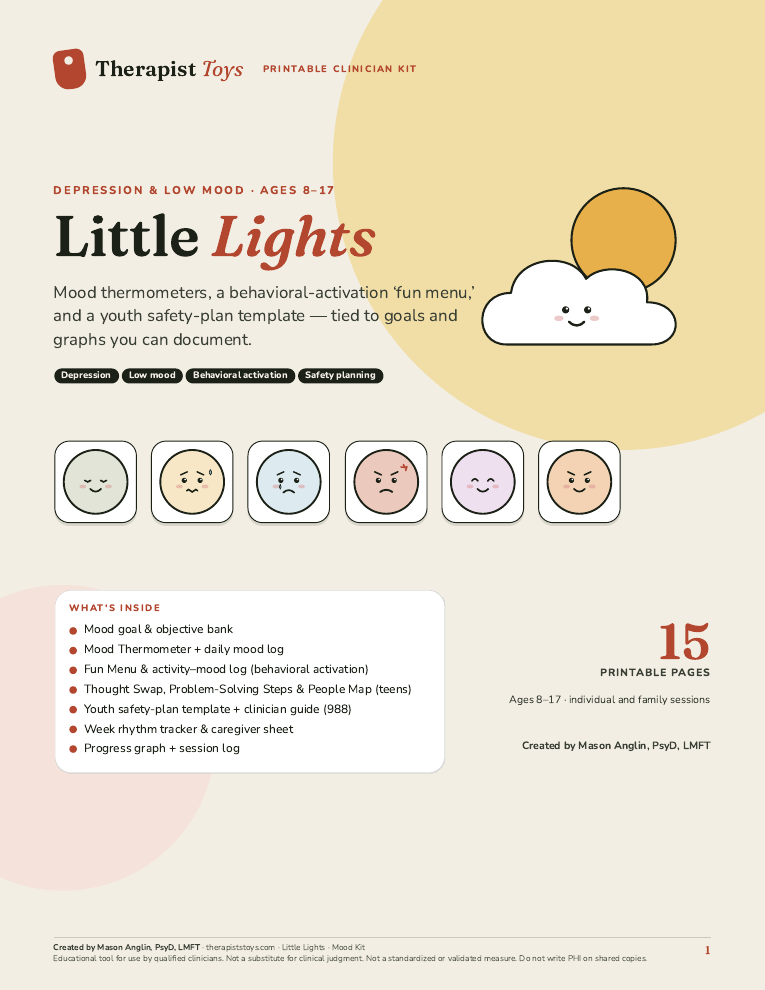
Page 1: Cover 
Page 2: How to use this kit 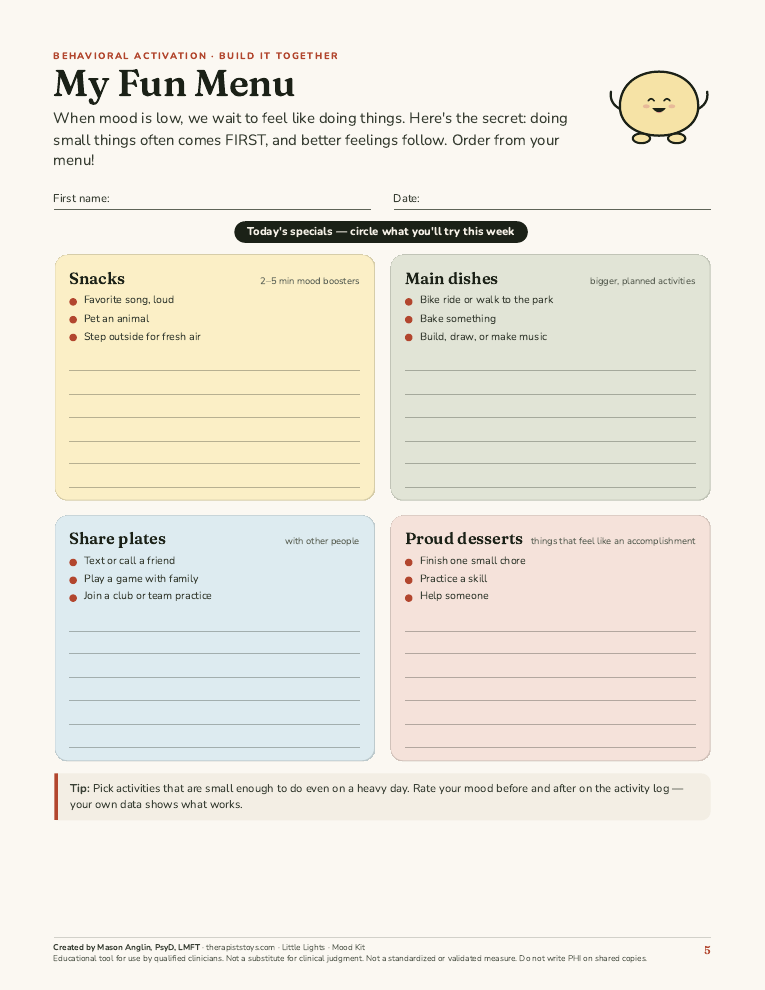
Page 5: My Fun Menu 
Page 7: Thought Swap
How clinicians use it
Low mood shrinks a kid's world. These pages help them notice mood, add small doses of fun and mastery, and keep safety front and center.
Built for
- Children and teens 8–17 with depressed or irritable mood, withdrawal, or loss of interest
- Individual sessions with a caregiver check-in
- Clinicians who need clear mood data and documented safety planning
A simple flow
- Screen for safety at intake and whenever mood dips; complete the safety plan together when indicated.
- Collect a baseline with the Mood Thermometer and week rhythm tracker.
- Choose objectives and fill in the numbers.
- Build the Fun Menu, then schedule 2–3 small activities each week.
- Add Thought Swap and Problem-Solving; with teens, use the People Map for relationship stress.
- Graph weekly mood and activities; review the safety plan at every session.
Informed by
From the kit’s evidence snapshot: For adolescents, CBT and interpersonal psychotherapy (IPT) are the best-supported treatments; for younger children the evidence is still thin, with CBT the most promising (Weersing et al., 2017, J Clin Child Adolesc Psychol). Behavioral activation — planning small, doable activities — has encouraging early support. The safety plan here is a template for clinician-guided use after your own risk assessment. It's not a no-harm contract and doesn't replace crisis services.
Clinician: informed by interpersonal approaches to teen depression (relationship inventory, role changes, communication practice). Not a substitute for formal IPT training.
Get Little Lights: Child & Teen Mood Kit
Digital PDF, delivered right after purchase. Questions or refunds: contact us.
Mason’s own product; Therapist Front Page earns from these sales.
Created by Mason Anglin, PsyD, LMFT #121211, Registered Psychological Associate #PSB94029529
An educational tool for qualified clinicians. It is not a substitute for clinical judgment, it isn’t a standardized or validated measure, and it doesn’t guarantee insurance authorization or reimbursement. Licensed for use with your own clients; please don’t redistribute or resell it.