Grief & family change · ages 4–14
Little Lanterns: Grief & Big Changes Kit
A gentle kit for kids grieving a death, a pet, or a family change — with memory play, coping, caregiver support, and goals you can document.
13 printable pages · US Letter PDF · Ages 4–14 · individual and family sessions
Digital PDF, delivered right after purchase. Questions or refunds: contact us. Checkout is by Stripe; the seller on your receipt is Advantage Coaching, LLC. After paying you’ll go straight to your download page, delivered through our sister shop, Therapist Toys.
Mason’s own product; Therapist Front Page earns from these sales.
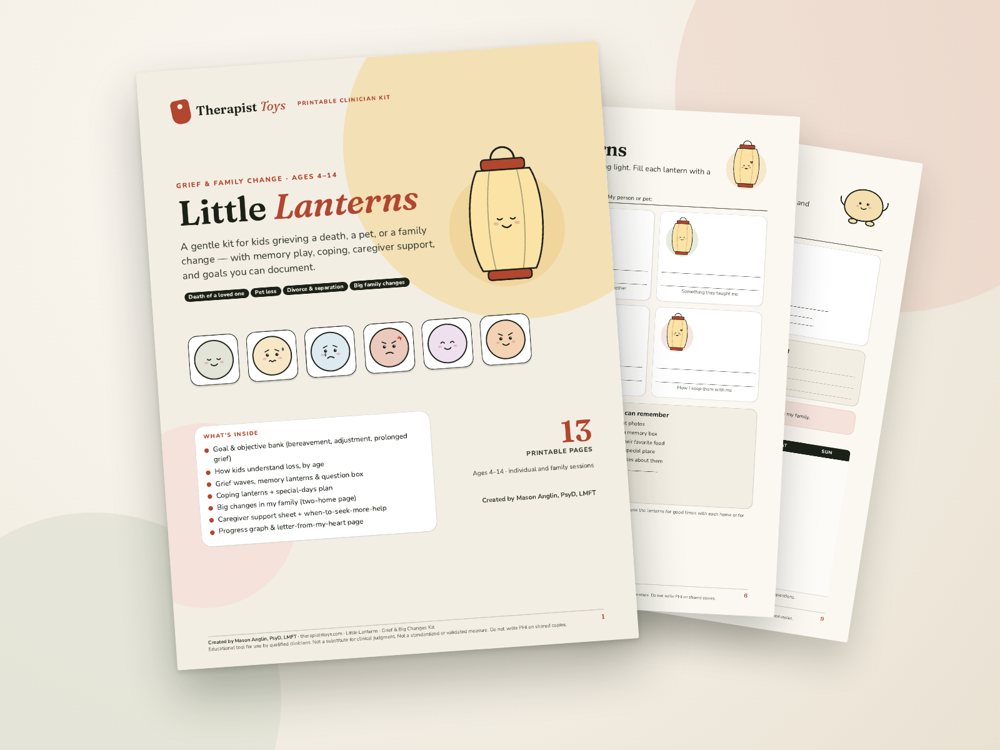
What’s inside
A gentle grief and family-change kit for ages 4–14: how kids understand loss by age, grief waves, memory lanterns, a question box, coping lanterns, a two-home page for divorce, a special-days plan, caregiver support, and a goal bank covering Z63.4, F43.2x, F43.81, and Z63.5.
- Goal & objective bank (bereavement, adjustment, prolonged grief)
- How kids understand loss, by age
- Grief waves, memory lanterns & question box
- Coping lanterns + special-days plan
- Big changes in my family (two-home page)
- Caregiver support sheet + when-to-seek-more-help
- Progress graph & letter-from-my-heart page
All 13 pages, and who each is for
- Cover · cover
- How to use this kit · Clinician
- Grief & change goal bank · Clinician
- How kids understand loss, by age · Clinician + caregiver
- My grief waves · Child
- My memory lanterns · Child
- My question box · Child + caregiver
- My coping lanterns · Child
- Big changes in my family · Child
- Special days plan · Child + family
- Supporting a grieving child · Caregiver
- Progress graph & session log · Clinician
- A letter from my heart · Child

Page 1: Cover 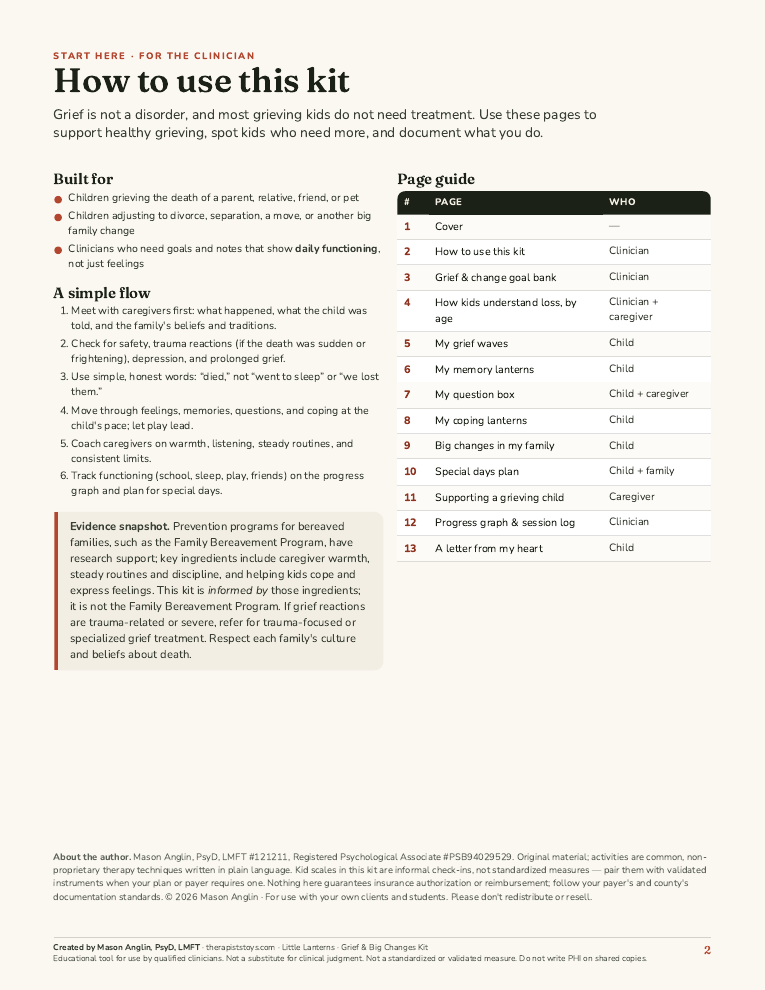
Page 2: How to use this kit 
Page 6: My memory lanterns 
Page 8: My coping lanterns
How clinicians use it
Grief is not a disorder, and most grieving kids do not need treatment. Use these pages to support healthy grieving, spot kids who need more, and document what you do.
Built for
- Children grieving the death of a parent, relative, friend, or pet
- Children adjusting to divorce, separation, a move, or another big family change
- Clinicians who need goals and notes that show daily functioning, not just feelings
A simple flow
- Meet with caregivers first: what happened, what the child was told, and the family's beliefs and traditions.
- Check for safety, trauma reactions (if the death was sudden or frightening), depression, and prolonged grief.
- Use simple, honest words: “died,” not “went to sleep” or “we lost them.”
- Move through feelings, memories, questions, and coping at the child's pace; let play lead.
- Coach caregivers on warmth, listening, steady routines, and consistent limits.
- Track functioning (school, sleep, play, friends) on the progress graph and plan for special days.
Informed by
From the kit’s evidence snapshot: Prevention programs for bereaved families, such as the Family Bereavement Program, have research support; key ingredients include caregiver warmth, steady routines and discipline, and helping kids cope and express feelings. This kit is informed by those ingredients; it is not the Family Bereavement Program. If grief reactions are trauma-related or severe, refer for trauma-focused or specialized grief treatment. Respect each family's culture and beliefs about death.
Get Little Lanterns: Grief & Big Changes Kit
Digital PDF, delivered right after purchase. Questions or refunds: contact us.
Mason’s own product; Therapist Front Page earns from these sales.
Created by Mason Anglin, PsyD, LMFT #121211, Registered Psychological Associate #PSB94029529
An educational tool for qualified clinicians. It is not a substitute for clinical judgment, it isn’t a standardized or validated measure, and it doesn’t guarantee insurance authorization or reimbursement. Licensed for use with your own clients; please don’t redistribute or resell it.