Child anxiety · ages 5–12
Brave Steps: Child Anxiety Kit
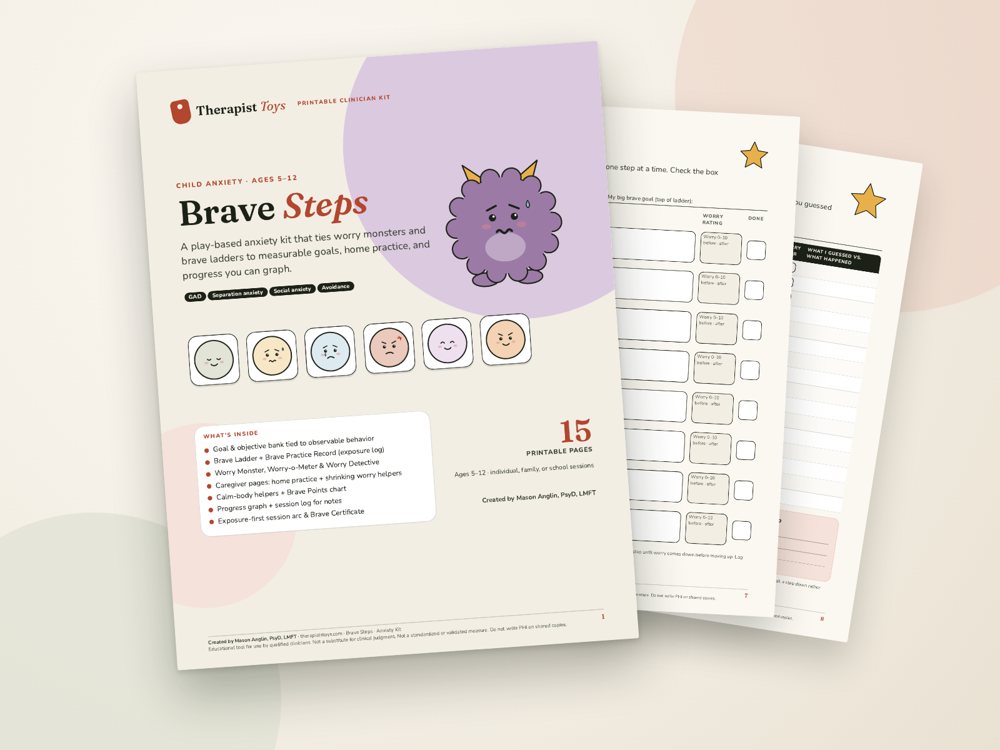
A play-based anxiety kit that ties worry monsters and brave ladders to measurable goals, home practice, and progress you can graph.
15 printable pages · US Letter PDF · Ages 5–12 · individual, family, or school sessions
Digital PDF, delivered right after purchase. Questions or refunds: contact us. Checkout is by Stripe; the seller on your receipt is Advantage Coaching, LLC. After paying you’ll go straight to your download page, delivered through our sister shop, Therapist Toys.
Mason’s own product; Therapist Front Page earns from these sales.
What’s inside
Exposure-first anxiety work for ages 5–12: a measurable goal bank, a 0–10 Worry-o-Meter, Worry Monster and Worry Detective pages, a Brave Ladder with a Brave Practice Record, caregiver pages for home practice and shrinking family accommodation, and a progress graph for notes and plan reviews.
- Goal & objective bank tied to observable behavior
- Brave Ladder + Brave Practice Record (exposure log)
- Worry Monster, Worry-o-Meter & Worry Detective
- Caregiver pages: home practice + shrinking worry helpers
- Calm-body helpers + Brave Points chart
- Progress graph + session log for notes
- Exposure-first session arc & Brave Certificate
All 15 pages, and who each is for
- Cover · cover
- How to use this kit · Clinician
- Anxiety goal & objective bank · Clinician
- Meet my Worry Monster · Child
- My Worry-o-Meter · Child
- Worry Detective · Child
- My Brave Ladder · Child + clinician
- Brave Practice Record · Child + clinician
- Calm-body helpers · Child
- Brave Points chart · Child + caregiver
- Caregiver home practice · Caregiver
- Shrinking the worry helpers · Caregiver + clinician
- Progress graph & session log · Clinician
- Exposure-first session arc · Clinician
- Brave Certificate · Child

Page 1: Cover 
Page 2: How to use this kit 
Page 7: My Brave Ladder 
Page 13: Progress graph & session log
How clinicians use it
Use these pages to turn what happens in play into goals you can measure, notes you can write, and practice families actually do at home.
Built for
- Children 5–12 with worry, fears, separation distress, or social avoidance
- Individual, family, school-based, and telehealth sessions (screen-share the child pages)
- Clinicians who need goals, notes, and reviews that show observable change
A simple flow
- Collect a baseline: Worry-o-Meter, plus caregiver counts of avoidance and reassurance-seeking.
- Pick 1–3 objectives from the goal bank and fill in the blanks with the baseline.
- Explain worry with the Worry Monster; bring caregivers in early.
- Build the Brave Ladder by session 3–5 and log every practice on the Brave Practice Record.
- Coach caregivers to model brave coping and shrink accommodation one step at a time.
- Plot ratings on the progress graph so trends are easy to document.
Informed by
From the kit’s evidence snapshot: Research reviews from the Society of Clinical Child & Adolescent Psychology (effectivechildtherapy.org) list CBT, exposure, modeling, and caregiver-involved CBT among the best-supported approaches for youth anxiety; for children under 8, family-based CBT has the strongest support. Relaxation alone is not well supported, so calm-body skills here are helpers for brave practice, not the main treatment. Rule out medical causes of physical complaints with the child's medical provider.
Get Brave Steps: Child Anxiety Kit
Digital PDF, delivered right after purchase. Questions or refunds: contact us.
Mason’s own product; Therapist Front Page earns from these sales.
Created by Mason Anglin, PsyD, LMFT #121211, Registered Psychological Associate #PSB94029529
An educational tool for qualified clinicians. It is not a substitute for clinical judgment, it isn’t a standardized or validated measure, and it doesn’t guarantee insurance authorization or reimbursement. Licensed for use with your own clients; please don’t redistribute or resell it.