School avoidance · ages 6–14
Back-to-School Bravely: School Refusal Kit
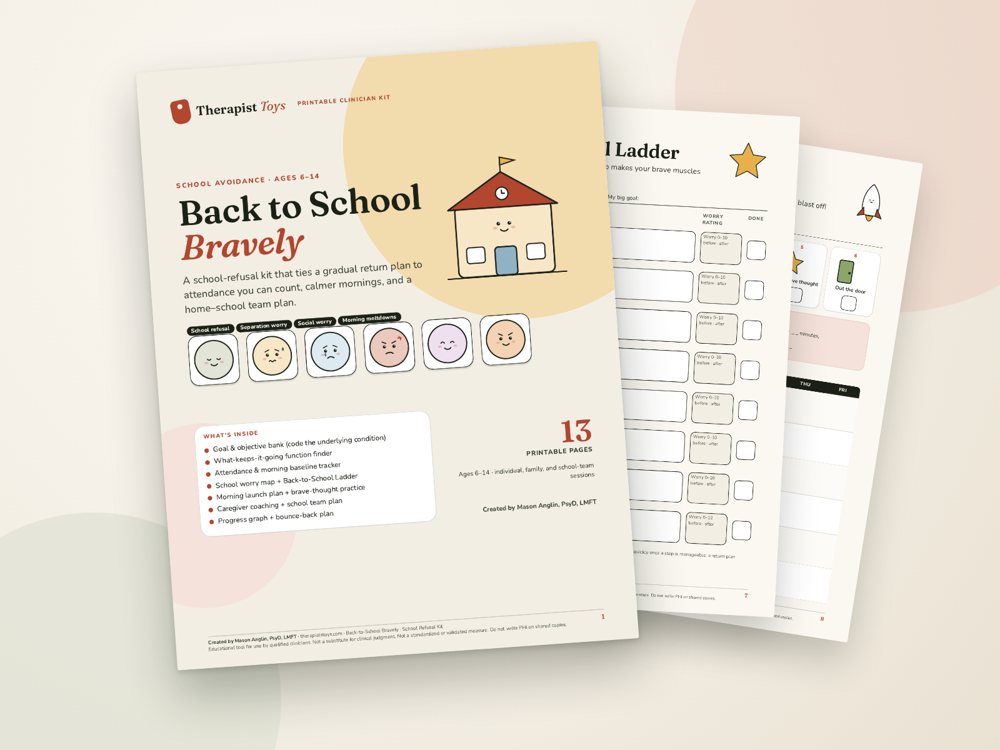
A school-refusal kit that ties a gradual return plan to attendance you can count, calmer mornings, and a home–school team plan.
13 printable pages · US Letter PDF · Ages 6–14 · individual, family, and school-team sessions
Digital PDF, delivered right after purchase. Questions or refunds: contact us. Checkout is by Stripe; the seller on your receipt is Advantage Coaching, LLC. After paying you’ll go straight to your download page, delivered through our sister shop, Therapist Toys.
Mason’s own product; Therapist Front Page earns from these sales.
What’s inside
School refusal tools for ages 6–14: a function finder, a two-week attendance baseline, a school worry map, a Back-to-School Ladder for gradual return, a morning launch plan, brave-thought practice, caregiver coaching, a school team plan, and an attendance graph. Goals code the underlying condition.
- Goal & objective bank (code the underlying condition)
- What-keeps-it-going function finder
- Attendance & morning baseline tracker
- School worry map + Back-to-School Ladder
- Morning launch plan + brave-thought practice
- Caregiver coaching + school team plan
- Progress graph + bounce-back plan
All 13 pages, and who each is for
- Cover · cover
- How to use this kit · Clinician
- School-refusal goal & objective bank · Clinician
- What keeps it going? (function finder) · Clinician + caregiver
- Attendance & morning tracker · Caregiver + clinician
- My school worry map · Child
- My Back-to-School Ladder · Child + clinician
- Morning launch plan · Child + caregiver
- Worry thoughts → brave thoughts · Child
- Calm, confident mornings · Caregiver
- School team plan · Clinician + school
- Attendance progress graph · Clinician
- Bounce-back plan & brave badges · Child + family

Page 1: Cover 
Page 2: How to use this kit 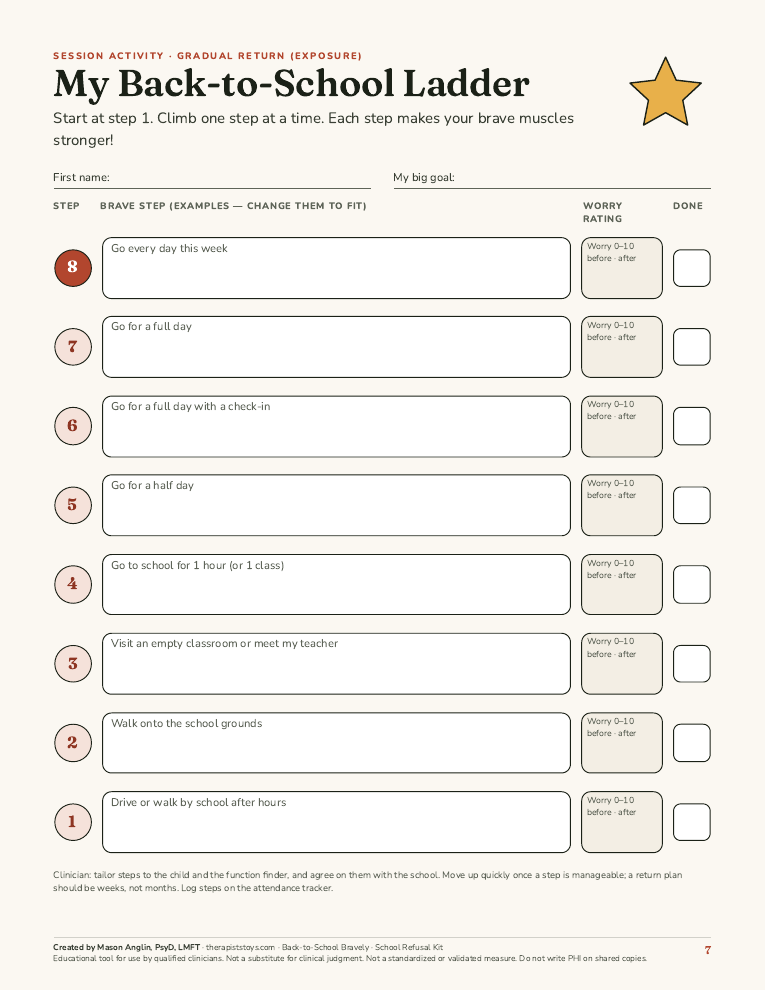
Page 7: My Back-to-School Ladder 
Page 8: Morning launch plan
How clinicians use it
School refusal is a pattern, not a diagnosis. Use these pages to find what keeps it going, set a gradual return plan, and show change in attendance you can count.
Built for
- Children and young teens who refuse, leave early, or arrive late to school because of distress
- Families stuck in hard mornings, and school teams who want a shared plan
- Clinicians who need goals tied to attendance and observable change
A simple flow
- Rule out and address safety first: bullying, harassment, unsafe settings, learning needs, and medical causes of physical complaints.
- Take a 2-week baseline on the attendance tracker (days, partial days, arrival time, morning distress).
- Use the function finder with child and caregiver to see what keeps avoidance going.
- Build the Back-to-School Ladder and start steps quickly; long breaks from school tend to make return harder.
- Coach caregivers on calm, confident mornings and on making home during school hours less rewarding.
- Meet with the school team; agree on one point person and a written plan.
- Graph attendance weekly and update objectives.
Informed by
From the kit’s evidence snapshot: CBT that includes graded exposure (gradual return), caregiver training, and school collaboration has the most research support for school refusal (e.g., Kearney & Albano's function-based treatment and reviews such as Maynard et al., 2018). Code the underlying condition — anxiety, depression, adjustment — not “school refusal.” The function finder here is an informal interview guide written for this kit; it is not the School Refusal Assessment Scale.
The function finder is an informal interview guide written for this kit, informed by the function-based approach to school refusal. Not a standardized or validated measure.
Get Back-to-School Bravely: School Refusal Kit
Digital PDF, delivered right after purchase. Questions or refunds: contact us.
Mason’s own product; Therapist Front Page earns from these sales.
Created by Mason Anglin, PsyD, LMFT #121211, Registered Psychological Associate #PSB94029529
An educational tool for qualified clinicians. It is not a substitute for clinical judgment, it isn’t a standardized or validated measure, and it doesn’t guarantee insurance authorization or reimbursement. Licensed for use with your own clients; please don’t redistribute or resell it.