Clinician toolkit No. 05 · Suicide risk formulation & safety planning
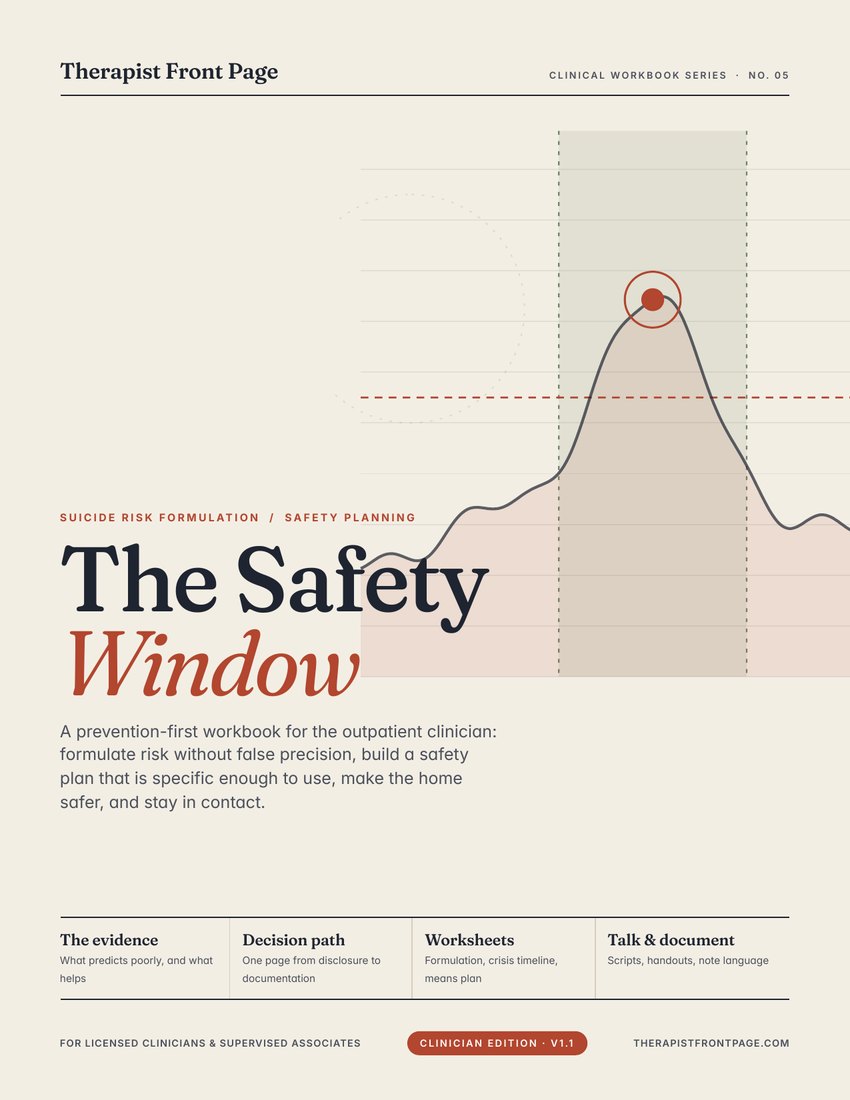
The Safety Window
A prevention-first workbook for the outpatient clinician: formulate risk without false precision, build a safety plan that is specific enough to use, make the home safer, and stay in contact.
19 pages · US Letter PDF, plus a print-friendly version · clinician edition v1.1 · for licensed clinicians and supervised associates
Instant PDF download right after purchase (full-color and print-friendly versions). Questions or refunds: contact us. Checkout is by Stripe; the seller on your receipt is Advantage Coaching, LLC.
Mason’s own product; Therapist Front Page earns from these sales.
What’s inside
Risk prediction is weak; brief, specific interventions are not. This workbook keeps the session focused on understanding this client’s risk now and building a plan they will actually use.
- Two evidence pages: why risk prediction is weak, and what brief, specific interventions do help
- Screens, tools, and licensing, pointing to official sources. No forms are reproduced
- A decision flowchart from a positive screen or disclosure to documentation, with the emergency branch first
- A four-part formulation and a crisis timeline
- A safety-plan quality check and a lethal-means planner
- Follow-up and caring contacts across discharge and transitions
- Scripts, two client handouts (my plan for hard moments, making home safer), documentation language, pitfalls and fixes, and references
All 19 pages
- Cover · p. 01
- How to use this kit · p. 02
- Scope & disclaimer · p. 03
- Evidence: prediction vs prevention · p. 04
- Evidence: what helps · p. 05
- Screens, tools & licensing · p. 06
- Decision flowchart · p. 07
- Four-part formulation · p. 08
- Crisis timeline · p. 09
- Safety plan quality check · p. 10
- Lethal-means planner · p. 11
- Follow-up & caring contacts · p. 12
- Scripts · p. 13
- Client handouts: my plan for hard moments; making home safer · pp. 14–15
- Documentation language · p. 16
- Pitfalls & fixes · p. 17
- References · pp. 18–19

Page 7: Decision flowchart 
Page 8: Four-part formulation 
Page 10: Safety plan quality check 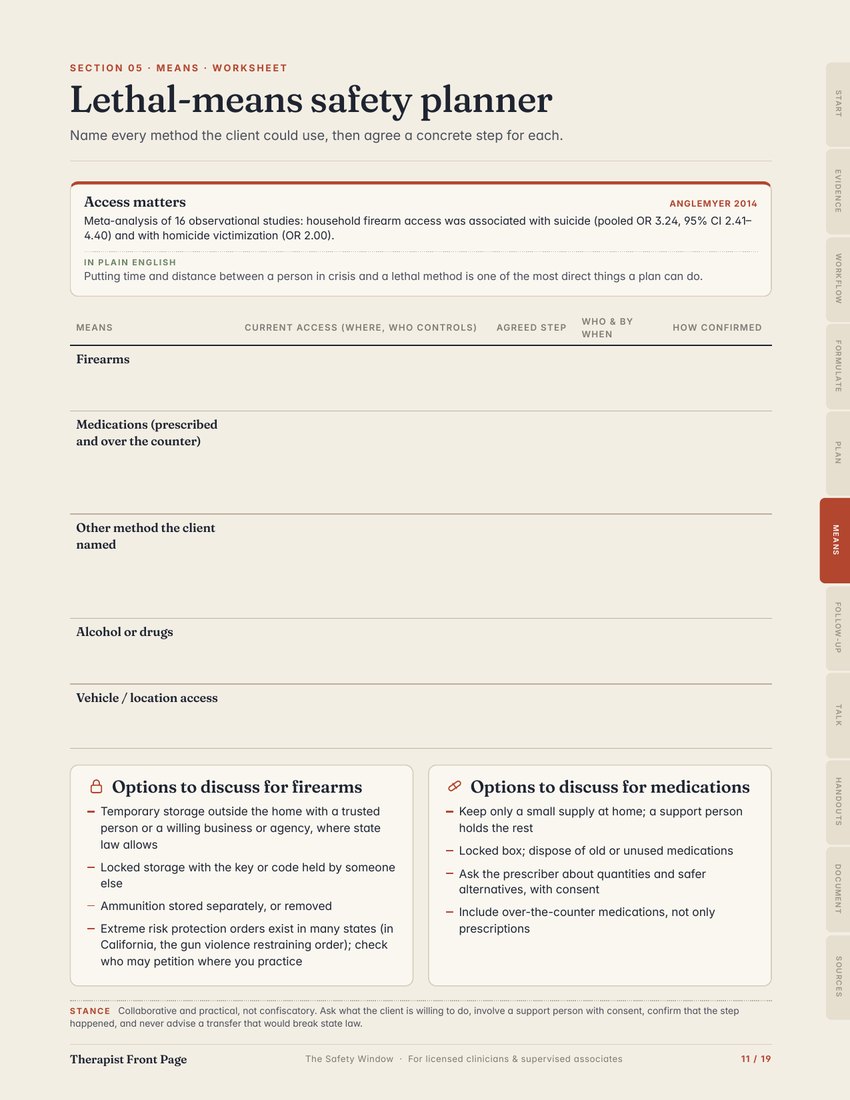
Page 11: Lethal-means planner 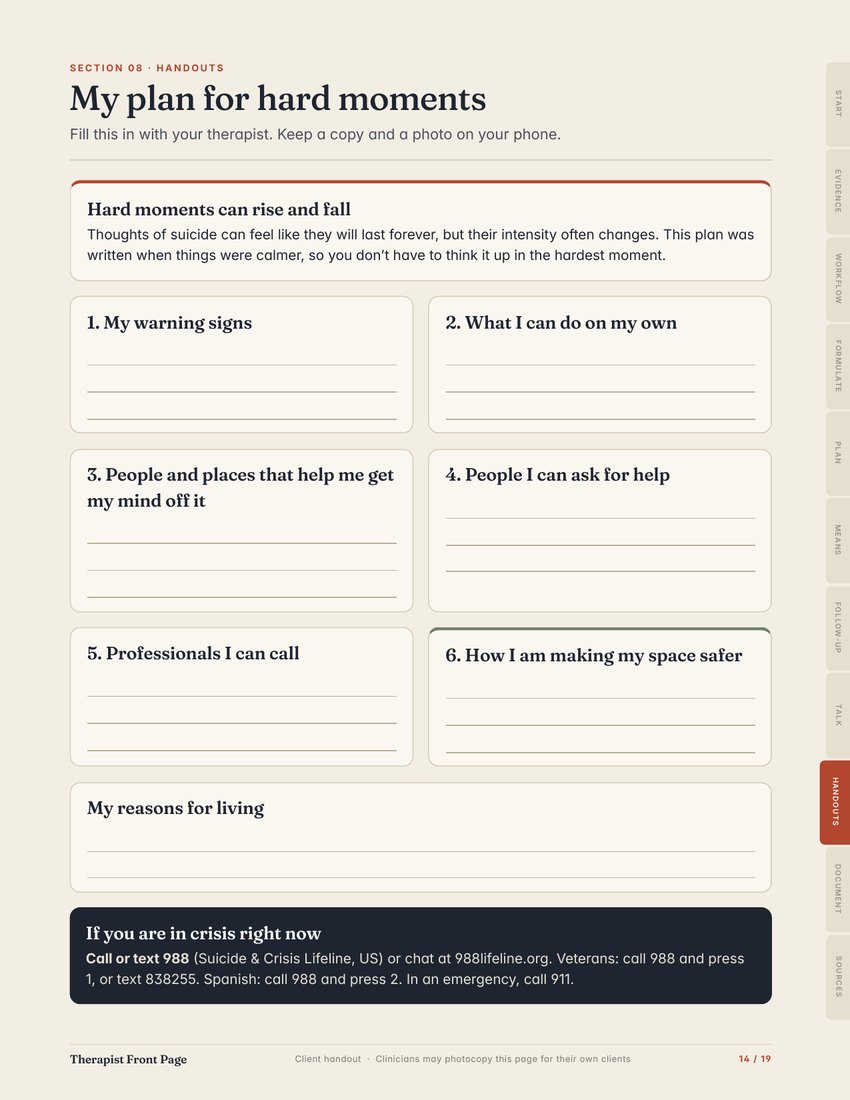
Page 14: Client handout: my plan for hard moments
How clinicians use it
Work it across assessment and the first weeks of treatment, alongside your usual intake and documentation.
Built for
- Outpatient clinicians after a positive screen or a disclosure
- Writing a safety plan with the client, in their words
- Lethal-means conversations with clients and families
- Supervised associates following a same-day supervisor contact plan
A simple flow
- Know the evidence: prediction versus prevention.
- Follow one path, emergency branch first.
- Formulate, don’t just rate: four-part formulation and crisis timeline.
- Build a usable plan and check it against the quality checklist.
- Make the home safer, stay in contact, and document your reasoning.
Scope
This is clinical decision support, not a risk-prediction tool or a way to assign a risk score. It is not a replacement for emergency services, your setting’s protocol, or consultation, and it is not legal advice on hospitalization, duty-to-protect, or firearm laws, which vary by state. The Stanley-Brown Safety Plan and the C-SSRS are copyrighted and are not reproduced; the kit describes what a strong plan contains in original words. If a client is in immediate danger, stop using worksheets and follow your emergency protocol.
Get The Safety Window
Instant PDF download right after purchase (full-color and print-friendly versions). Questions or refunds: contact us. Checkout is by Stripe; the seller on your receipt is Advantage Coaching, LLC.
Mason’s own product; Therapist Front Page earns from these sales.
Created by Mason Anglin, PsyD, LMFT, MBA · LMFT #121211 · Registered Psychological Associate #PSB94029529
An educational, clinical decision-support tool for licensed clinicians and supervised associates. It does not diagnose, it is not a standardized or validated measure, it does not reproduce DSM-5-TR criteria or screener items, and it does not replace clinical judgment, supervision, or protocol training. Licensed for use with your own clients; please don’t redistribute or resell it.