Clinician toolkit No. 02 · Mood instability
The Mood-Shift Differential
A clinician’s workbook for adults whose presenting problem is mood swings, emotional intensity, or unstable relationships: bipolar II, borderline personality, complex trauma, and what else can look like them.
29 pages · US Letter PDF · for licensed clinicians and supervised associates
Digital PDF, delivered right after purchase. Questions or refunds: contact us. Checkout is by Stripe; the seller on your receipt is Advantage Coaching, LLC.
Mason’s own product; Therapist Front Page earns from these sales.
What’s inside
“Mood swings” can mean very different things. This workbook helps you look at the shape of a shift, not just its intensity, and keeps the alternatives in view from the first interview to a plan.
- A presenting-problem intake map that turns “mood swings” into specific recent examples
- Medical, medication, substance, sleep, and life-context rule-outs
- An eight-way differential grid: bipolar II, borderline personality, complex trauma, unipolar depression, ADHD, autism, substance-related, and medical or medication causes, with distinguishing questions
- A mood-shift anatomy page for reading the shape of a shift: duration, trigger, sleep, and what happens between shifts
- Collateral and history prompts
- Pointers to published screening instruments and their terms of use, plus refer and consult triggers. No items are reproduced
- A one-page case formulation summary
- Eight treatment pathways, one page each (bipolar II, borderline personality, complex trauma, borderline plus PTSD, unipolar depression, ADHD, autism, substance-related), with cited approaches, in-session moves, tracking, and when to refer
- A plan page, a risk and safety page, a plain-language client explanation script, notes and life-chart pages, and full references
All 29 pages
- Cover · p. 01
- How to use this workbook · p. 02
- Clinical scope & disclaimer · p. 03
- Presenting-problem intake map · p. 04–05
- Rule-outs & contributors · p. 06–07
- The differential grid · p. 08–09
- Mood-shift anatomy · p. 10
- Collateral & history prompts · p. 11
- Screening & referral · p. 12
- Case formulation summary · p. 13
- Treatment pathways overview · p. 14
- Eight treatment pathways: bipolar II, borderline personality, complex trauma, borderline + PTSD, unipolar depression, ADHD, autism, substance-related · p. 15–22
- Building the plan · p. 23
- Risk & safety across the picture · p. 24
- Client explanation script · p. 25
- Notes & life chart · p. 26–27
- References · p. 28–29
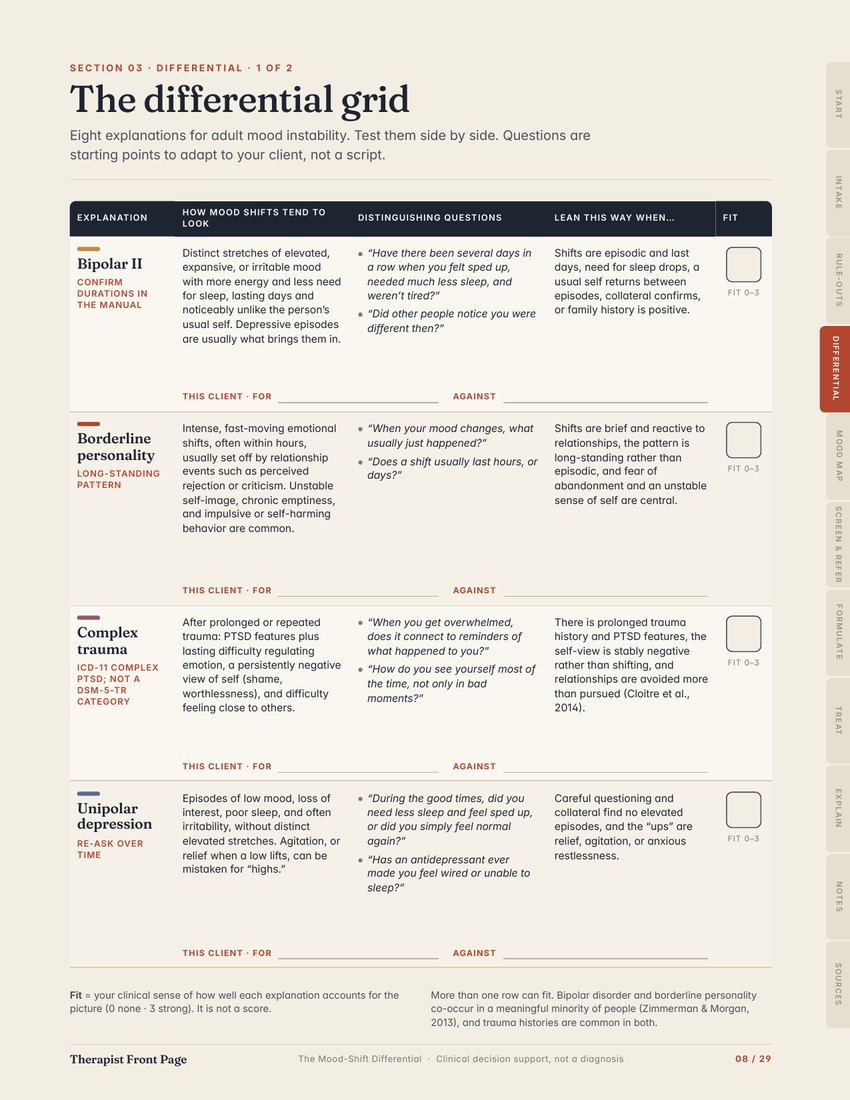
Page 8: The eight-way differential grid 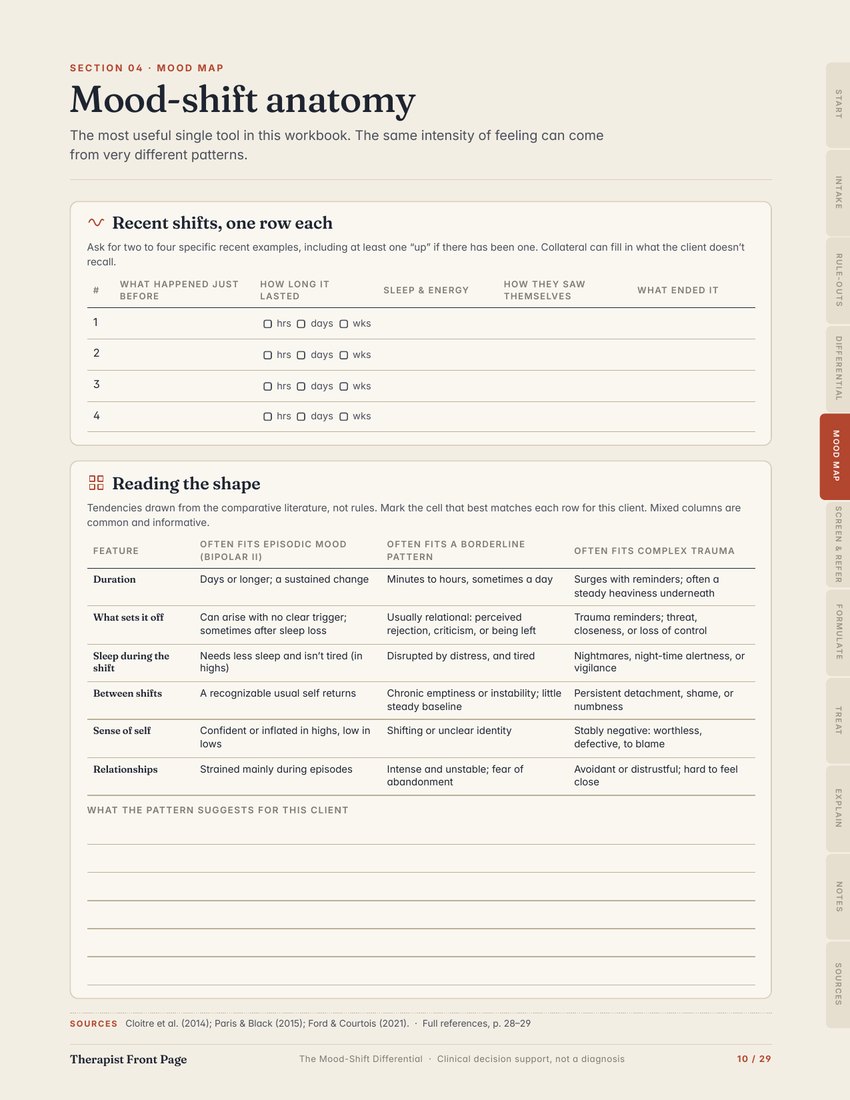
Page 10: Mood-shift anatomy 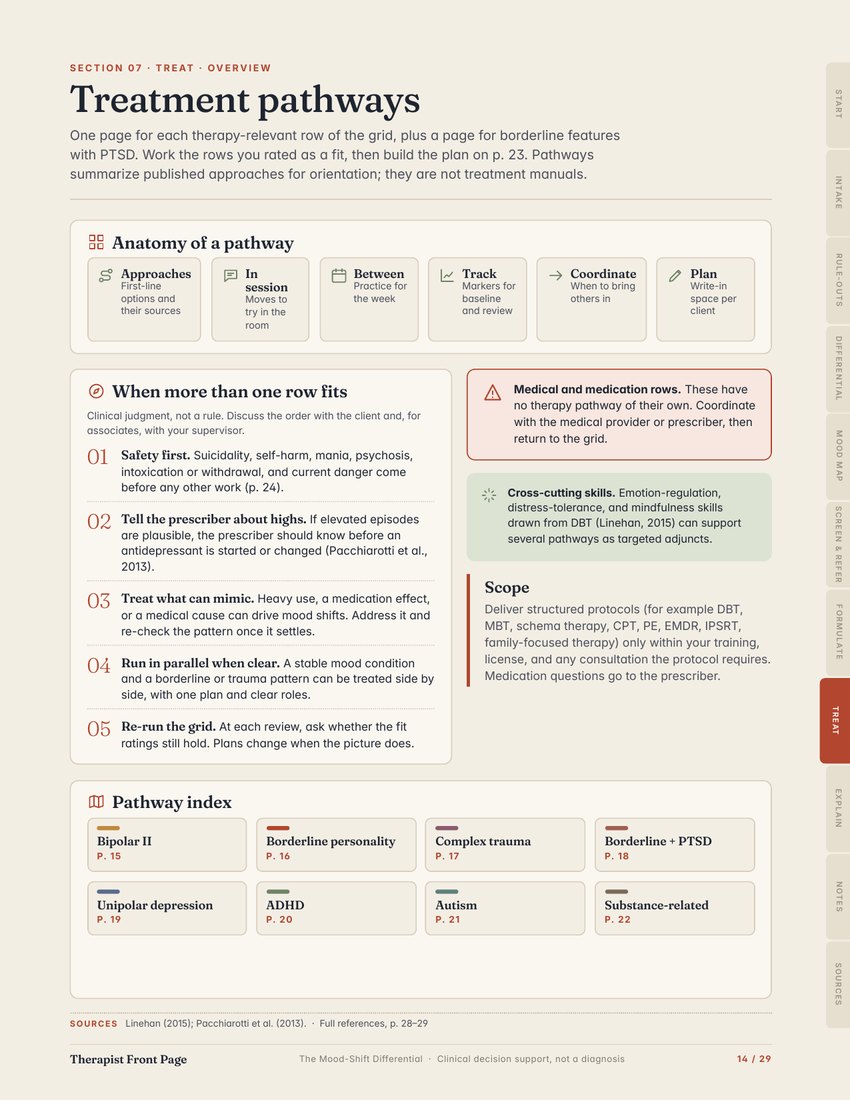
Page 14: Treatment pathways overview 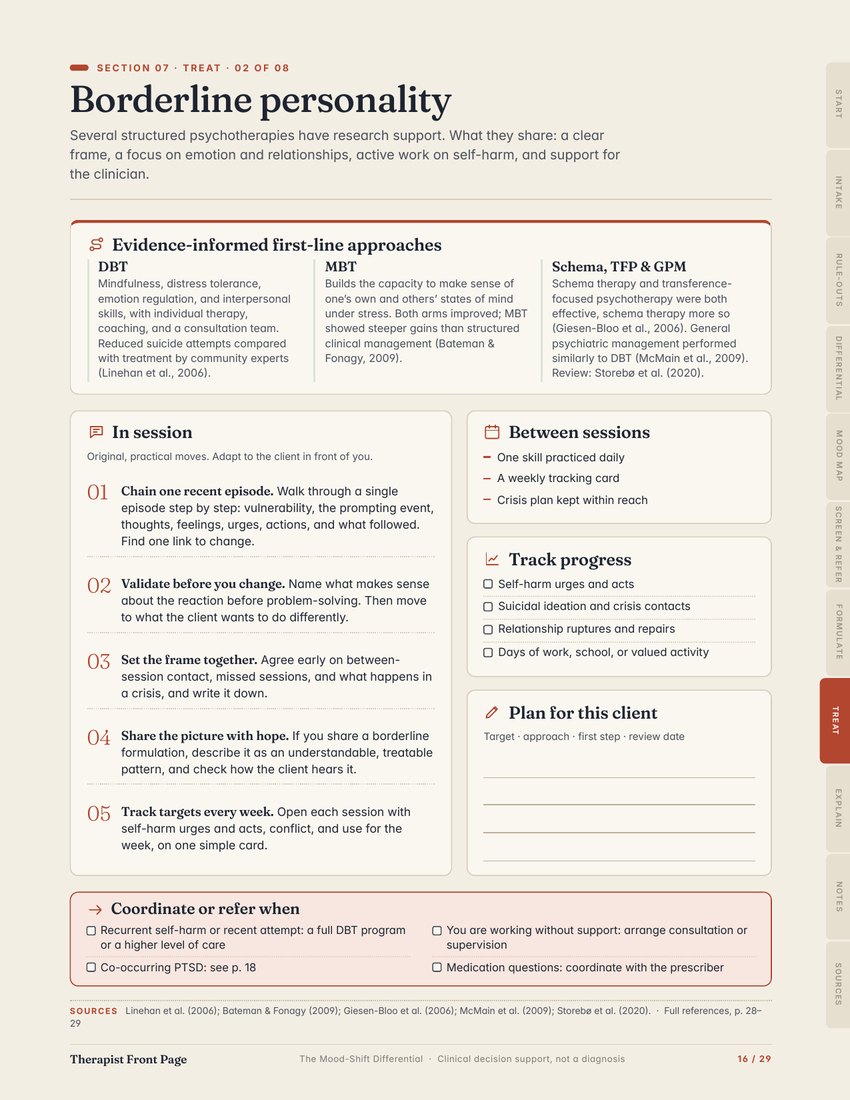
Page 16: Treatment pathway: borderline personality 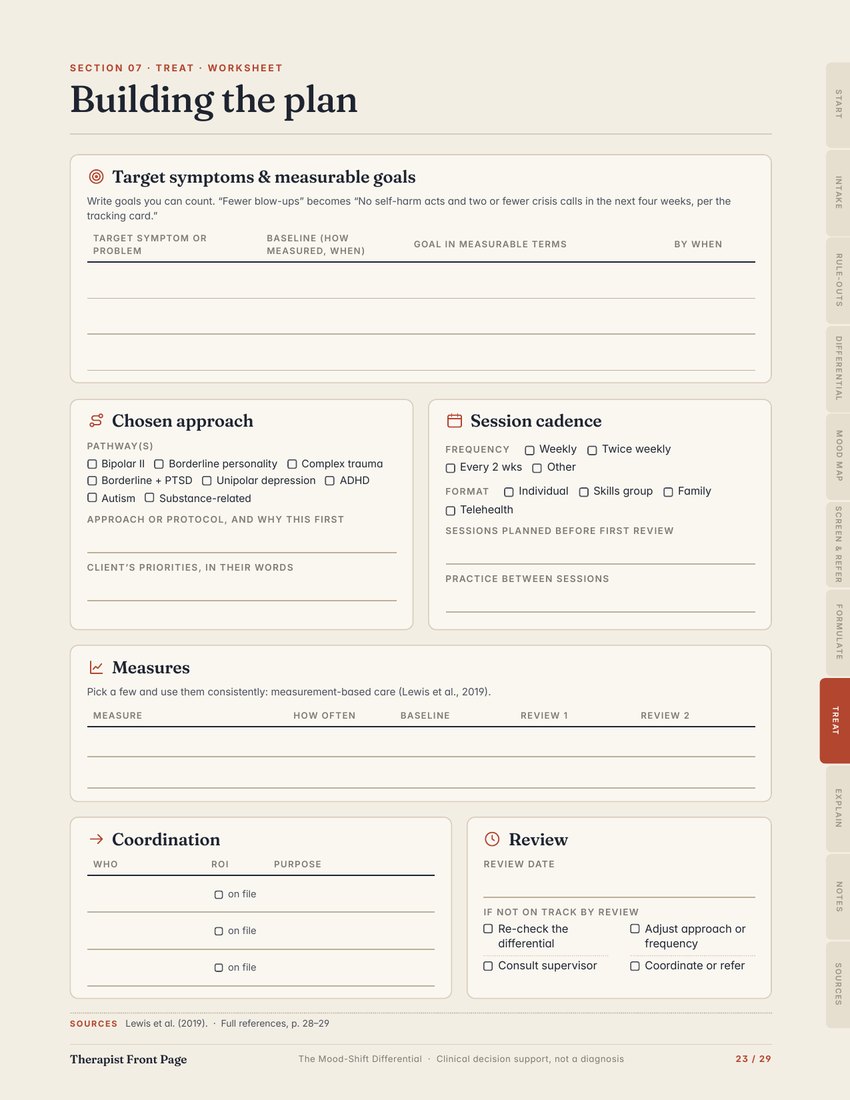
Page 23: Building the plan 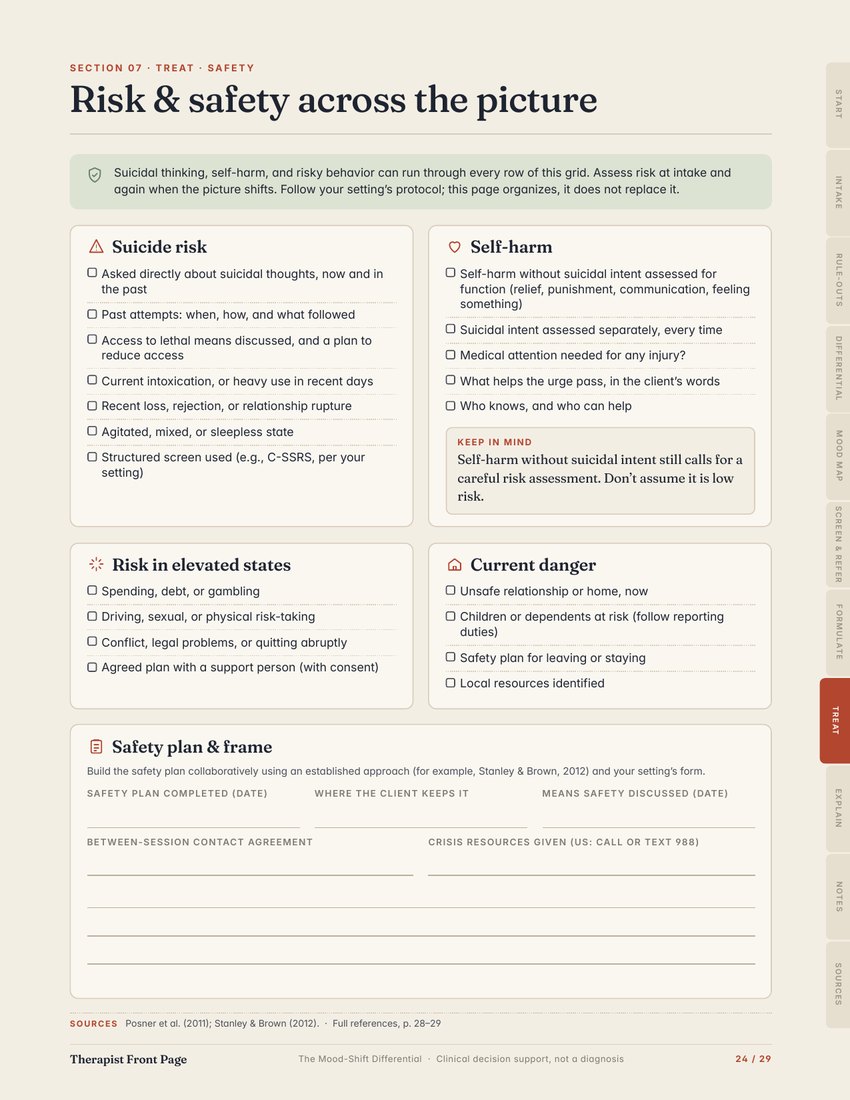
Page 24: Risk and safety across the picture
How clinicians use it
Work it across the first few sessions, alongside your usual intake and documentation.
Built for
- Adults describing mood swings, emotional intensity, or unstable relationships
- Clients who arrive sure they are bipolar, or who have been told they are
- Clients with trauma histories where mood shifts are part of the picture
- Supervised associates working through a differential with their supervisor
A simple flow
- Unpack “mood swings” into two or three specific recent examples.
- Clear medical, medication, substance, and sleep contributors.
- Map the shape of each shift, then run the eight-way grid.
- Corroborate with collateral and screeners where they help.
- Formulate, choose a pathway, and share the working picture with care. Safety comes first throughout.
Scope
This is clinical decision support, not a diagnostic instrument. It paraphrases concepts for orientation and points you to the DSM-5-TR and ICD-11 for criteria. It does not reproduce them. Screeners are referenced with where to obtain them, not reproduced. Treatment pathways summarize published approaches, with sources, and are not treatment manuals. Medication decisions belong with the prescriber. Complex PTSD is an ICD-11 diagnosis with no separate DSM-5-TR category, and the workbook labels it that way.
Get The Mood-Shift Differential
Digital PDF, delivered right after purchase. Questions or refunds: contact us. Checkout is by Stripe; the seller on your receipt is Advantage Coaching, LLC.
Mason’s own product; Therapist Front Page earns from these sales.
Created by Mason Anglin, PsyD, LMFT, MBA · LMFT #121211 · Registered Psychological Associate #PSB94029529
An educational, clinical decision-support tool for licensed clinicians and supervised associates. It does not diagnose, it is not a standardized or validated measure, it does not reproduce DSM-5-TR criteria or screener items, and it does not replace clinical judgment, supervision, or protocol training. Licensed for use with your own clients; please don’t redistribute or resell it.