Clinician toolkit No. 04 · Measurement-based care
The Feedback Loop
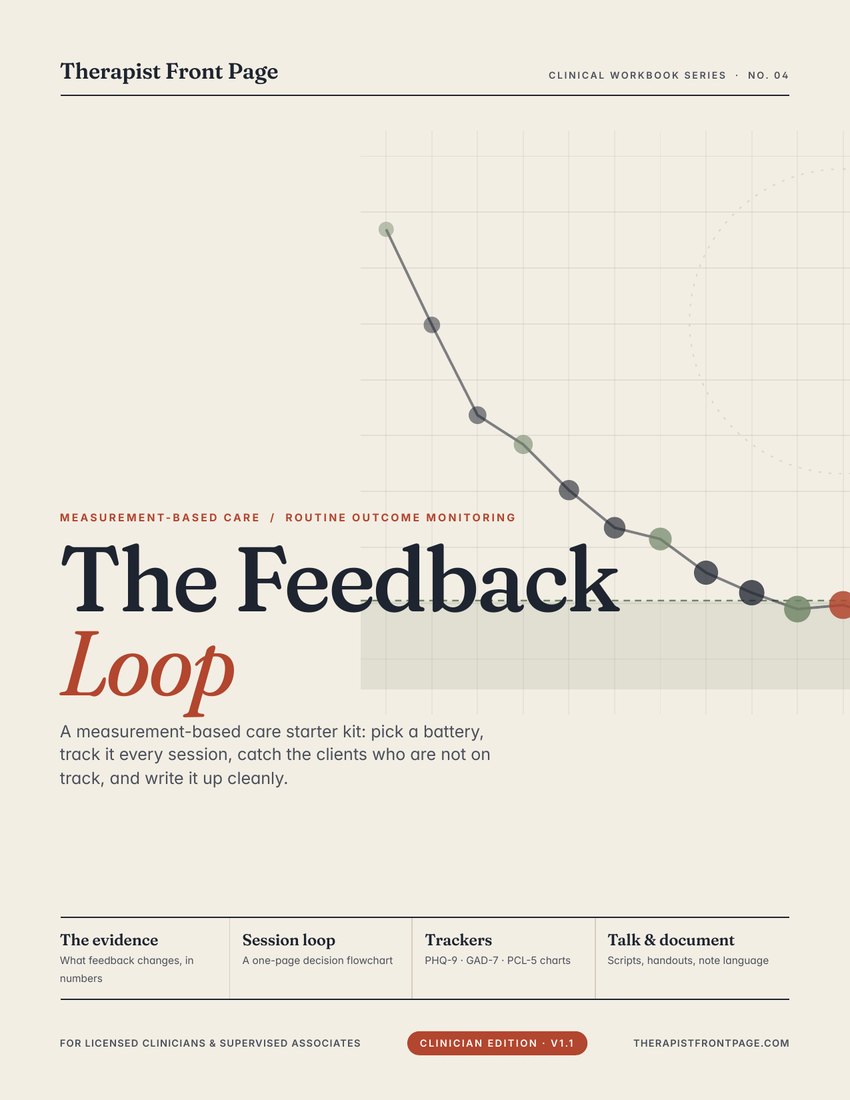
A measurement-based care starter kit: pick a battery, track it every session, catch the clients who are not on track, and write it up cleanly.
18 pages · US Letter PDF, plus a print-friendly version · clinician edition v1.1 · for licensed clinicians and supervised associates
Instant PDF download right after purchase (full-color and print-friendly versions). Questions or refunds: contact us. Checkout is by Stripe; the seller on your receipt is Advantage Coaching, LLC.
Mason’s own product; Therapist Front Page earns from these sales.
What’s inside
Feedback helps most for the clients who are quietly getting worse. This kit gives you a small, legal battery, a session loop, and the words to make measures collaborative.
- Two evidence pages: what routine feedback changes, in numbers, and the numbers behind the measures, each figure quoted from its source
- A one-page session-loop flowchart, with the self-harm branch first
- Choosing a small battery, with a licensing table that points to the official, current version of each measure
- A PHQ-9 and GAD-7 tracker, and a PCL-5 tracker with reliable-change and benchmark values
- A structured not-on-track review: eight places to look when the line isn’t moving
- Scripts for using measures, two client handouts (why check-ins, my progress chart), and documentation language
- Pitfalls and fixes, a 30-day implementation plan, and references
All 18 pages
- Cover · p. 01
- How to use this kit · p. 02
- Scope & disclaimer · p. 03
- The evidence for feedback · p. 04
- The numbers behind the measures · p. 05
- The session loop flowchart · p. 06
- Choosing a battery & licensing · p. 07
- PHQ-9 & GAD-7 tracker · p. 08
- PCL-5 tracker & reliable change · p. 09
- Not-on-track review · p. 10
- Scripts for using measures · p. 11
- Client handouts: why check-ins; my progress chart · pp. 12–13
- Documentation language · p. 14
- Pitfalls & fixes · p. 15
- 30-day implementation plan · p. 16
- References · pp. 17–18

Page 6: The session loop flowchart 
Page 7: Choosing a battery & licensing 
Page 8: PHQ-9 & GAD-7 tracker 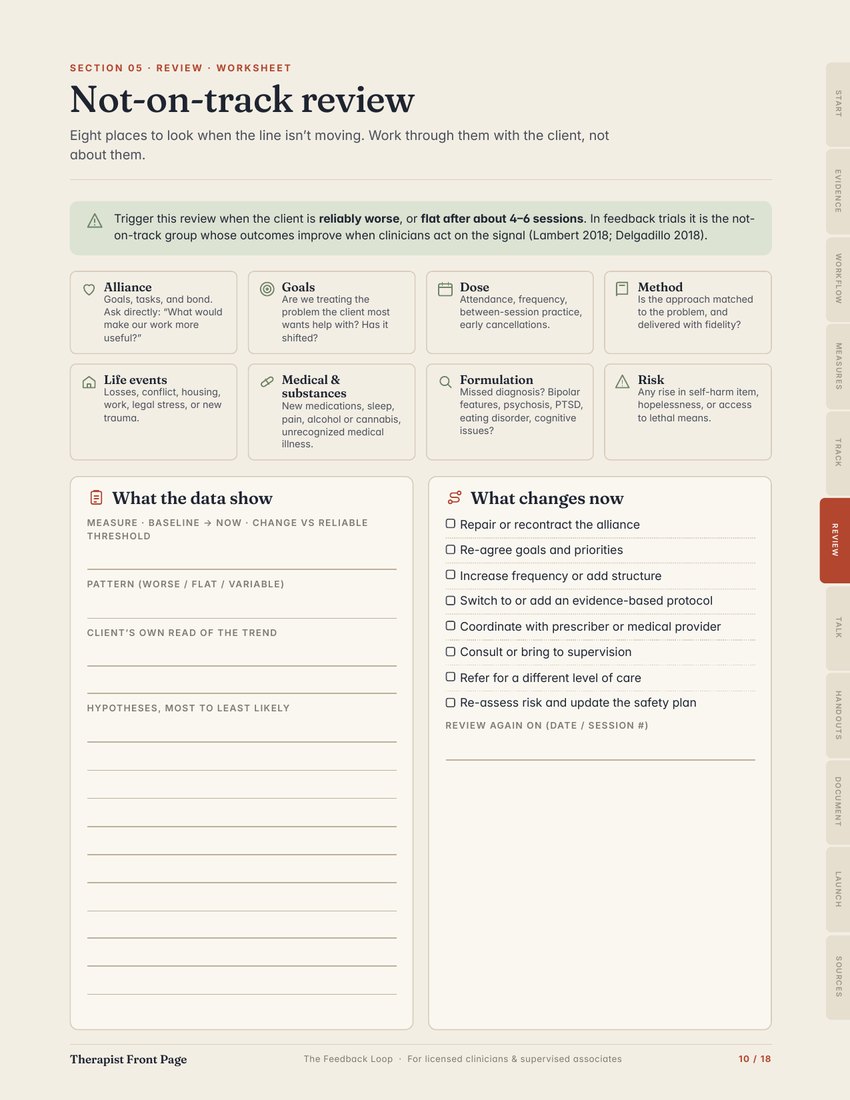
Page 10: Not-on-track review 
Page 13: Client handout: my progress chart
How clinicians use it
Work it across assessment and the first weeks of treatment, alongside your usual intake and documentation.
Built for
- Outpatient therapists starting measurement-based care
- Practices that need to show progress to supervisors or payers
- Clients whose progress has stalled or quietly slipped
- Supervised associates building a consistent tracking habit
A simple flow
- Know why it works: two evidence pages.
- Run the loop: measure at the start of each session and look at the trend together.
- Choose a small battery: one core measure plus one or two targeted ones.
- Track and judge change with reliable-change values.
- Review what is off track, then talk and document.
Scope
This is clinical decision support, not a test, and it does not produce a diagnosis. No item text from any questionnaire is reproduced; the kit tracks total scores and points to each measure’s official source. It is not a replacement for suicide risk assessment when a measure flags risk, or for your payer, agency, or EHR requirements. Screening cut-points are reference points from specific samples, not diagnostic rules.
Get The Feedback Loop
Instant PDF download right after purchase (full-color and print-friendly versions). Questions or refunds: contact us. Checkout is by Stripe; the seller on your receipt is Advantage Coaching, LLC.
Mason’s own product; Therapist Front Page earns from these sales.
Created by Mason Anglin, PsyD, LMFT, MBA · LMFT #121211 · Registered Psychological Associate #PSB94029529
An educational, clinical decision-support tool for licensed clinicians and supervised associates. It does not diagnose, it is not a standardized or validated measure, it does not reproduce DSM-5-TR criteria or screener items, and it does not replace clinical judgment, supervision, or protocol training. Licensed for use with your own clients; please don’t redistribute or resell it.