Clinician toolkit No. 08 · OCD in adults
The Exposure Map
A clinician’s workbook for OCD in adults: a careful differential, exposure and response prevention delivered well, and a plan for when progress stalls.
26 pages · US Letter PDF, plus a print-friendly version · clinician edition v1.1 · for licensed clinicians and supervised associates
Instant PDF download right after purchase (full-color and print-friendly versions). Questions or refunds: contact us. Checkout is by Stripe; the seller on your receipt is Advantage Coaching, LLC.
Mason’s own product; Therapist Front Page earns from these sales.
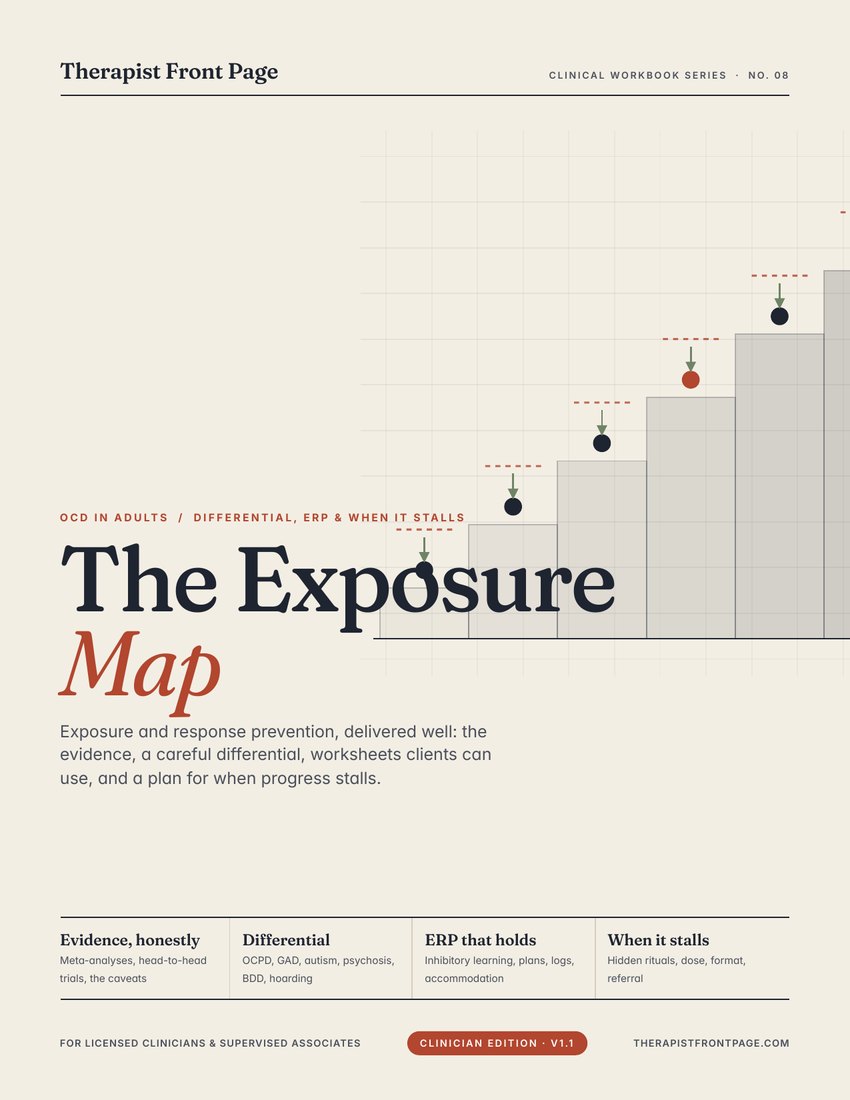
What’s inside
ERP-based CBT is the first-line psychological treatment for OCD, with large effects that hold. The caveats are real, and hidden rituals are easy to miss. This workbook takes you from the first interview through a measured course of ERP.
- Evidence on three pages: meta-analyses, controlled trials, and newer formats and alternatives, with exact figures and their caveats
- An intake map that asks about mental rituals, reassurance seeking and family accommodation, plus a suicide screen prompt
- Measurement and licensing: which severity measures you may use and how, consensus response and remission definitions, and a tracking chart
- Two differential grids (worry, OCPD, depressive rumination, health anxiety, panic, autistic routines, psychosis and insight, tics, BDD, hoarding)
- A page on taboo intrusive thoughts (harm, sexual, perinatal): obsession or risk, and reporting duties
- A formulation worksheet, a treatment-planning flowchart, exposure design principles, an exposure plan and practice log, and exposure ideas by theme
- Reassurance and family accommodation, and a checklist for when ERP stalls
- Scripts, two client handouts, documentation language, treatment-plan goals, pitfalls, and 45 verified references
All 26 pages
- Cover · p. 01
- How to use this kit · p. 02
- Scope & disclaimer · p. 03
- Evidence: meta-analyses, controlled trials, formats & alternatives · pp. 04–06
- Intake map · p. 07
- Measurement & tracking · p. 08
- Differential grids · pp. 09–10
- Taboo intrusions vs risk · p. 11
- Formulation worksheet · p. 12
- Treatment-planning flowchart · p. 13
- ERP design principles · p. 14
- Exposure plan & log · p. 15
- Exposure ideas by theme · p. 16
- Reassurance & accommodation · p. 17
- When ERP stalls · p. 18
- Scripts · p. 19
- Client handouts: OCD and ERP; family and partners · pp. 20–21
- Documentation & goals · p. 22
- Pitfalls & fixes · p. 23
- References · pp. 24–26

Page 9: Differential grid: worry, OCPD and mood 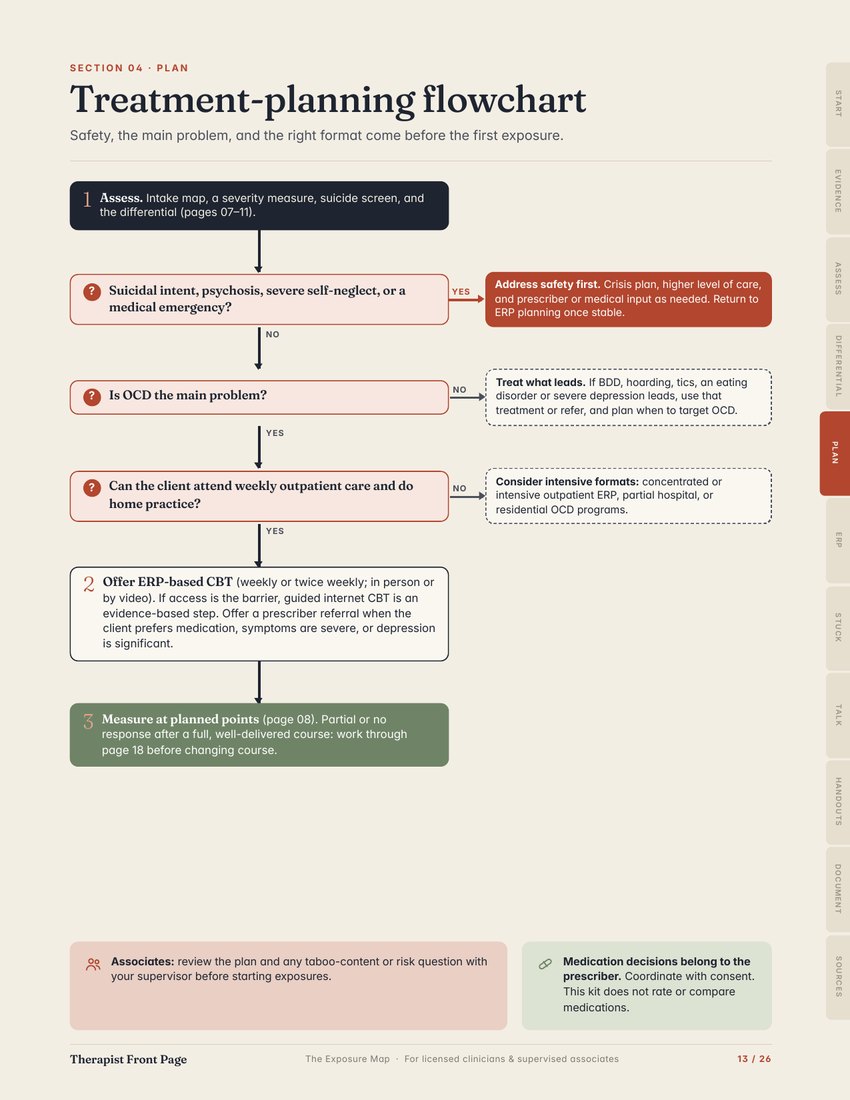
Page 13: Treatment-planning flowchart 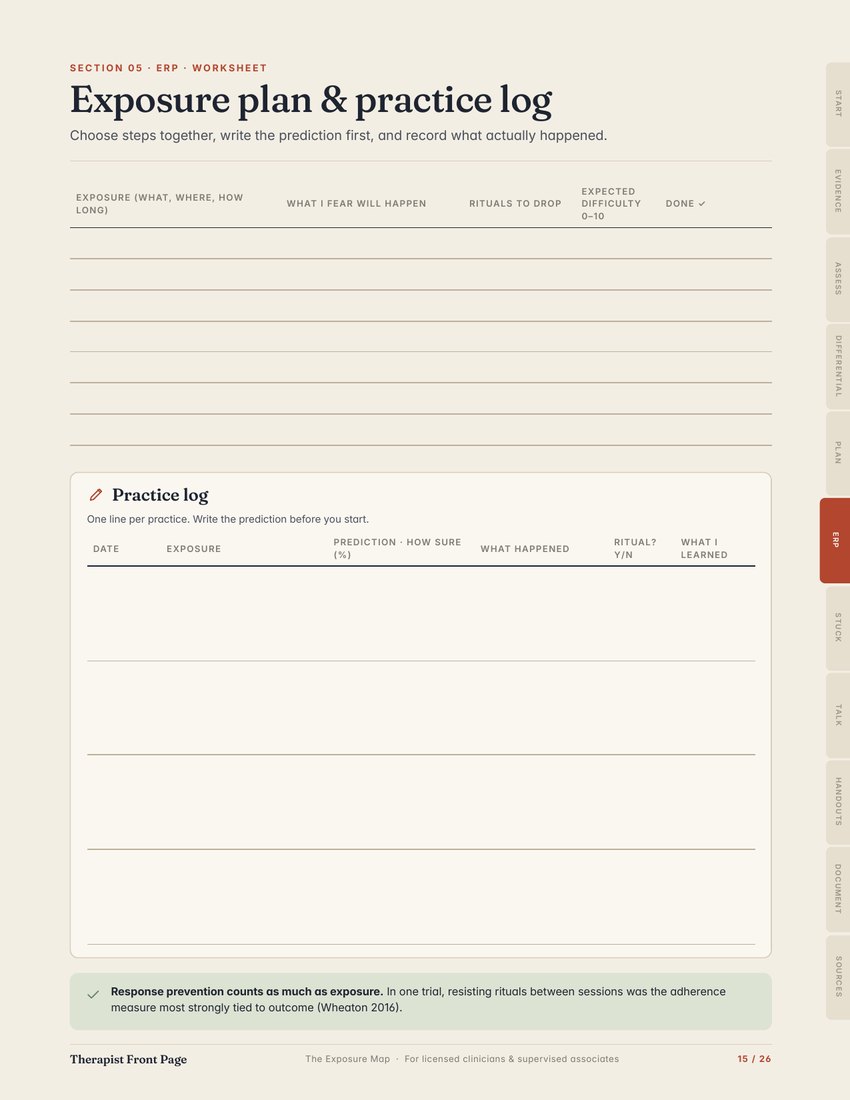
Page 15: Exposure plan & practice log 
Page 18: When ERP stalls: a checklist 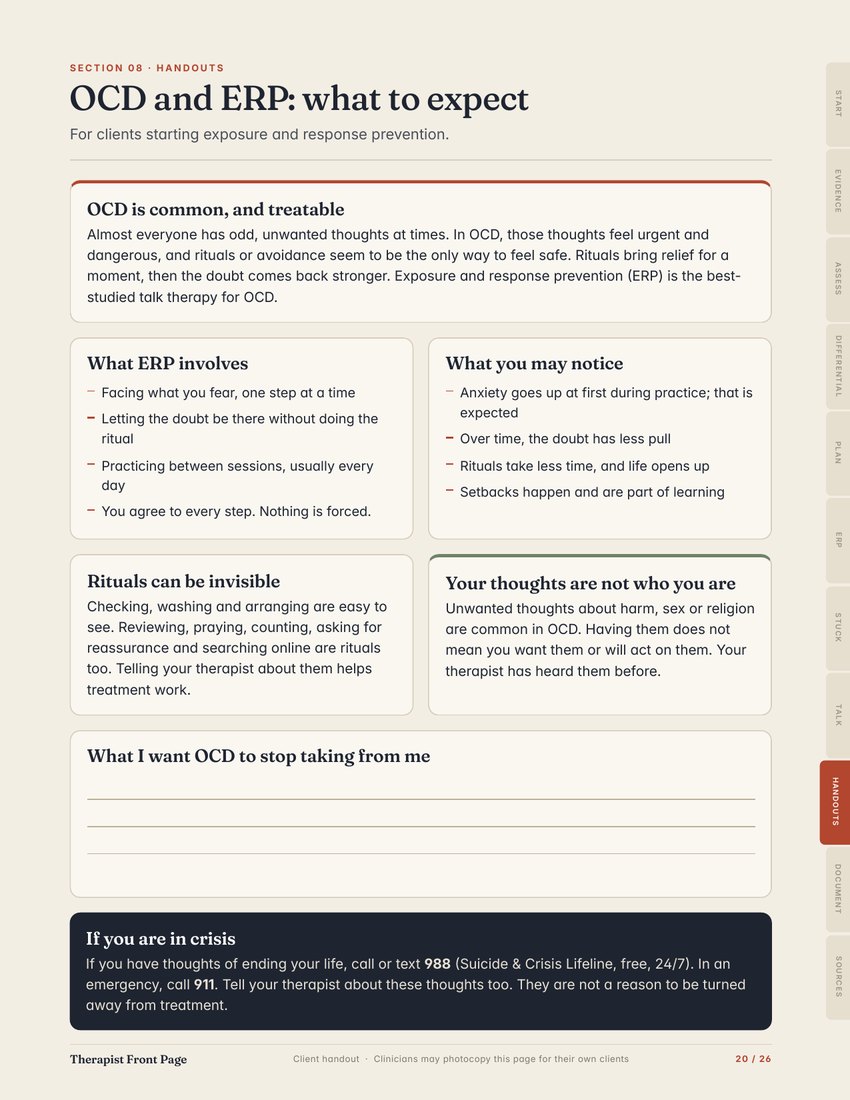
Page 20: Client handout: OCD and ERP
How clinicians use it
Work it across assessment and the first weeks of treatment, alongside your usual intake and documentation.
Built for
- Adults with obsessions, rituals, reassurance seeking or avoidance
- Clients with harm, sexual, religious or perinatal intrusive thoughts
- ERP that has stalled, including clients already prescribed medication who still have symptoms (coordinate with the prescriber)
- Supervised associates planning exposure work with their supervisor
A simple flow
- Map obsessions, rituals and accommodation at intake.
- Work through the differential and the taboo-thought page.
- Formulate the cycle and choose the format.
- Design exposures around feared predictions and track practice.
- Measure at planned points and troubleshoot with the stall checklist.
Scope
This is clinical decision support, not a diagnostic instrument or a treatment manual. It does not reproduce DSM-5-TR criteria text or the items of any instrument. Severity measures are described with their licensing terms and where to obtain them; the Y-BOCS requires permission from its copyright holder even for paper clinical use. The taboo-thought page is a clinical-judgment synthesis, not a validated risk tool. Medication is outside its scope: the kit does not rate, rank, or compare medications, and prescribing decisions belong with the prescriber.
Get The Exposure Map
Instant PDF download right after purchase (full-color and print-friendly versions). Questions or refunds: contact us. Checkout is by Stripe; the seller on your receipt is Advantage Coaching, LLC.
Mason’s own product; Therapist Front Page earns from these sales.
Created by Mason Anglin, PsyD, LMFT, MBA · LMFT #121211 · Registered Psychological Associate #PSB94029529
An educational, clinical decision-support tool for licensed clinicians and supervised associates. It does not diagnose, it is not a standardized or validated measure, it does not reproduce DSM-5-TR criteria or screener items, and it does not replace clinical judgment, supervision, or protocol training. Licensed for use with your own clients; please don’t redistribute or resell it.