Clinician toolkit No. 01 · Adult inattention
The Attention Differential
A clinician’s workbook for adults whose presenting problem is focus, attention, or disorganization: ADHD and the conditions that can look like it.
29 pages · US Letter PDF, plus a print-friendly version · clinician edition v1.1 · for licensed clinicians and supervised associates
Instant PDF download right after purchase (full-color and print-friendly versions). Questions or refunds: contact us. Checkout is by Stripe; the seller on your receipt is Advantage Coaching, LLC.
Mason’s own product; Therapist Front Page earns from these sales.
What’s inside
Inattention in adults has many possible sources. This workbook walks you from the first interview to a plan, keeping the alternatives in view the whole way.
- A presenting-problem intake map: onset, course, settings, and impairment
- Medical, medication, substance, sleep, and load rule-outs
- A ten-way differential grid with distinguishing questions and a fit rating
- Collateral and history prompts
- Pointers to published screening instruments, plus referral triggers
- A one-page case formulation summary
- Ten treatment pathways, one page each, with cited psychological approaches, in-session moves, tracking, and when to refer or coordinate with a prescriber
- A plan page with measurable goals, a plain-language client explanation script, notes pages, and full references
All 29 pages
- Cover · p. 01
- How to use this workbook · p. 02
- Clinical scope & disclaimer · p. 03
- Presenting-problem intake map · pp. 04–05
- Rule-outs & contributors · pp. 06–07
- The differential grid · pp. 08–09
- Collateral & history prompts · p. 10
- Screening instruments & referral · p. 11
- Case formulation summary · p. 12
- Treatment pathways overview · p. 13
- Ten treatment pathways: ADHD, depression, anxiety, trauma, bipolar, substance-related, sleep, learning disorder, autism, cognitive change · pp. 14–23
- Building the plan · p. 24
- Client explanation script · p. 25
- Notes · pp. 26–27
- References · pp. 28–29
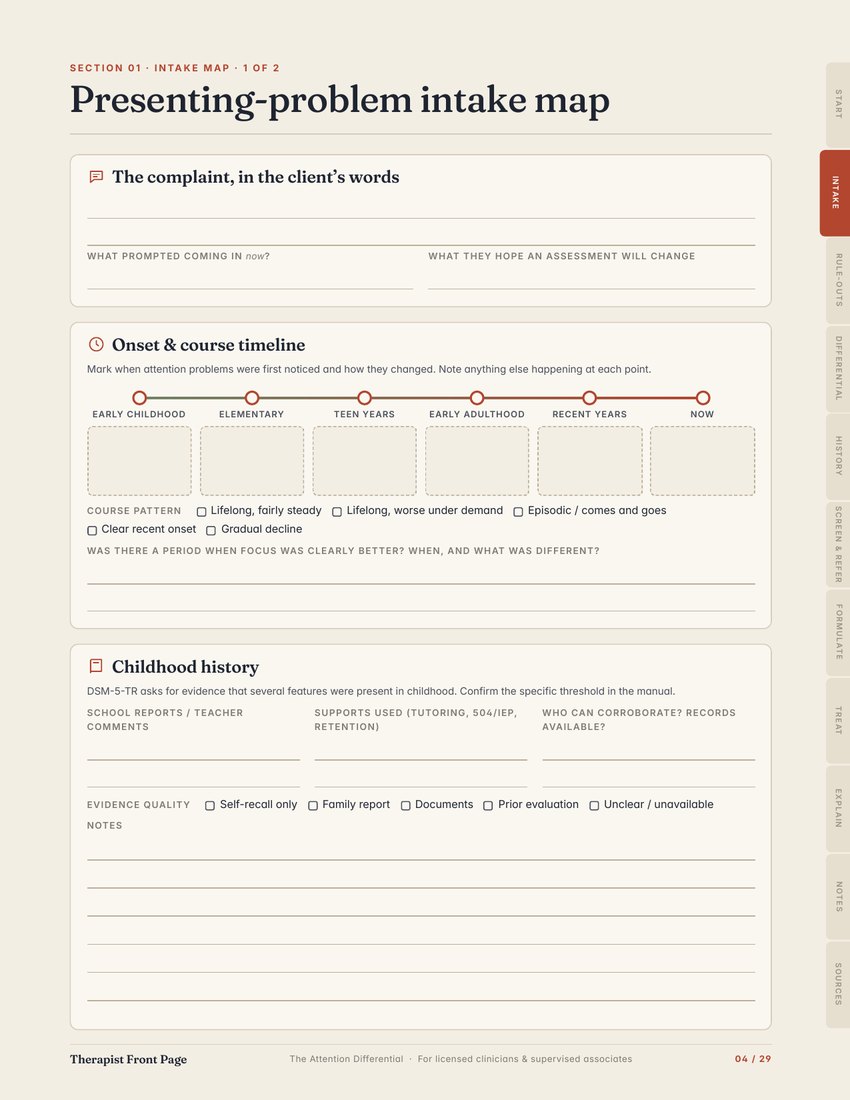
Page 4: Presenting-problem intake map 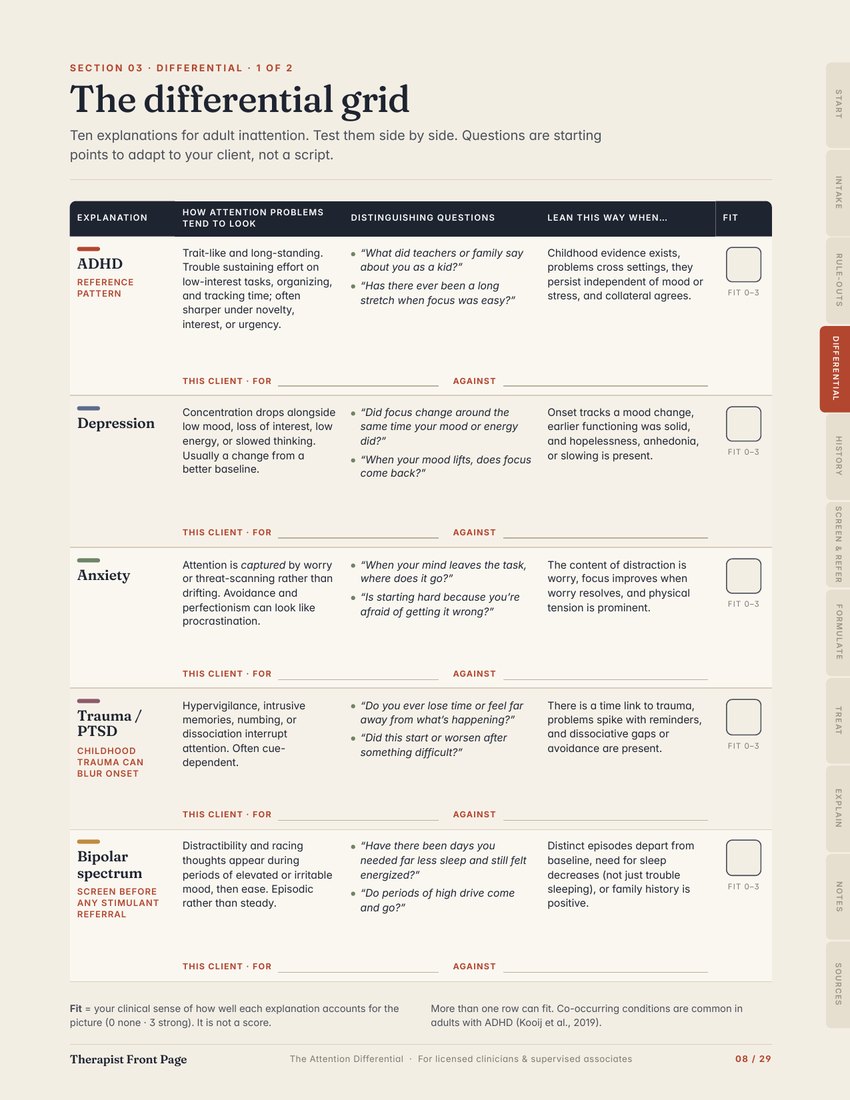
Page 8: The differential grid 
Page 12: Case formulation summary 
Page 13: Treatment pathways overview 
Page 14: Treatment pathway: ADHD 
Page 24: Building the plan
How clinicians use it
Work it across the first few sessions, alongside your usual intake and documentation.
Built for
- Adults referred for, or asking about, ADHD
- Clients whose focus problems began with low mood, worry, trauma, poor sleep, or substance use
- Supervised associates working through a differential with their supervisor
- Planning treatment once you have a working impression
A simple flow
- Map the complaint and its course at intake.
- Check rule-outs and gather collateral.
- Rate each explanation on the grid, then screen or refer.
- Write the formulation and choose a pathway.
- Explain the picture to the client and set measurable goals.
Scope
This is clinical decision support, not a diagnostic instrument or a treatment manual. It does not reproduce DSM-5-TR or ICD-11 criteria text or the items of any instrument; measures and forms are named with where to obtain them. Medication is outside its scope: it does not rate, rank, or compare medications, and prescribing decisions belong with a prescriber. The pathways summarize published psychological approaches, with sources; medication questions go to the client’s prescriber.
Get The Attention Differential
Instant PDF download right after purchase (full-color and print-friendly versions). Questions or refunds: contact us. Checkout is by Stripe; the seller on your receipt is Advantage Coaching, LLC.
Mason’s own product; Therapist Front Page earns from these sales.
Created by Mason Anglin, PsyD, LMFT, MBA · LMFT #121211 · Registered Psychological Associate #PSB94029529
An educational, clinical decision-support tool for licensed clinicians and supervised associates. It does not diagnose, it is not a standardized or validated measure, it does not reproduce DSM-5-TR criteria or screener items, and it does not replace clinical judgment, supervision, or protocol training. Licensed for use with your own clients; please don’t redistribute or resell it.