Where Is the Evidence? No. 35
When Good News Happens
Notice how you respond when your partner shares good news, and practice responding with real interest.
5 pages · US Letter PDF, print and fillable versions · references with PMIDs
Where’s the evidence? Sharing good news was tied to better daily mood, more so when partners responded with enthusiasm (Gable 2004).
Instant PDF download right after purchase (print and fillable versions). Questions or refunds: contact us. Checkout is by Stripe; the seller on your receipt is Advantage Coaching, LLC.
Clinician use included. Licensed for personal use, or for one clinician to use with their own clients and students. Please don’t resell, redistribute, or upload it to shared drives or marketplaces.
Mason’s own product; Therapist Front Page earns from these sales.
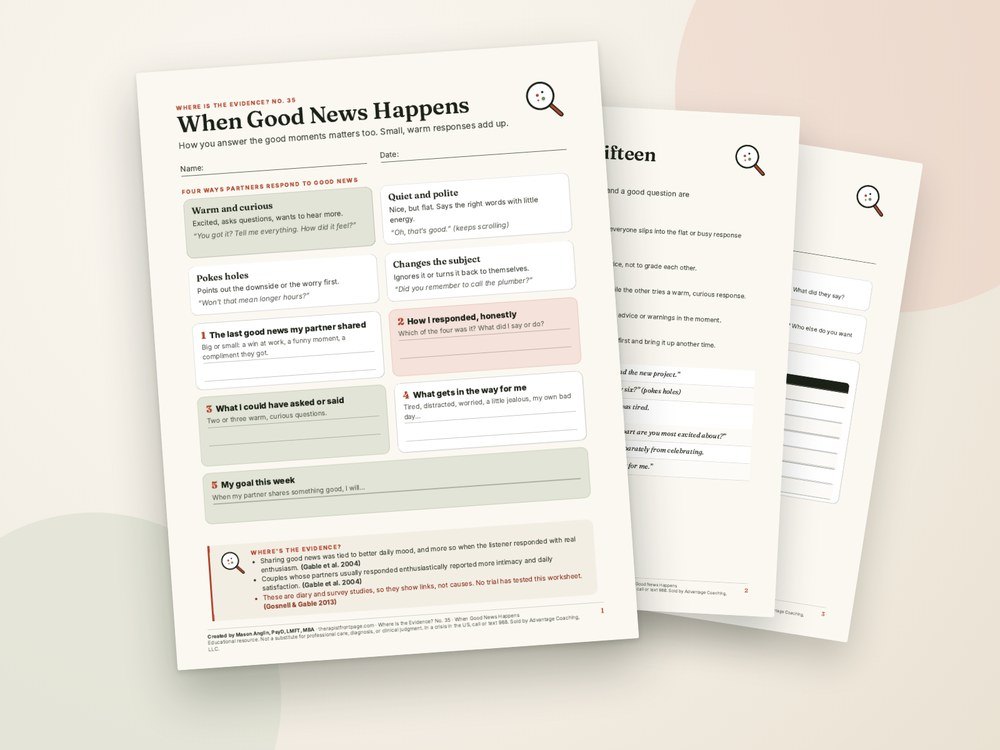
What’s inside
Couples often focus on how they handle conflict, but how partners respond to each other’s good news matters too. This worksheet shows four common ways people respond when a partner shares something good, helps each partner notice their own habit, and builds a week of practice responding with real interest and curiosity. A short strip shows the research, which comes from diary and survey studies rather than treatment trials. Includes a how-to with a worked example, a quick card of curious questions, and one honest clinician evidence page with PubMed references.
- One page good news worksheet with the evidence printed on it
- How-to plus a short worked example
- Quick card: curious questions and a week of practice
- Clinician page: evidence, honest limits, when not to use
- References with PMIDs and DOIs
All 5 pages, and who each is for
- When Good News Happens · Client
- Five steps, about fifteen minutes together · Client
- Questions and a week of practice · Client
- Where's the evidence? · Clinician
- References · Clinician
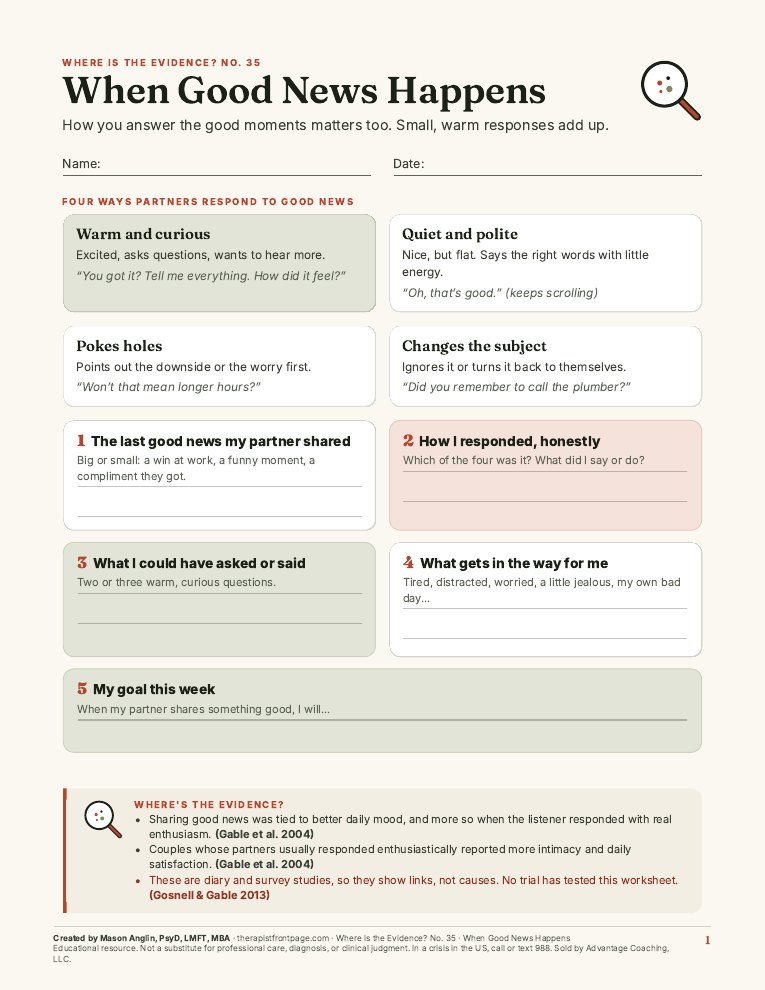
Page 1: When Good News Happens 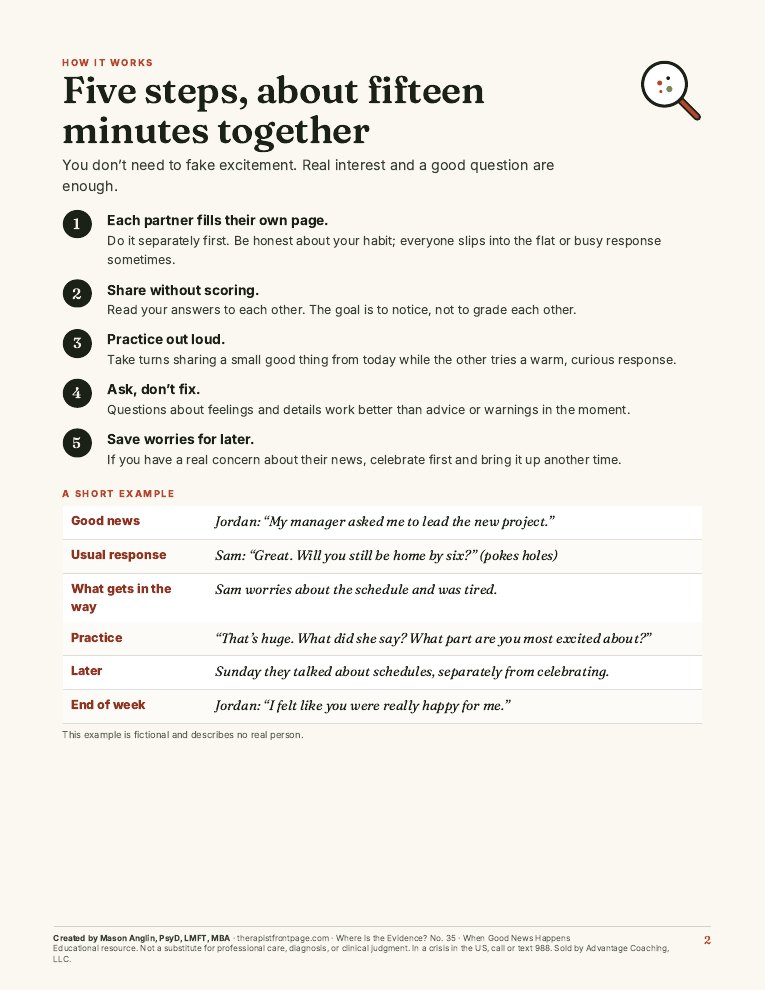
Page 2: Five steps, about fifteen minutes together 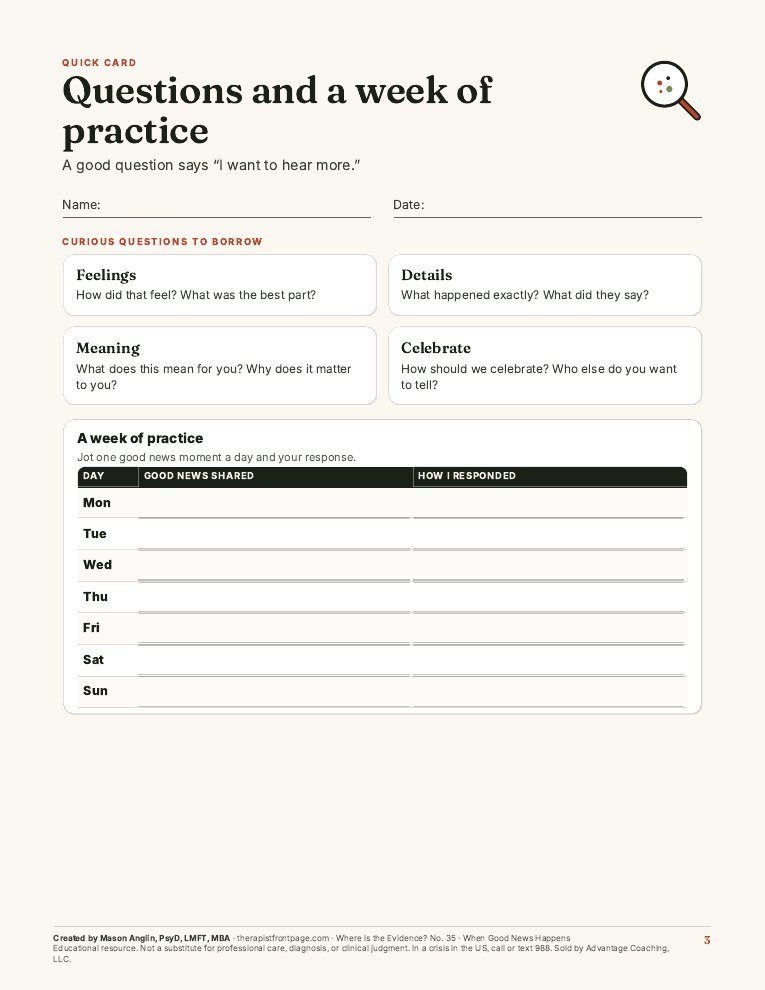
Page 3: Questions and a week of practice 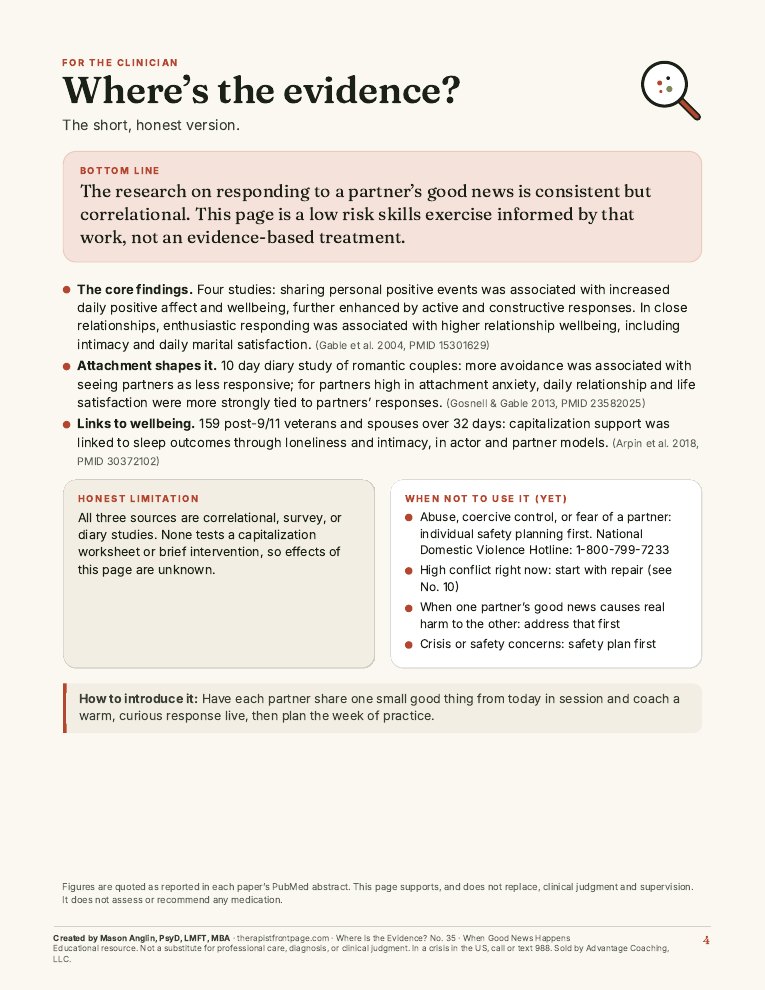
Page 4: Where's the evidence? 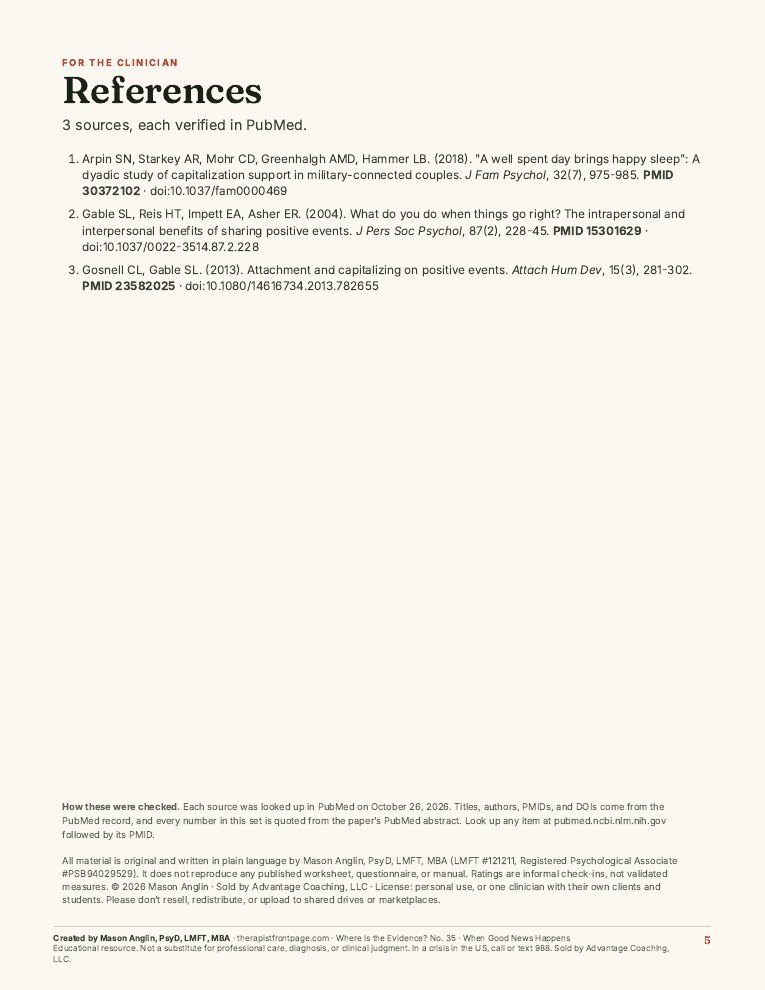
Page 5: References
Where’s the evidence?
The research on responding to a partner’s good news is consistent but correlational. This page is a low risk skills exercise informed by that work, not an evidence-based treatment.
On the worksheet itself
- Sharing good news was tied to better daily mood, and more so when the listener responded with real enthusiasm. (Gable et al. 2004)
- Couples whose partners usually responded enthusiastically reported more intimacy and daily satisfaction. (Gable et al. 2004)
- These are diary and survey studies, so they show links, not causes. No trial has tested this worksheet. (Gosnell & Gable 2013)
On the clinician page
- The core findings. Four studies: sharing personal positive events was associated with increased daily positive affect and wellbeing, further enhanced by active and constructive responses. In close relationships, enthusiastic responding was associated with higher relationship wellbeing, including intimacy and daily marital satisfaction. (Gable et al. 2004)
- Attachment shapes it. 10 day diary study of romantic couples: more avoidance was associated with seeing partners as less responsive; for partners high in attachment anxiety, daily relationship and life satisfaction were more strongly tied to partners’ responses. (Gosnell & Gable 2013)
- Links to wellbeing. 159 post-9/11 veterans and spouses over 32 days: capitalization support was linked to sleep outcomes through loneliness and intimacy, in actor and partner models. (Arpin et al. 2018)
Honest limitation
All three sources are correlational, survey, or diary studies. None tests a capitalization worksheet or brief intervention, so effects of this page are unknown.
When not to use it (yet)
- Abuse, coercive control, or fear of a partner: individual safety planning first. National Domestic Violence Hotline: 1-800-799-7233
- High conflict right now: start with repair (see No. 10)
- When one partner’s good news causes real harm to the other: address that first
- Crisis or safety concerns: safety plan first
Figures are quoted as reported in each paper’s PubMed abstract. Every source below was checked in PubMed on October 26, 2026.
References (3 sources, with PMIDs)
- Arpin SN, Starkey AR, Mohr CD, et al. (2018). "A well spent day brings happy sleep": A dyadic study of capitalization support in military-connected couples. J Fam Psychol. PMID 30372102
- Gable SL, Reis HT, Impett EA, et al. (2004). What do you do when things go right? The intrapersonal and interpersonal benefits of sharing positive events. J Pers Soc Psychol. PMID 15301629
- Gosnell CL, Gable SL (2013). Attachment and capitalizing on positive events. Attach Hum Dev. PMID 23582025
The clinician page
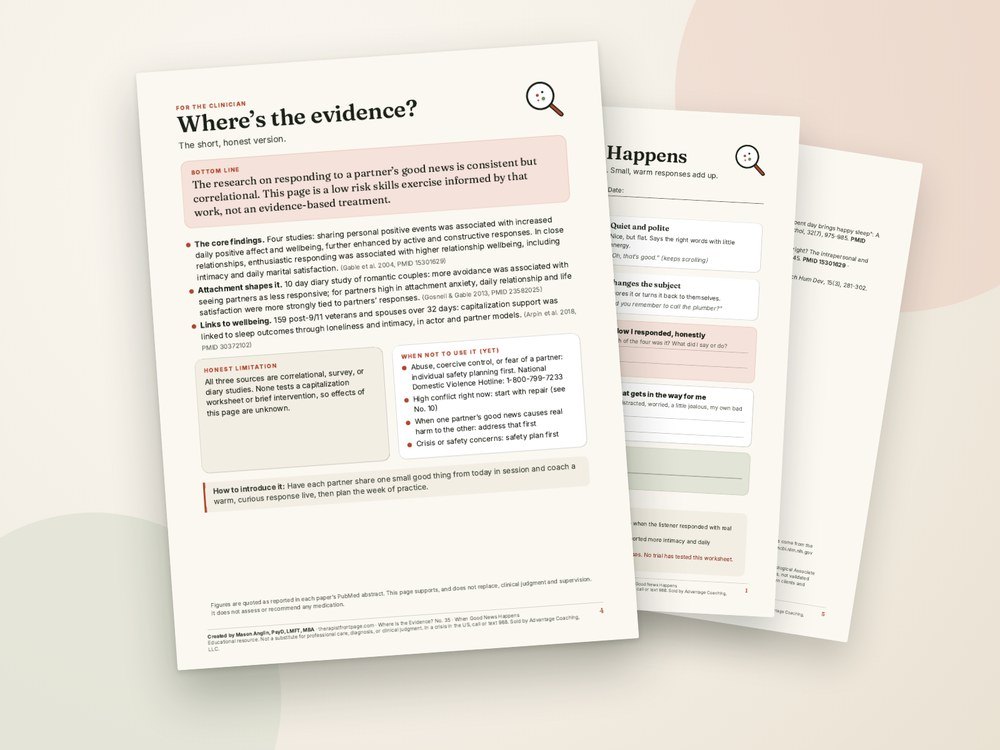
Every worksheet in the series ends with one clinician page and a references page. The numbers come straight from each study’s PubMed abstract, and thin evidence is labeled as thin.
How it’s used
Built for
- Couples who want more warmth and closeness
- Couples therapists and counselors
- Premarital and relationship coaching
- Couples workshops
A simple flow
- Learn the four ways to respond
- Notice your usual habit
- Practice warm, curious responses
- Check in at the end of the week
License: clinician use included
Clinician use included. Licensed for personal use, or for one clinician to use with their own clients and students. Please don’t resell, redistribute, or upload it to shared drives or marketplaces.
Get When Good News Happens
Instant PDF download right after purchase (print and fillable versions). Questions or refunds: contact us. Checkout is by Stripe; the seller on your receipt is Advantage Coaching, LLC.
Mason’s own product; Therapist Front Page earns from these sales.
Created by Mason Anglin, PsyD, LMFT, MBA · LMFT #121211 · Registered Psychological Associate #PSB94029529
Educational, not a substitute for care. In a crisis in the US, call or text 988.