Where Is the Evidence? No. 09
Four Patterns That Hurt, Four That Help
Spot four conflict patterns that wear couples down, and practice the swap that helps.
6 pages · US Letter PDF, print and fillable versions · references with PMIDs
Where’s the evidence? Hostile conflict behavior went with lower relationship satisfaction across 64 studies (Woodin 2011).
Instant PDF download right after purchase (print and fillable versions). Questions or refunds: contact us. Checkout is by Stripe; the seller on your receipt is Advantage Coaching, LLC.
Clinician use included. Licensed for personal use, or for one clinician to use with their own clients and students. Please don’t resell, redistribute, or upload it to shared drives or marketplaces.
Mason’s own product; Therapist Front Page earns from these sales.
What’s inside
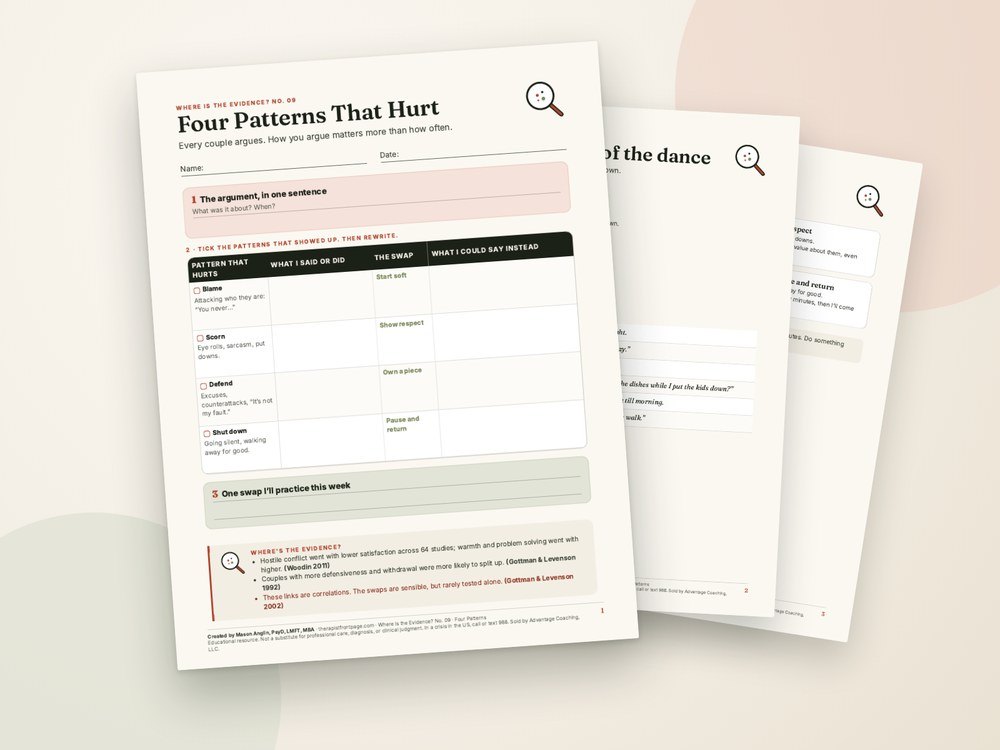
Blame, scorn, defending, and shutting down: four patterns that wear relationships down. This one page worksheet helps a couple look back at one argument and practice the swap for each. The evidence strip is honest: the link between these patterns and unhappiness is well documented, but the swaps themselves are rarely tested alone.
- One page Pattern Check with the evidence printed on it
- How-to plus a short worked example
- Quick card: the four swaps with starter phrases
- Weekly couple check
- Clinician page: evidence, honest limits, when not to use
- References with PMIDs and DOIs
All 6 pages, and who each is for
- Four Patterns That Hurt · Client
- Look at your side of the dance · Client
- The four swaps · Client
- How Did We Fight This Week? · Client
- Where's the evidence? · Clinician
- References · Clinician
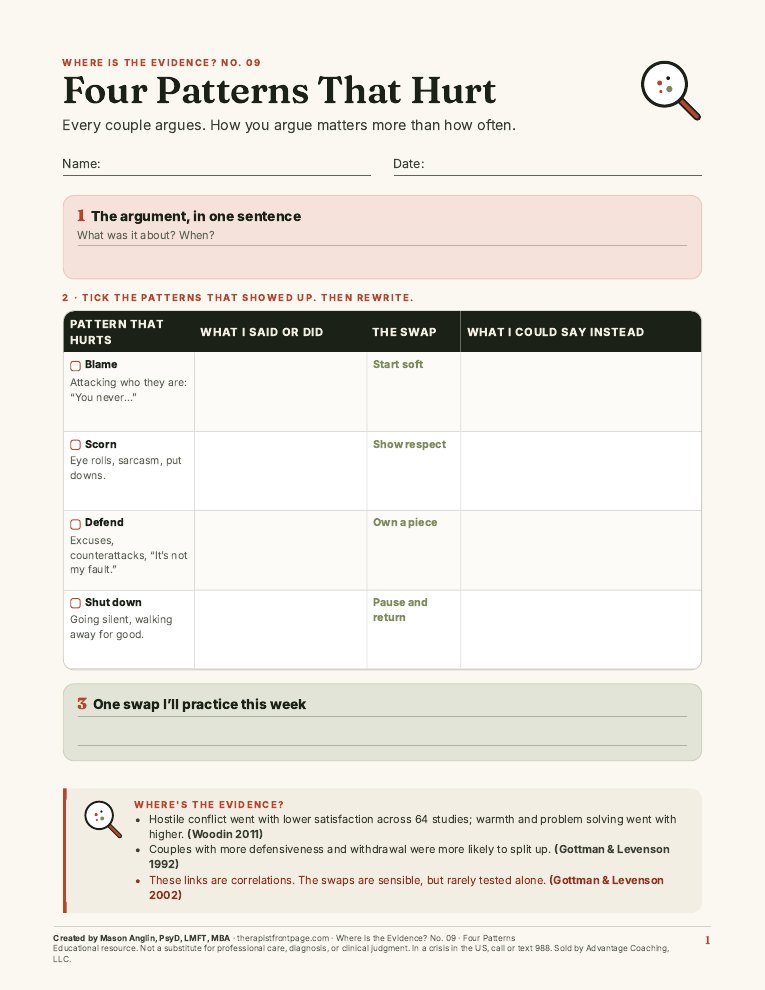
Page 1: Four Patterns That Hurt 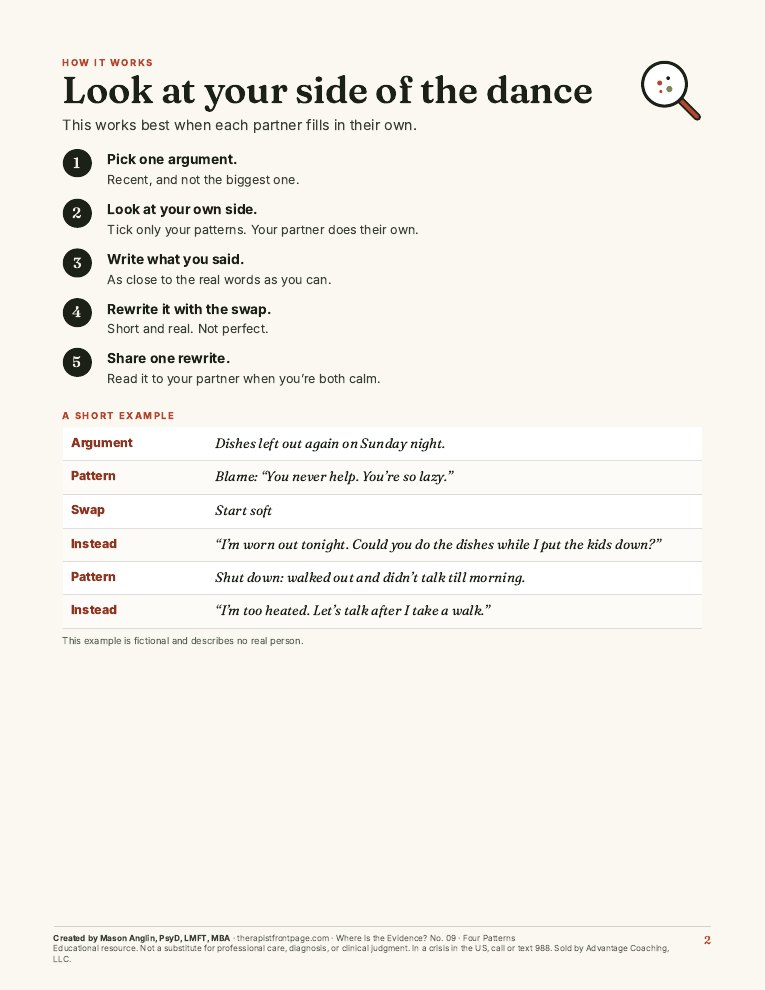
Page 2: Look at your side of the dance 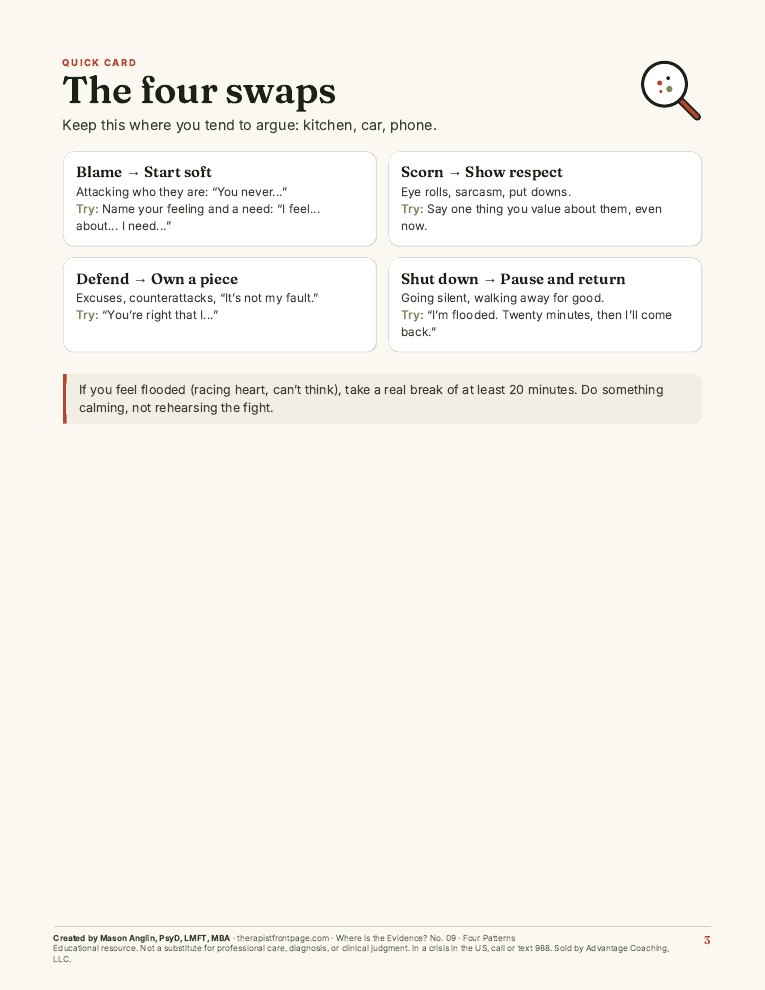
Page 3: The four swaps 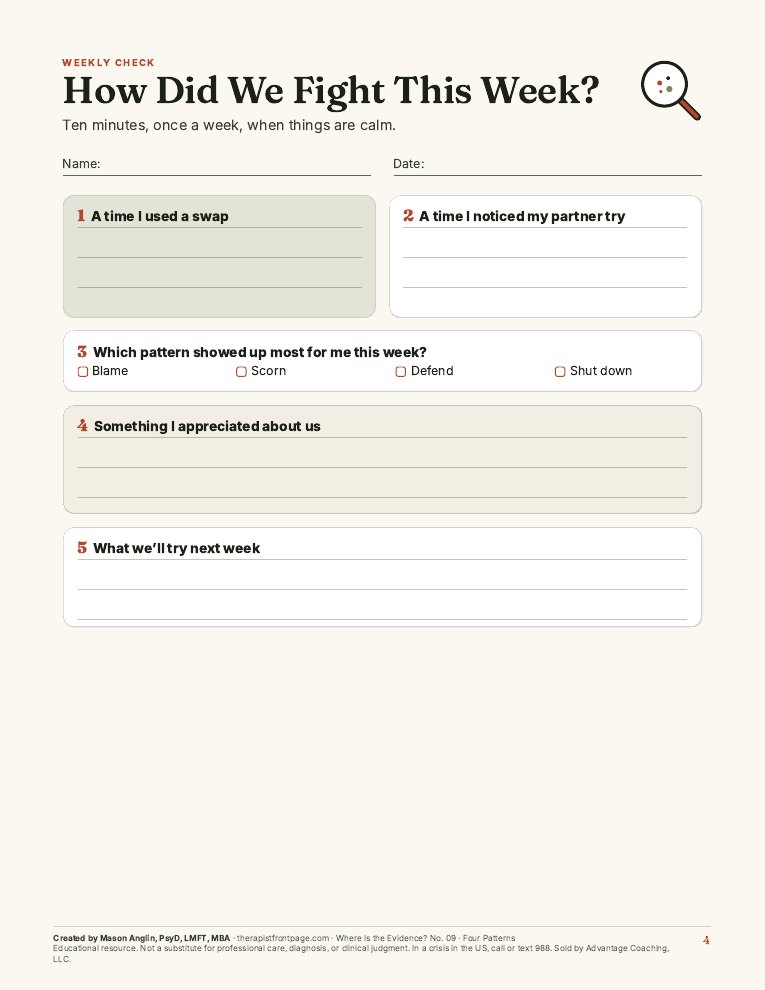
Page 4: How Did We Fight This Week? 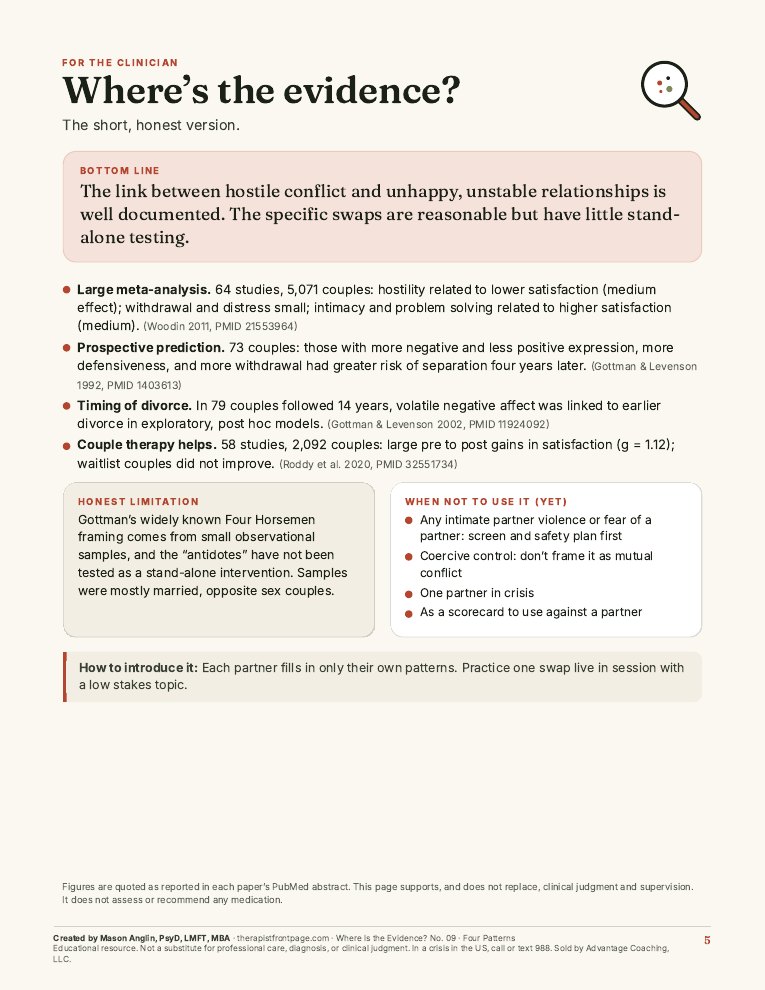
Page 5: Where's the evidence? 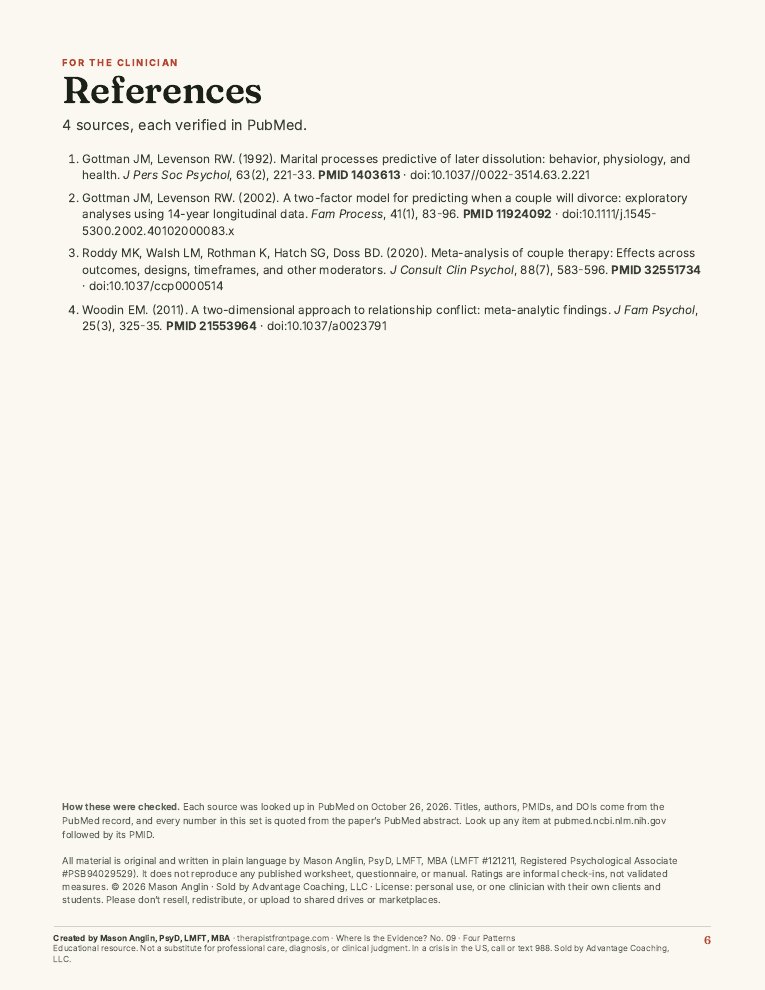
Page 6: References
Where’s the evidence?
The link between hostile conflict and unhappy, unstable relationships is well documented. The specific swaps are reasonable but have little stand-alone testing.
On the worksheet itself
- Hostile conflict went with lower satisfaction across 64 studies; warmth and problem solving went with higher. (Woodin 2011)
- Couples with more defensiveness and withdrawal were more likely to split up. (Gottman & Levenson 1992)
- These links are correlations. The swaps are sensible, but rarely tested alone. (Gottman & Levenson 2002)
On the clinician page
- Large meta-analysis. 64 studies, 5,071 couples: hostility related to lower satisfaction (medium effect); withdrawal and distress small; intimacy and problem solving related to higher satisfaction (medium). (Woodin 2011)
- Prospective prediction. 73 couples: those with more negative and less positive expression, more defensiveness, and more withdrawal had greater risk of separation four years later. (Gottman & Levenson 1992)
- Timing of divorce. In 79 couples followed 14 years, volatile negative affect was linked to earlier divorce in exploratory, post hoc models. (Gottman & Levenson 2002)
- Couple therapy helps. 58 studies, 2,092 couples: large pre to post gains in satisfaction (g = 1.12); waitlist couples did not improve. (Roddy et al. 2020)
Honest limitation
Gottman’s widely known Four Horsemen framing comes from small observational samples, and the “antidotes” have not been tested as a stand-alone intervention. Samples were mostly married, opposite sex couples.
When not to use it (yet)
- Any intimate partner violence or fear of a partner: screen and safety plan first
- Coercive control: don’t frame it as mutual conflict
- One partner in crisis
- As a scorecard to use against a partner
Figures are quoted as reported in each paper’s PubMed abstract. Every source below was checked in PubMed on October 26, 2026.
References (4 sources, with PMIDs)
- Gottman JM, Levenson RW (1992). Marital processes predictive of later dissolution: behavior, physiology, and health. J Pers Soc Psychol. PMID 1403613
- Gottman JM, Levenson RW (2002). A two-factor model for predicting when a couple will divorce: exploratory analyses using 14-year longitudinal data. Fam Process. PMID 11924092
- Roddy MK, Walsh LM, Rothman K, et al. (2020). Meta-analysis of couple therapy: Effects across outcomes, designs, timeframes, and other moderators. J Consult Clin Psychol. PMID 32551734
- Woodin EM (2011). A two-dimensional approach to relationship conflict: meta-analytic findings. J Fam Psychol. PMID 21553964
The clinician page
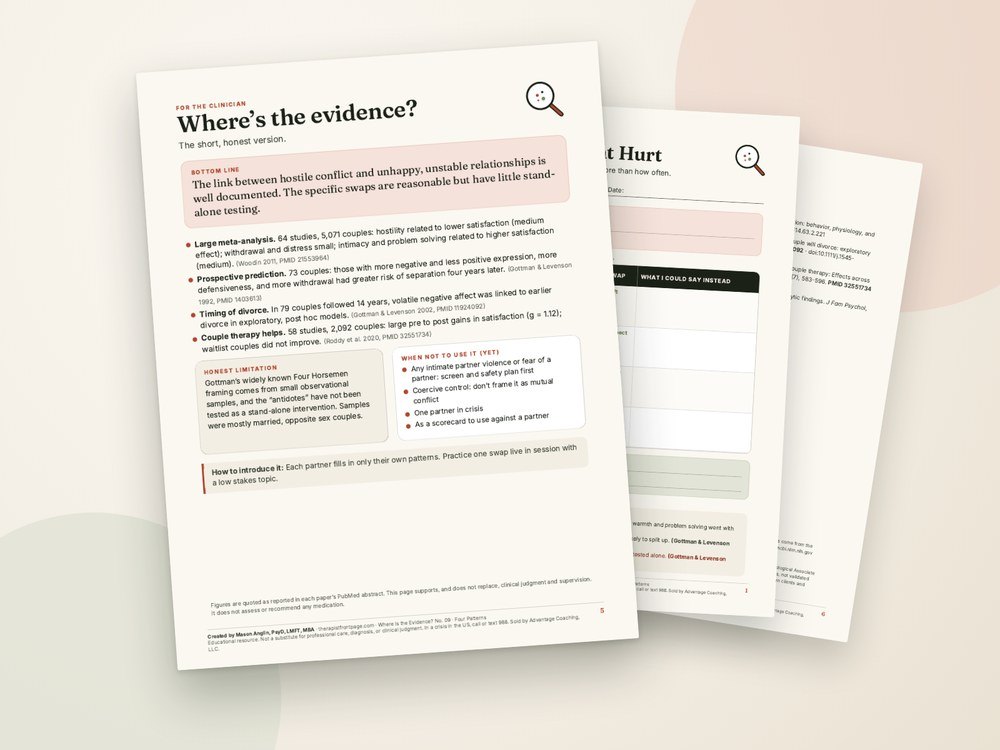
Every worksheet in the series ends with one clinician page and a references page. The numbers come straight from each study’s PubMed abstract, and thin evidence is labeled as thin.
How it’s used
Built for
- Couples in therapy or coaching
- Couples and family therapists
- Premarital and relationship education
- Anyone wanting calmer arguments
A simple flow
- Pick one recent argument
- Tick which patterns showed up
- Write what you said
- Rewrite it with the swap
License: clinician use included
Clinician use included. Licensed for personal use, or for one clinician to use with their own clients and students. Please don’t resell, redistribute, or upload it to shared drives or marketplaces.
Get Four Patterns That Hurt, Four That Help
Instant PDF download right after purchase (print and fillable versions). Questions or refunds: contact us. Checkout is by Stripe; the seller on your receipt is Advantage Coaching, LLC.
Mason’s own product; Therapist Front Page earns from these sales.
Created by Mason Anglin, PsyD, LMFT, MBA · LMFT #121211 · Registered Psychological Associate #PSB94029529
Educational, not a substitute for care. In a crisis in the US, call or text 988.