Where Is the Evidence? No. 07
Step by Step: Exposure Ladder
Build a ladder of small, brave steps toward what OCD or fear has taken from you.
6 pages · US Letter PDF, print and fillable versions · references with PMIDs
Where’s the evidence? CBT for OCD showed very large effects across 37 trials (Öst 2015).
Instant PDF download right after purchase (print and fillable versions). Questions or refunds: contact us. Checkout is by Stripe; the seller on your receipt is Advantage Coaching, LLC.
Clinician use included. Licensed for personal use, or for one clinician to use with their own clients and students. Please don’t resell, redistribute, or upload it to shared drives or marketplaces.
Mason’s own product; Therapist Front Page earns from these sales.
What’s inside
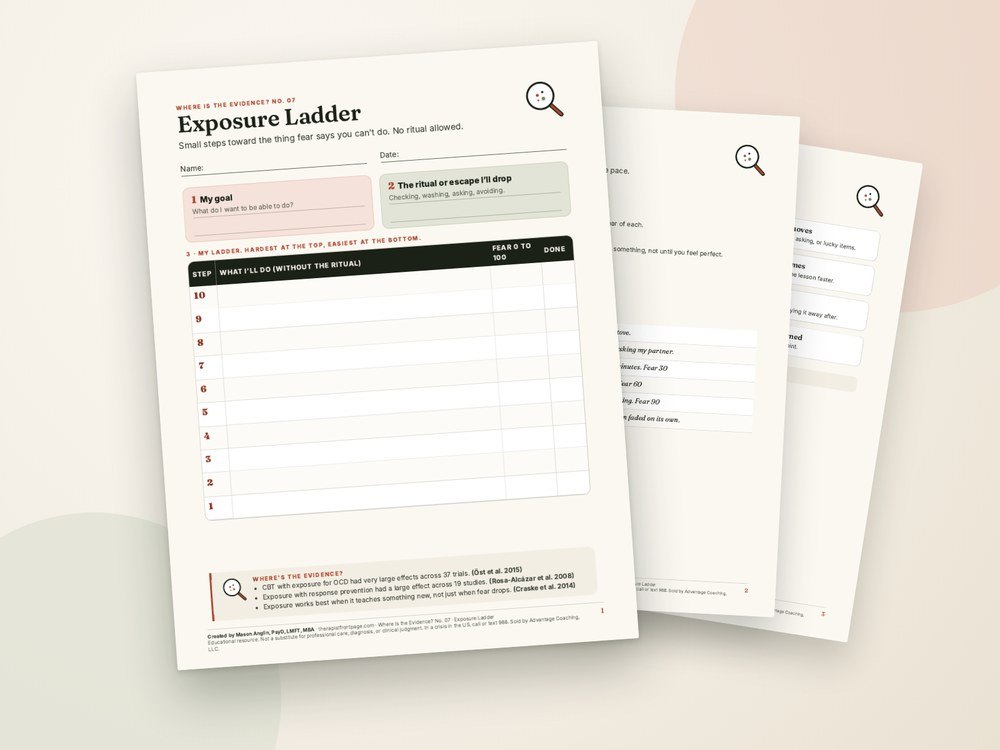
A one page exposure ladder: name the goal, list steps from easier to harder, and climb without the ritual. A short evidence strip on the page shows why exposure with response prevention is a first line approach, and the clinician page adds tips for making each exposure count.
- One page exposure ladder with the evidence printed on it
- How-to plus a short worked example
- Quick card: make each step count
- Practice log: expected vs. what happened
- Clinician page: evidence, honest limits, when not to use
- References with PMIDs and DOIs
All 6 pages, and who each is for
- Exposure Ladder · Client
- Climb, don't leap · Client
- Make each step count · Client
- Expected vs. Happened · Client
- Where's the evidence? · Clinician
- References · Clinician
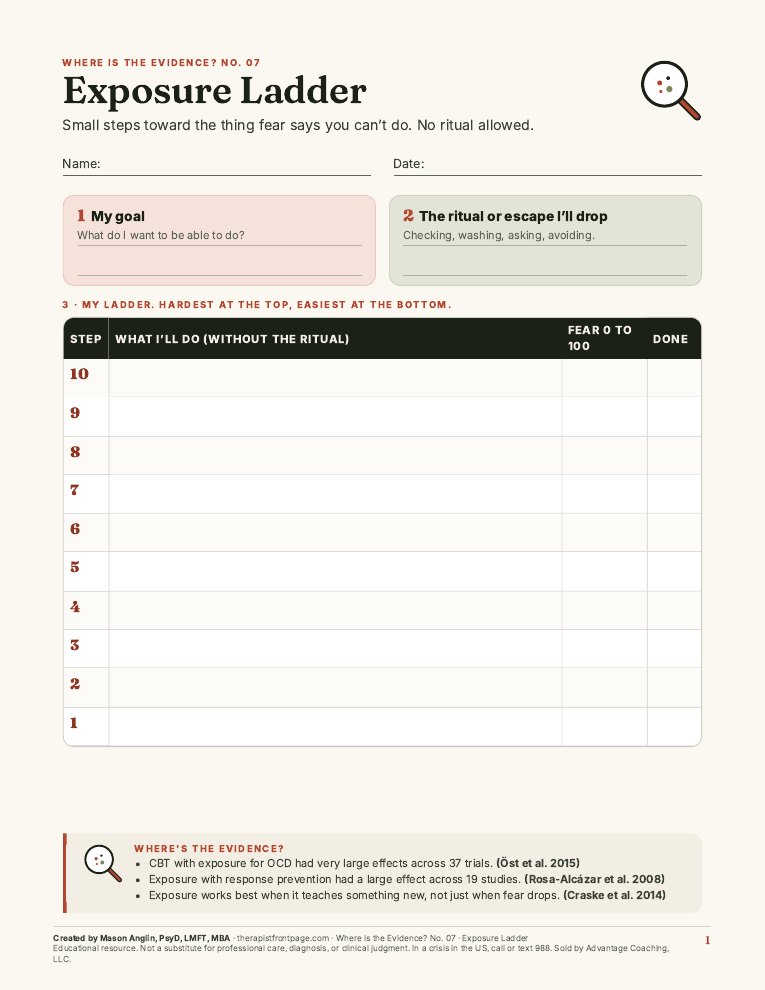
Page 1: Exposure Ladder 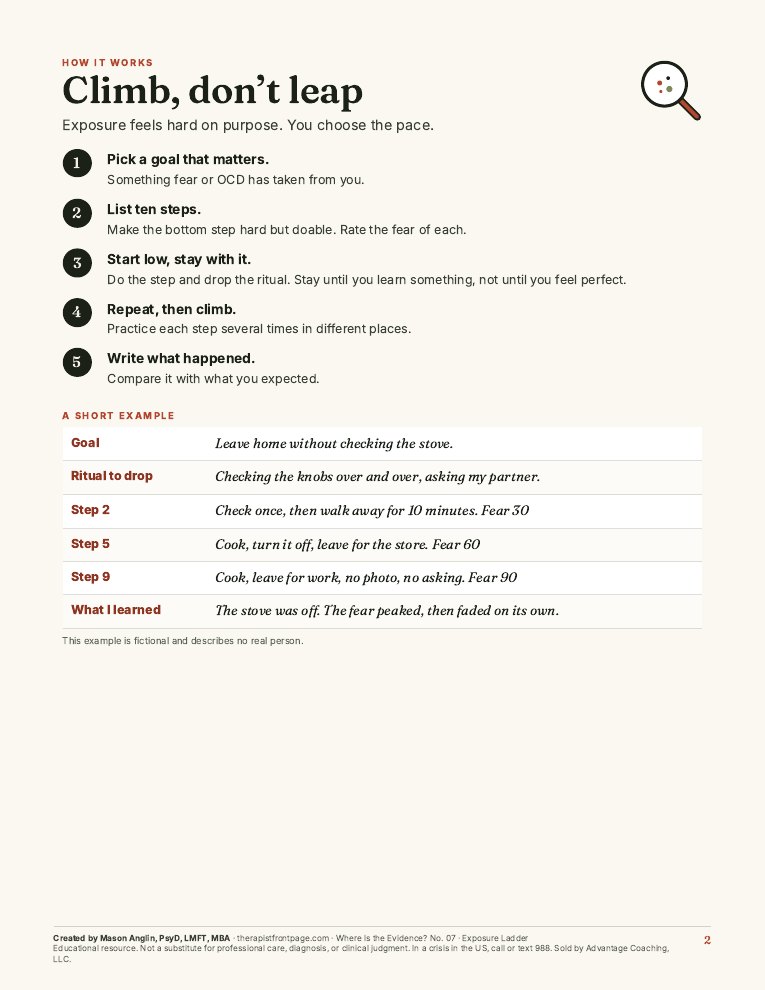
Page 2: Climb, don't leap 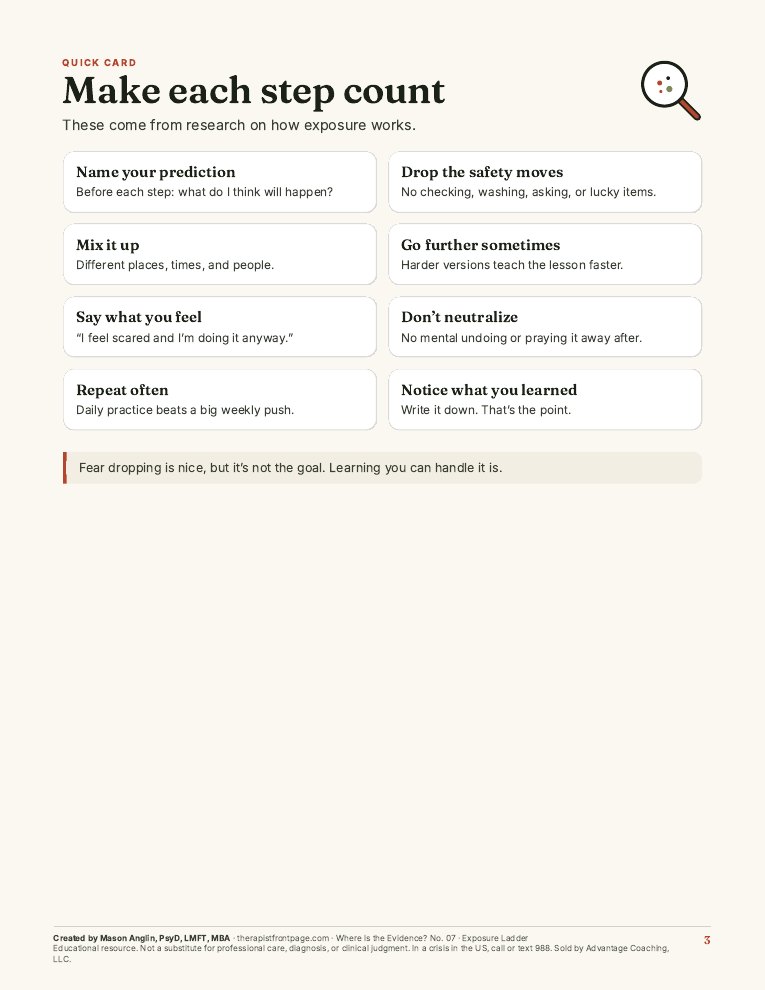
Page 3: Make each step count 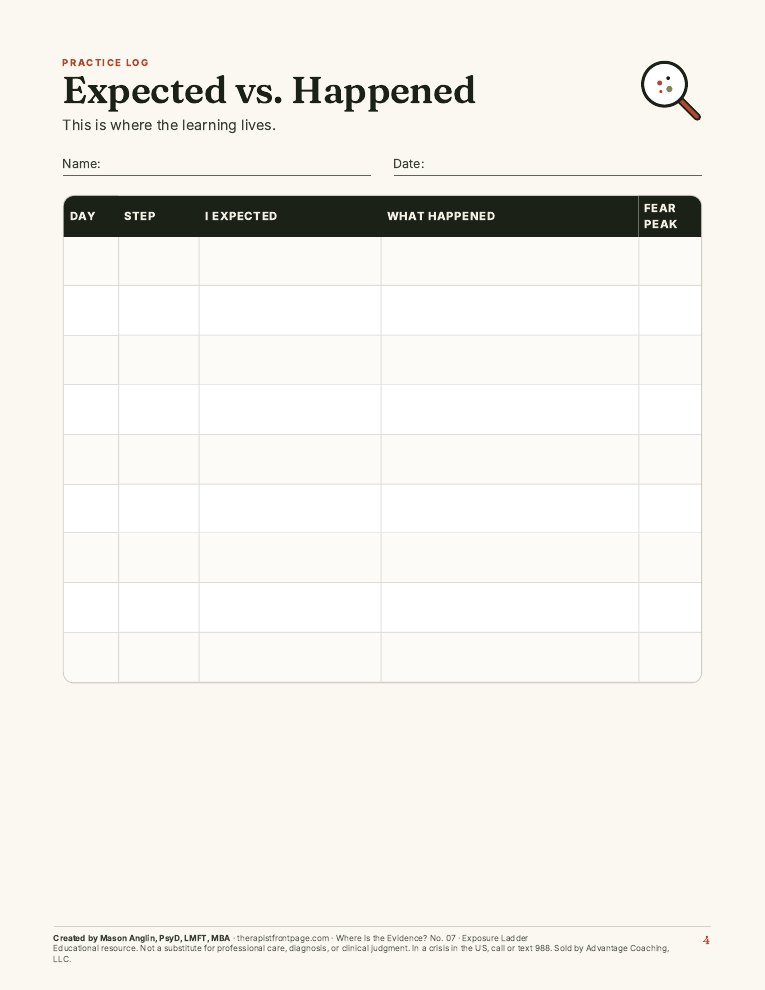
Page 4: Expected vs. Happened 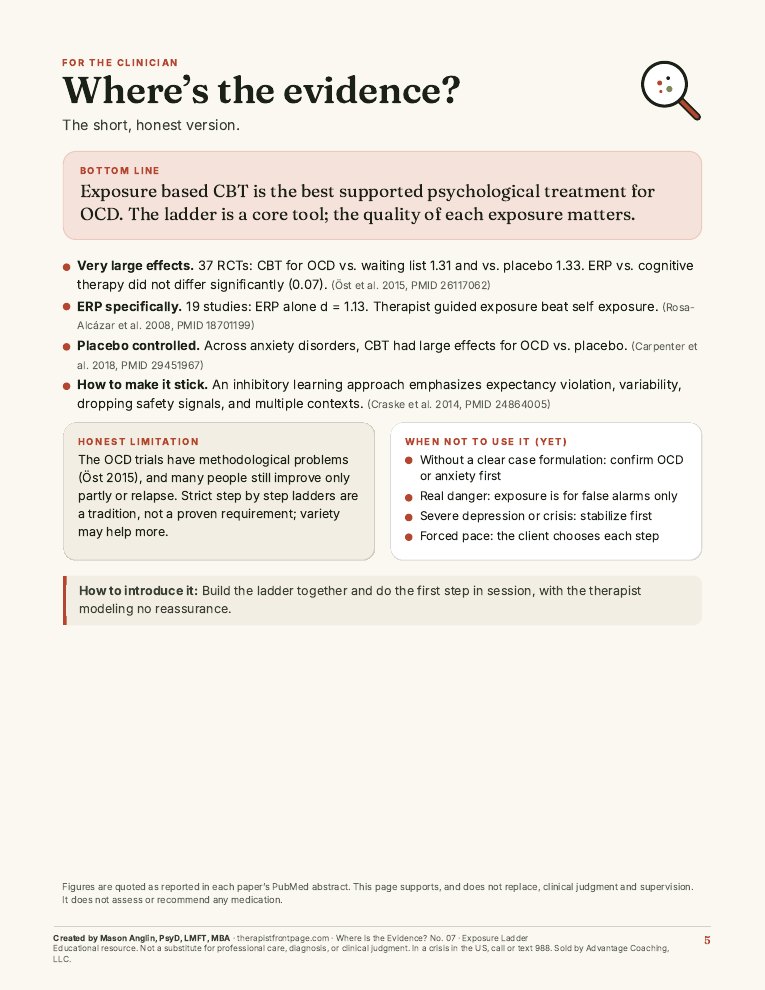
Page 5: Where's the evidence? 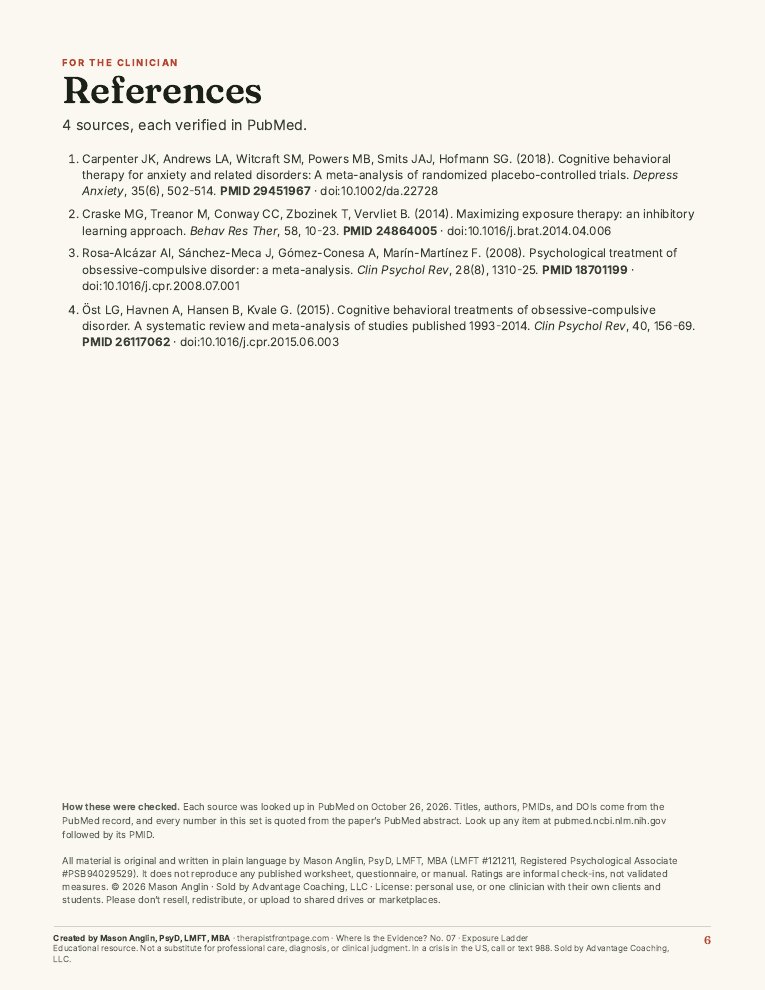
Page 6: References
Where’s the evidence?
Exposure based CBT is the best supported psychological treatment for OCD. The ladder is a core tool; the quality of each exposure matters.
On the worksheet itself
- CBT with exposure for OCD had very large effects across 37 trials. (Öst et al. 2015)
- Exposure with response prevention had a large effect across 19 studies. (Rosa-Alcázar et al. 2008)
- Exposure works best when it teaches something new, not just when fear drops. (Craske et al. 2014)
On the clinician page
- Very large effects. 37 RCTs: CBT for OCD vs. waiting list 1.31 and vs. placebo 1.33. ERP vs. cognitive therapy did not differ significantly (0.07). (Öst et al. 2015)
- ERP specifically. 19 studies: ERP alone d = 1.13. Therapist guided exposure beat self exposure. (Rosa-Alcázar et al. 2008)
- Placebo controlled. Across anxiety disorders, CBT had large effects for OCD vs. placebo. (Carpenter et al. 2018)
- How to make it stick. An inhibitory learning approach emphasizes expectancy violation, variability, dropping safety signals, and multiple contexts. (Craske et al. 2014)
Honest limitation
The OCD trials have methodological problems (Öst 2015), and many people still improve only partly or relapse. Strict step by step ladders are a tradition, not a proven requirement; variety may help more.
When not to use it (yet)
- Without a clear case formulation: confirm OCD or anxiety first
- Real danger: exposure is for false alarms only
- Severe depression or crisis: stabilize first
- Forced pace: the client chooses each step
Figures are quoted as reported in each paper’s PubMed abstract. Every source below was checked in PubMed on October 26, 2026.
References (4 sources, with PMIDs)
- Carpenter JK, Andrews LA, Witcraft SM, et al. (2018). Cognitive behavioral therapy for anxiety and related disorders: A meta-analysis of randomized placebo-controlled trials. Depress Anxiety. PMID 29451967
- Craske MG, Treanor M, Conway CC, et al. (2014). Maximizing exposure therapy: an inhibitory learning approach. Behav Res Ther. PMID 24864005
- Rosa-Alcázar AI, Sánchez-Meca J, Gómez-Conesa A, et al. (2008). Psychological treatment of obsessive-compulsive disorder: a meta-analysis. Clin Psychol Rev. PMID 18701199
- Öst LG, Havnen A, Hansen B, et al. (2015). Cognitive behavioral treatments of obsessive-compulsive disorder. A systematic review and meta-analysis of studies published 1993-2014. Clin Psychol Rev. PMID 26117062
The clinician page
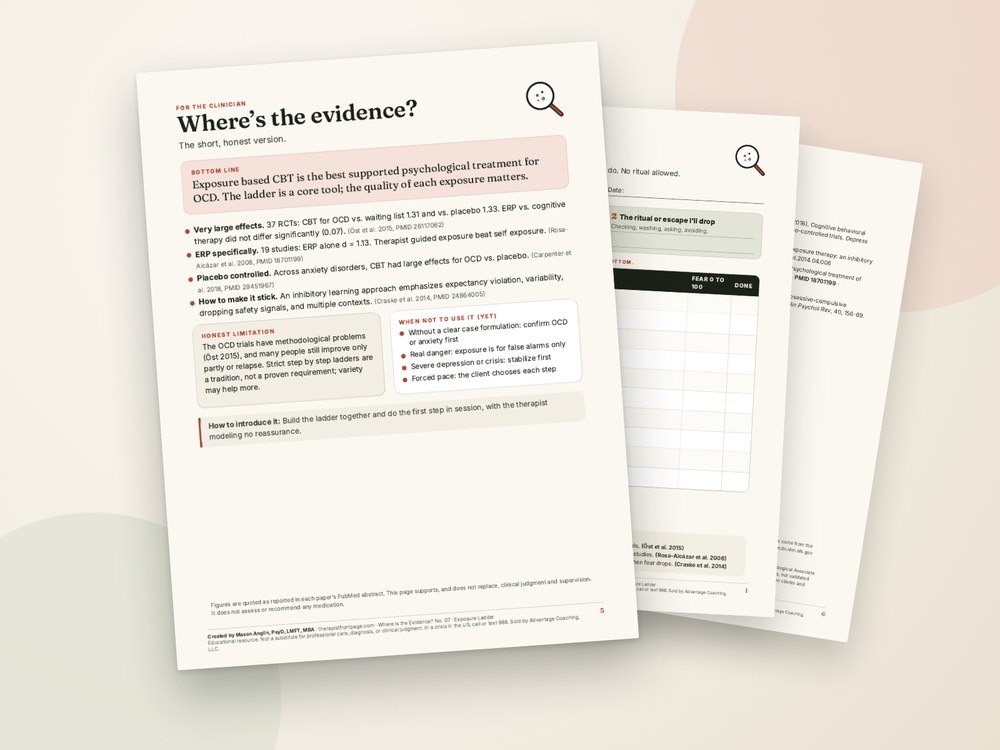
Every worksheet in the series ends with one clinician page and a references page. The numbers come straight from each study’s PubMed abstract, and thin evidence is labeled as thin.
How it’s used
Built for
- Clients with OCD or anxiety working with a therapist
- Therapists using ERP or exposure
- Teens and adults
- Counselors in training
A simple flow
- Name the goal
- List ten steps from easier to harder
- Practice a step without the ritual
- Compare what you expected to what happened
License: clinician use included
Clinician use included. Licensed for personal use, or for one clinician to use with their own clients and students. Please don’t resell, redistribute, or upload it to shared drives or marketplaces.
Get Step by Step: Exposure Ladder
Instant PDF download right after purchase (print and fillable versions). Questions or refunds: contact us. Checkout is by Stripe; the seller on your receipt is Advantage Coaching, LLC.
Mason’s own product; Therapist Front Page earns from these sales.
Created by Mason Anglin, PsyD, LMFT, MBA · LMFT #121211 · Registered Psychological Associate #PSB94029529
Educational, not a substitute for care. In a crisis in the US, call or text 988.